Cost of living is a pressing issue faced by many people today. Inflation, gas prices, and housing costs all impact our quality of life. Recently these pressures have encouraged many people to move to areas where they hope to find better conditions. Large cities offer many conveniences. However, one’s home will not only be quite expensive, but also quite small. For the cost of a one bedroom condo in San Francisco, one could purchase a large house with a yard here in South Bend. Where one lives has a significant effect on the home they can have. This relationship between house size and location is not unique to today.
Those living in medieval Byzantium could not consult home listings from across the Empire. Nor was the freedom of movement that we have today in existence in the Middle Ages. However, there still existed significant variation in the size of village houses across regions. Villagers may not have simply been able to decide to move to an area that would provide their family with a larger house or greater resources, but clear differences in housing are preserved in the archaeological record.
Looking at the villages of the Byzantine Empire provides us with a fascinating glimpse of how location affected the houses of everyday people. Movement by villagers was restricted within Byzantium, but it did occur regularly. Most often this movement was spurred by necessity and not personal choice. After all, there was no simple way to compare houses from Anatolia and the Peloponnese. Further, the greatest impact on village houses was not the amount of money one could pay for them. The materials used to construct the house and local topography were the most significant factors. Most frequently, village houses were built by those who lived within them.
The physical location of one’s house would have a significant impact on its overall size. Often village houses were constructed on the slopes of hills or mountains. The steeper the incline, the smaller the house would be. Houses were most often rectangular in form and built perpendicular with the slope with the long sides of the house descending down slope. The short wall connecting these sides at the bottom of the slope served not just as a kind of retaining wall for the building, but needed to have a rather significant height in order to make a level platform for the second floor that was frequently included. If the incline on which the house was constructed was quite significant, this would limit the length that the house could be.
Holger Uwe Schmitt, The Byzantine ruined city of Mystras
For example, if the elevation along the slope changed by 5 meters after a 10 meter distance, then a house with 10 meter long walls would require a 5 meter high wall at the bottom in order to make a level area for second floor. That would be quite significant, and in some cases might be impossible to construct. Further, the short wall would need to be even higher to accommodate the height of the second floor and support the roof. A shorter house than would be required on the slope.
Examples of how incline affects house size in the Byzantine village are found in the Mani peninsula. The Mani is the southernmost region of the Greek Peloponnese. The houses of the Byzantine village of Marathos are built along a steep mountainside. For the village of Sarania, the houses are built on a modest hill. While the houses of Marathos belong to a village that by all appearances had a longer and more prosperous life than Sarania, the houses here are generally smaller. In their original form, houses at Sarania are more than 10 m2 larger on average than houses at Marathos. Economic status of the settlements was not the determining factor in the size of the homes. Rather, it was topography that played the more significant role.
Camster, Modern village of Vathia in the Mani
In addition to their local topography, the physical material that houses were made from would impact their size as well. The houses of the Mani were built in the “megalithic” style. Large, roughly cut blocks of local limestone formed the walls of the house. Stone was even used to span the houses, forming support for additional floors or the roof. The use of stone for this purpose would limit the width of the village house. In theory, one could make their house as long as they wanted, but it would still be relatively narrow. Materials would limit size.
Moving across Byzantium to Cappadocia in central Anatolia, modern Turkey, we come to one of the most unique landscapes in the medieval world. Here, houses, churches, monasteries, and more are all carved into the volcanic rock of the region. Carving one’s house from stone would seemingly provide less limitations on the overall form and size. Building material did not need to be acquired and the physical limitations of built architecture were absent. There were other factors to consider however. While the volcanic stone of the region is considered soft as far as rock goes, it requires specialized tools and labor to carve. Different limitations then were placed on the houses of villagers here. It was not the building material that constrained the size of the houses, but the labor one could employ.
W. Bulach, Rock Carved settlement near Göreme in Cappadocia, Turkey
One can only imagine the thoughts that would go through the mind of a Byzantine villager who was able to observe the variation in housing within the Empire. How struck would they be by the different size of houses in one region compared to another? Would the rock carved homes of Cappadocia appear familiar or strange? Just as in the United States individuals working similar jobs can afford much different houses depending on their location, the housing of Byzantine villagers may be affected by similar dynamics. Other differences exist of course. Today, individuals working the same job may be paid differently based on where they live. However, anyone that has looked at house prices in the past year would see that these differences in pay are not proportional to the difference in the cost of housing. Villagers in one region of Byzantium may have had a better quality of life than those in another. The richness of Byzantine housing provides an important insight into these elements of daily life that reflect similarities of our experiences today.
Mark James Pawlowski Byzantine Studies Post-Doc Medieval Institute University of Notre Dame
Further Reading:
Pawlowski, Mark James. “Housing and the Village Landscape in the Byzantine Mani,” PhD Diss. (UCLA, 2019)
Ousterhout, Robert. Visualizing Community, Art, Material Culture, and Settlement in Byzantine Cappadocia (Washington D.C., 2017).
Bouras, C. 1983. Houses in Byzantium. Δελτίον τῆς Xριστιανικῆς ἀρχαιολογικῆς ἐταιρείας 11: 1-26
Earlier this month, the corpse of a woman with a protruding front tooth and a sickle positioned across her throat was discovered in a 17th-century cemetery near the village of Pien in south-eastern Poland. The sickle was meant to keep the body contained: should the deceased woman have attempted to rise from her grave, the blade would have promptly beheaded her. Coupled with the woman’s prominent incisor, the placement of the sickle suggests that those who tended to her burial may have feared she was a vampire.
Professor Dariusz Poliński from Nicholas Copernicus University observed, “The sickle was not laid flat but placed on the neck in such a way that if the deceased had tried to get up most likely the head would have been cut off or injured.” Photo courtesy of Miroslaw Blicharski and Alexsander Poznan.
The woman was found with the remains of a silk head dressing, which indicates she was someone of high social status, as such a garment would have been an expensive commodity. Of course, this woman would be neither the first aristocrat nor the first woman to be suspected of vampirism.
In addition to the positioning of the sickle and her prominent incisor, a padlock was secured around the big toe of the woman’s left foot, which may be meant to symbolize “the closing of a stage and the impossibility of returning,” according to Poliński. Photo courtesy of Miroslaw Blicharski and Alexsander Poznan.
Elizabeth Báthory was a Hungarian noblewoman and history’s most prolific female serial killer, who tortured and murdered as many as 650 girls and women between 1590 and 1610. Her association with vampirism manifests in the folklore that describes the countess’s ritual of bathing in her virgin victims’ blood to retain her youthful beauty. Neither the number of victims nor her bathing activities are confirmed. Nevertheless, a servant girl testified that she saw the figure recorded in one of Báthory’s private books, and another witness stated that he had seen the countess covered in blood. Colloquially, she became known as the Bloody Countess and, more contemporarily, Lady Dracula.
A copy of the only known portrait of Elizabeth Báthory, depicting the countess at age 25. The original painting from 1585 has been lost.
Vlad Dracul, the late medieval ruler more commonly known as Vlad the Impaler, derived his namesake from his preferred method of murdering his enemies: impalement, a particularly gruesome form of death where a wood or metal pole is inserted through the body either front to back, such as a stake might be driven through a vampire’s chest, or vertically through the rectum or vagina. The prince purportedly enjoyed dining amongst his dying victims and dipping his bread into their blood.
Portrait of Vlad Dracul by an unknown artist, circa 1560. This painting, like the one of Elizabeth Báthory above, may be a copy.
As Dracul’s surname, which incidentally means dragon, and Transylvanian origins indicate, the intermittent ruler whose brutality spiraled into legend subsequently became a source of inspiration for Bram Stoker’s Dracula character. Another source, Sheridan Le Fanu’s Carmilla, not only preceded Dracula but also, conversely, rendered its vampire antagonist female. Moreover, the novella, set in Austria in the late 1800s, positions Carmilla as a clever seductress whose victims are predominantly male. Although Stoker’s iconic novel all but synonymized the vampire with maleness, Le Fanu’s character reflects the traditional association of vampiric tendencies with femaleness that preceded and pervaded the medieval period.
Depiction of Carmilla and her companion, Laura, whom the novella positions as both a friend and a romantic interest. The illustration, by D. H. Friston, accompanied Carmilla when it was first published as a serial in the literary magazine The Dark Blue between 1871 and 1872.
While sensational news specifically citing vampires did not appear in Britain or Europe until the 1700s, the veil of vampirism shrouded the female body during the medieval period and for centuries prior in many parts of the world. In ancient Mesopotamia, for example, the Assyrians feared a demon goddess known as Lamashtu, a name meaning “she who erases,” who was said to steal infants and suck their blood. Lilith, first wife of Adam turned primordial demon, has a similar reputation. Some stories describe her as a creature who steals babies under the cover of darkness, but she also has sex with men in their dreams and spawns demon offspring with their seed. Lilith’s legacy as a sexually wanton demon of the night seems fitting, as she was the woman who first cohabitated with man but refused subservience. More specifically, Lilith questioned why she should lie beneath her husband during sex, and her resistance reinscribed her as monstrous. She became a succubus, a demon in female form who, essentially, sucks the life from men.
Painting of Lilith produced by John Collier in 1887, which conveys her association with the devil and her sexual proclivity through the intimacy she shares with the snake that embraces her naked body.
In the late Middle Ages, the fear of women’s vampiric nature was embodied by the figure of the succubus and implied throughout the wildly popular treatise De secretis mulierum, or On the Secrets of Women. The misogynistic, pseudo-medical textposited women as polluted physiologically and prone to witchcraft; in turn, it laid the foundation for the 15th-century inquisitorial treatise Malleus maleficarum, or The Hammer of Witches. Witches were also believed to imbibe in blood, particularly when feasting on the bodies of infants.
Unlike depictions of the incubus, who adopts a male form and engages in sex with willing women, the succubus stalks unconsenting men, often in their sleep. As medieval historian Dyan Elliott explains, “Often a succubus is introduced into a tale so that the holy man can resist it.”[i] Involuntary nocturnal ejaculation served as evidence that a man had been preyed upon by a succubus whilst asleep. As the victim of a rapacious female entity who had extracted semen from his body without permission, the man was absolved of any sin stemming from sexual emission.
In her book Fallen Bodies, Dyan Elliott identifies the life of Saint Anthony as a quintessential depiction of a man who resists the succubus. Painting titled The Torment of Saint Anthony by Michaelango, circa 1487-88, depicts a demon with breasts and a perineal orifice that also functions as the mouth of a second face.
Semen was understood during the medieval period as a substance that was not only life-engendering through its role in conception but also life-sustaining in relation to the maintenance of men’s health. In short, the preservation of semen was vital to the preservation of the male body. Sex, therefore, posed a danger to men, who could become “dried out” if they engaged in sexual activity too frequently. Women, however, were believed to draw strength from the male body during sex by absorbing its heat, as described in the Secrets.[ii] Sapped of both his semen and his own bodily heat, the man was physically drained by intercourse, and the woman ingested his life force.
The Secrets heightens the vampiric qualities of the female body when it identifies a sign of conception as the feeling of the penis being “sucked into the closure of the vagina,”[iii] emphasizing how the woman’s sexual anatomy acts upon the male body to extract its fluids and does so, seemingly, of its own accord. One of the commentaries that frequently circulated with the text exacerbates this somewhat unsettling sentiment by ascribing desire directly to the female body when the writer states, “The womb sucks in the penis, for it is attracting the sperm because of the great desire it has.”[iv] This is not the only instance where the Secrets suggests that female bodies behave so deliberately. Another commentator explains how “it often happens that a woman conceives if she is in a bath where a man has ejaculated because the vulva strongly attracts the sperm,”[v] whereby the language alludes to the agency possessed by the female body that appears inherently poised to entice and consume the essence of its male counterpart if only for the purposes of reproduction.
Moreover, the Secrets infers that the vagina itself might bite the man during intercourse when the text warns its readers that women sometimes place iron inside their vaginas with the malicious intention of harming their sexual partner, who then “suffer[s] a large wound and serious infection of the penis.”[vi] The phrase vagina dentata was not coined until psychoanalyst Sigmund Freud connected it with his concept of castration anxiety circa 1900, but the idea of the “toothed vagina” effectively manifests much earlier in a medieval treatise that likens women to succubi who thirst for mortal men and threaten them with their monstrous appetite.
Written and directed by Mitchell Lichtenstein and produced by Joyce Pierpoline, Teethis a 2007 comedy-horror film that draws upon the concept of the vagina dentata. The film was positively received by critics when it debuted at the Sundance Film Festival and provides a sharp commentary on consent and sexual violence, despite its poor performance at the box office.
Although women’s relationship with the postmedieval vampire can only be implied in a document that predates the term, women’s correlation with monstrosity could not be clearer. The commentator takes pains to note at an odd point in the text that, “according to Aristotle in the 16th book On Animals, woman is a failed male, that is, the matter that forms a human being will not result in a girl except when nature is impeded in her actions,” so “[i]f a female results, this is because of certain factors hindering the disposition of matter, and thus is has been said that woman is not human, but a monster in nature.”[vii]
As for the female remains recently unearthed in Poland, the skeleton has been relocated to a university for further study. While this woman was not the first to be found buried in a way that suggests her contemporaries feared she might rise from the dead, the placement of the sickle across her throat was unique. She was also spared from mutilation intended to prevent a vampire’s resurrection, which has been observed at other sites. Perhaps those who orchestrated her burial were being politely precautious. After all, if stories had instilled in them that a woman naturally desires to feed on men while she lives, how terrifying that hunger might be once her body was released from restraint by her death.
Emily McLemore, Ph.D. Department of English University of Notre Dame
[i] Dyan Elliott, Fallen Bodies, University of Pennsylvania Press (1999), 53.
[ii] Helen Rodnite Lemay, Women’s Secrets: A Translation of Pseudo-Albertus Magnus’ De Secretis Mulierum with Commentaries, State University of New York Press (1992), 127.
Few people, even Floridians, know about the medieval roots of St. Augustine discussed in my previous blog. In fact, if you’re planning a trip there and you Google “medieval St. Augustine,” you’ll only get results for the city’s Medieval Torture Museum or for the antique Christian philosopher St. Augustine of Hippo.
As readers of this blog know well, though, there is far more to any society, medieval or otherwise, than its methods of policing and punishment. Allow me, then, to take you on a medievalist’s tour of St. Augustine!
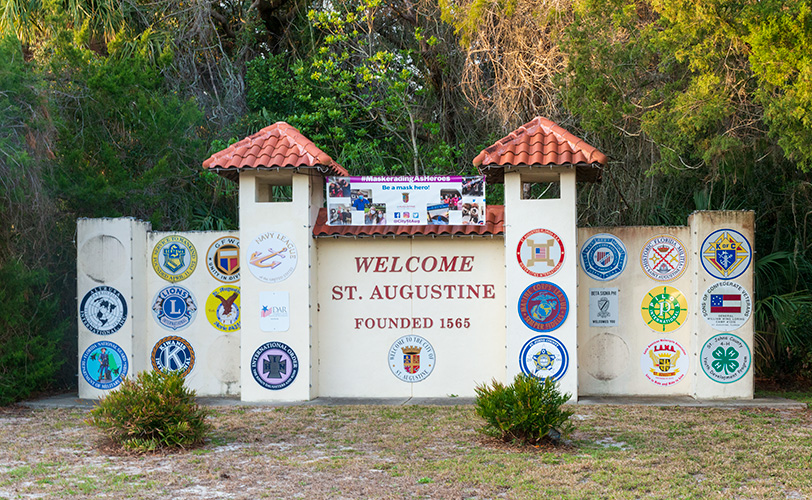
Welcome gateway in St. Augustine. Photo by the author.
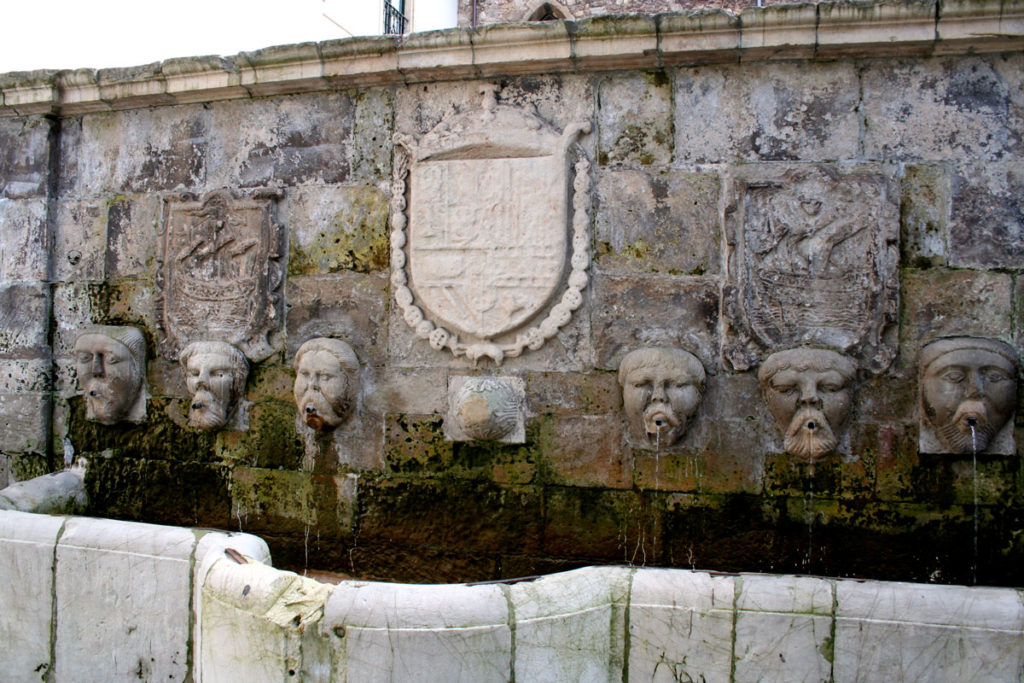
I recommend beginning at the St. Augustine Visitor Information Center. The parking is plentiful (though not free), the air conditioning glorious, and the informational brochures abundant. The VIC also has terrific museum-quality exhibits, including replicas of Spanish sailing ships and plenty of historical documents, explanatory placards, and artifacts. The plaza also houses a notable fountain, a replica of the Fuentos de los Caños de San Francisco (Fountain of the Spouts, in the Avilés neighborhood of San Francisco). St. Augustine’s sister city, Avilés, Spain, also the birthplace of St. Augustine’s founder Pedro Menéndez, gifted the fountain to St. Augustine in 2005. The original Fuentos de los Caños de San Francisco in Avilés was built in the sixteenth century, in the late medieval/early modern transitional period, and will set the medieval mood quite well for you!
Fuente de los caños en Avilés. Photography by Sitomon, posted to Wikimedia Commons.
The Castillo de San Marcos
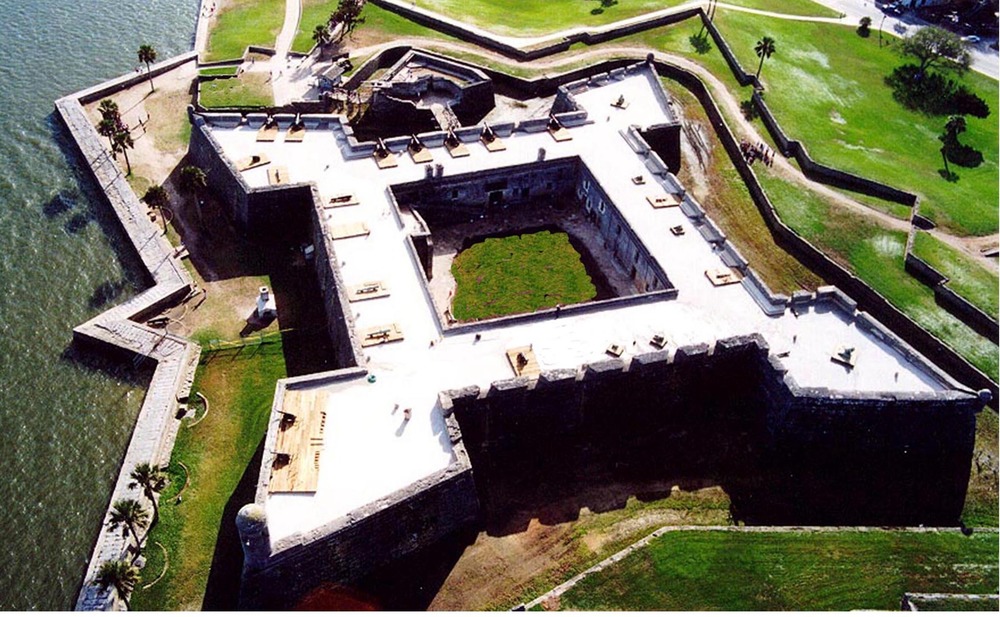
From the VIC you can walk east to the Castillo de San Marcos (the Fort of St. Mark, managed by the National Park Service). As you’ll see in your visit, the Castillo blends the functions of medieval stronghold and defensive New World frontier fort.
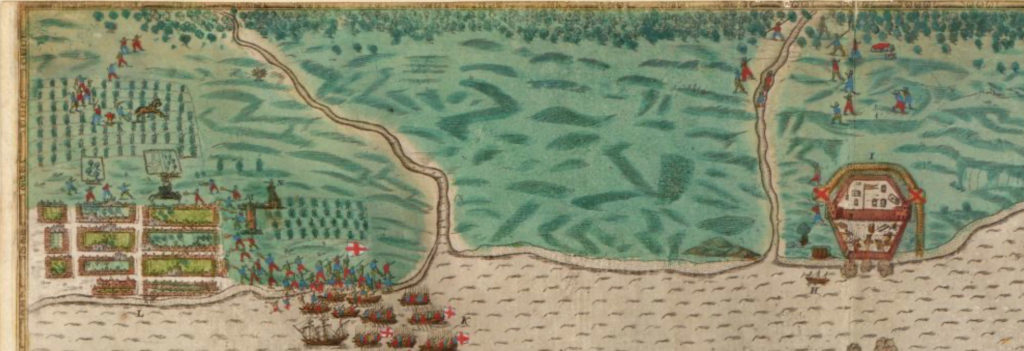
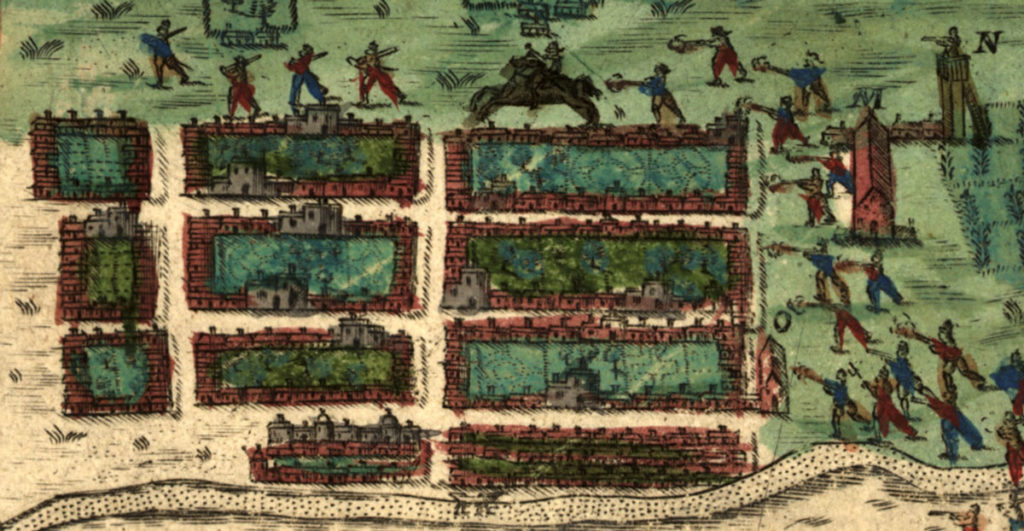
From the early days of the settlement, this spot held a defensive fort, though the earliest ones—nine in total—were wooden. [1] We know this from a significant map made by Baptisto Boazio, created to accompany a written account of Sir Francis Drake’s 1585 raiding expedition to attempt an upset of Spanish settlements in their new territories.
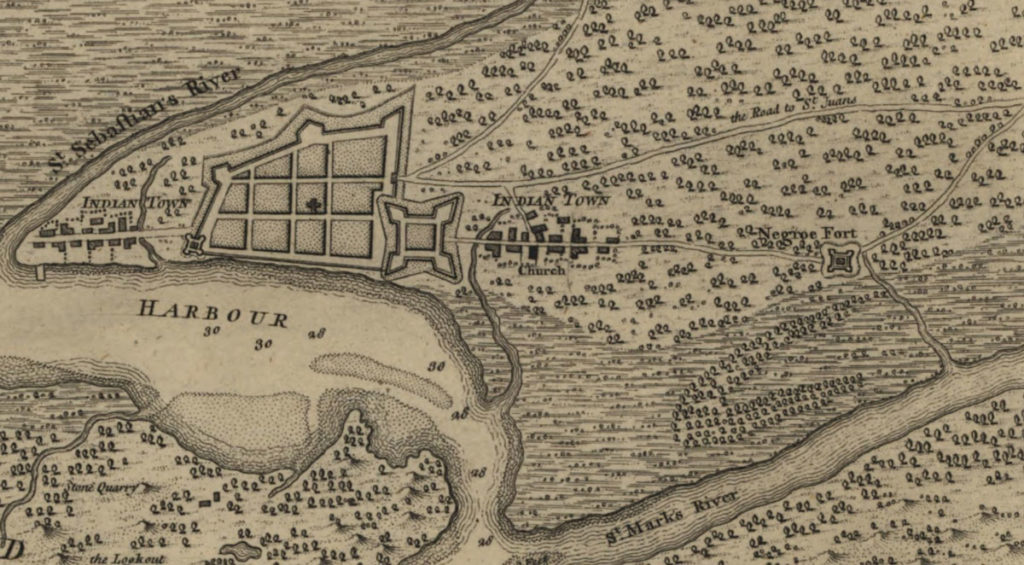
Close-up view of the Boazio map of St. Augustine, showing a wooden fort at the right, on the site of the present-day Castillo, and the first Spanish settlement at the left, with crop-growing fields at the top and right, and a watchtower, town house, and church to the right of the houses. Image from the Library of Congress.
In September 1585 Drake set out with 29 vessels. He and his crew raided and captured Santiago (Cape Verde), Santo Domingo (modern-day Dominican Republic), Cartagena (modern-day Columbia), and St. Augustine. The illustrations made by Boazio, who either went on the voyage or used information provided by Sir Francis Drake or other sailors, are the first recorded views of each of these locations, and his drawing of St. Augustine is particularly notable as the first recorded view of a European settlement in North America.
His maps were printed to accompany the written account two sailors kept of that voyage. Captain Walter Bigges began the account and kept it until he died in Cartagena; Lieutenant Croftes continued it after Bigges’s death. [2]
Croftes described St. Augustine’s fort as still in progress, only three or four months old, “all built of timber, the walles being none other but whole mastes or bodies of trees set uppe right and close together in manner of a pale, without any ditch as yet made.”[3] Drake and his company burned the unfinished fort, and the town, to the ground.
Though the fled survivors returned and rebuilt, much of the town was destroyed again just a few years later in a hurricane of 1599. Finally in 1672, the settlers began construction of a stone fort. Its first stage was finished in 1695 (the second stage ran from 1738–1756). [4]
Though the structure of the stone fort, made of native coquina, was post-medieval, it served in many ways as a medieval castle, a defense for the town around it and a place for St. Augustinians to shelter when under assault. In 1702, for example, when the British attacked, “about 1,500 soldiers and civilians were packed into the Castillo for 51 days!” [5]
The courtyard had three freshwater wells, the dry moat and the glacis offered protection from invasion, and both the inner and outer fortress had cannons and other types of munitions for fending off attackers.
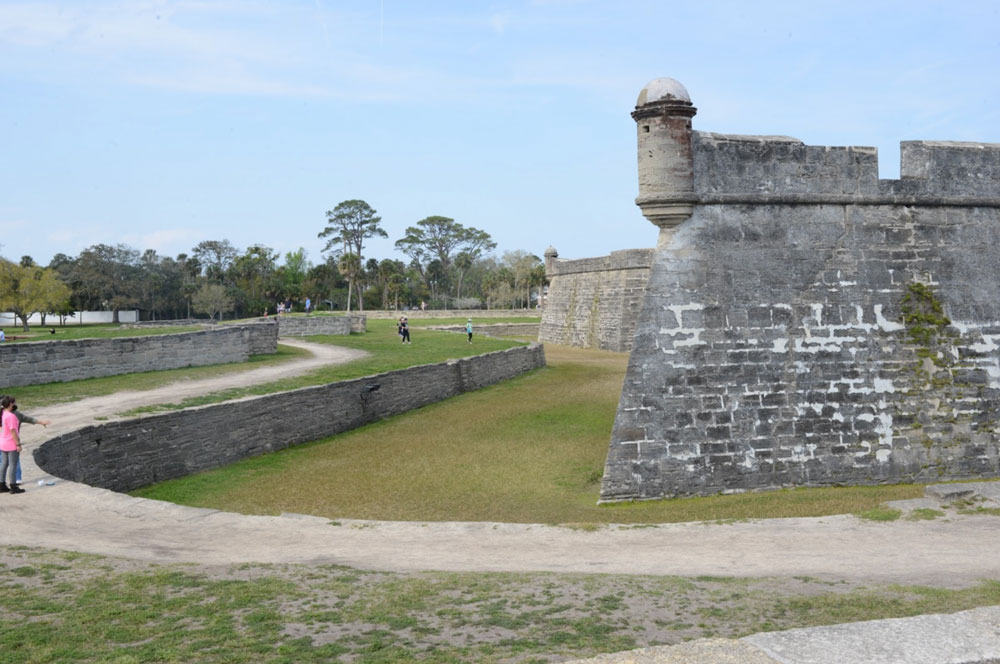
The southwest corner of the fort, showing the Bastion de San Pedro (each of the four angled corners of the fort contains a bastion, and each is named: NE, San Carlos (also the main watch tower); NW, San Pablo; SW, San Pedro; SE, San Agustín). Photo by the author.
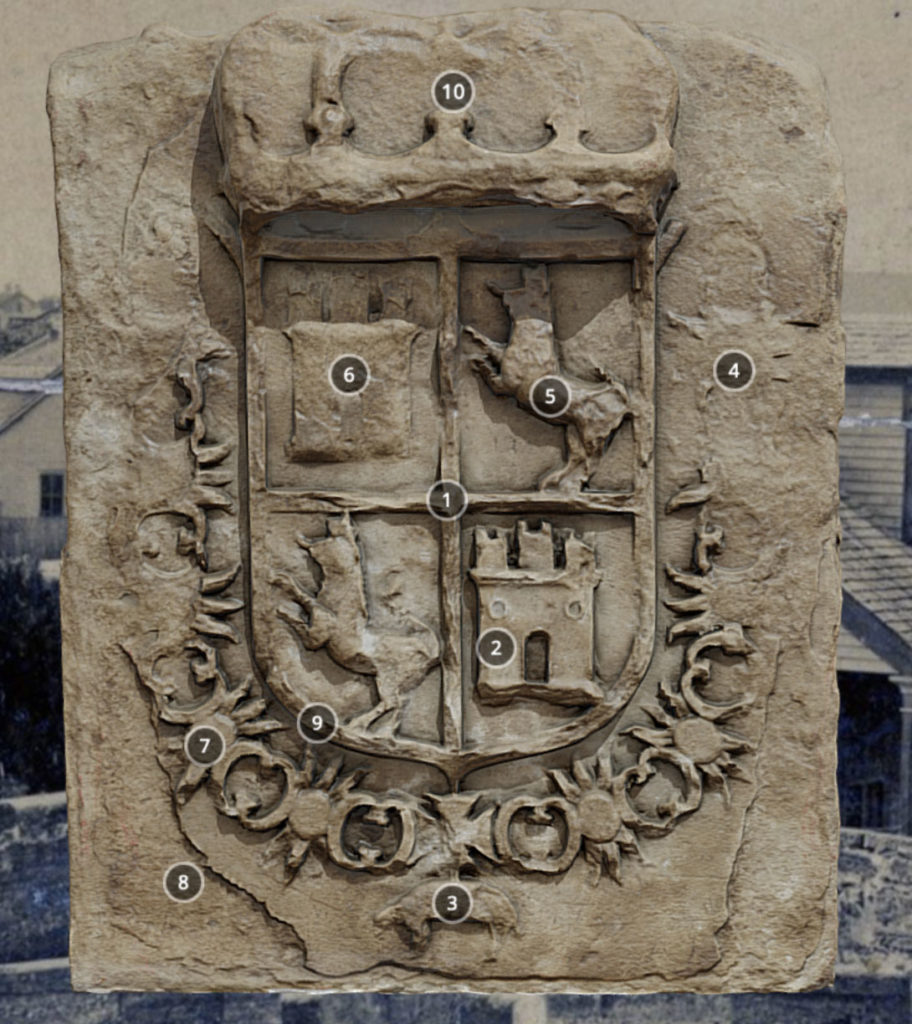
A medieval coat of arms appears above both the ravelin (the v-shaped protective installation at the south end) and the sally port (the entrance into the south wall, reached by the drawbridge and protected by the ravelin). As in the city coat of arms that I discussed in Part One, the lions represent the Kingdom of León and the castles the Kingdom of Castile, the crown atop Spain, and the sheep and enclosing chain the medieval Order of the Golden Fleece.
Image of the (replica) stone crest on the ravelin. Image from the NPS virtual tour of the Castillo.
Want to learn more about the fort from the comfort of your browser? Take the great virtual tour offered by NPS and hosted by the University of South Florida Libraries’ Center for Digital Heritage and Geospatial Information!
The City Gate and Walls
Running out from the western side of the Castillo, and reconstructed and visible today, is one of the city’s defensive walls. Like medieval cities, St. Augustine had not only a fortified stronghold but also a city gate and defensive walls. Most of these walls, or lines as the Spanish termed them, are reconstructions, though you will still feel very much like you’re walking through a medieval city when you see them (imagine, for example, the walls and gates of York, one of the most complete medieval walled cities in England.)
The gate and city walls of St. Augustine were not actually erected at its first settlement but in response to the British invasion of 1702. That experience prompted the city to enclose itself afterwards within medieval-style walls. The builders used native materials and constructed the lines as earthworks strengthened with local crushed coquina, or as walls of palm trunks.
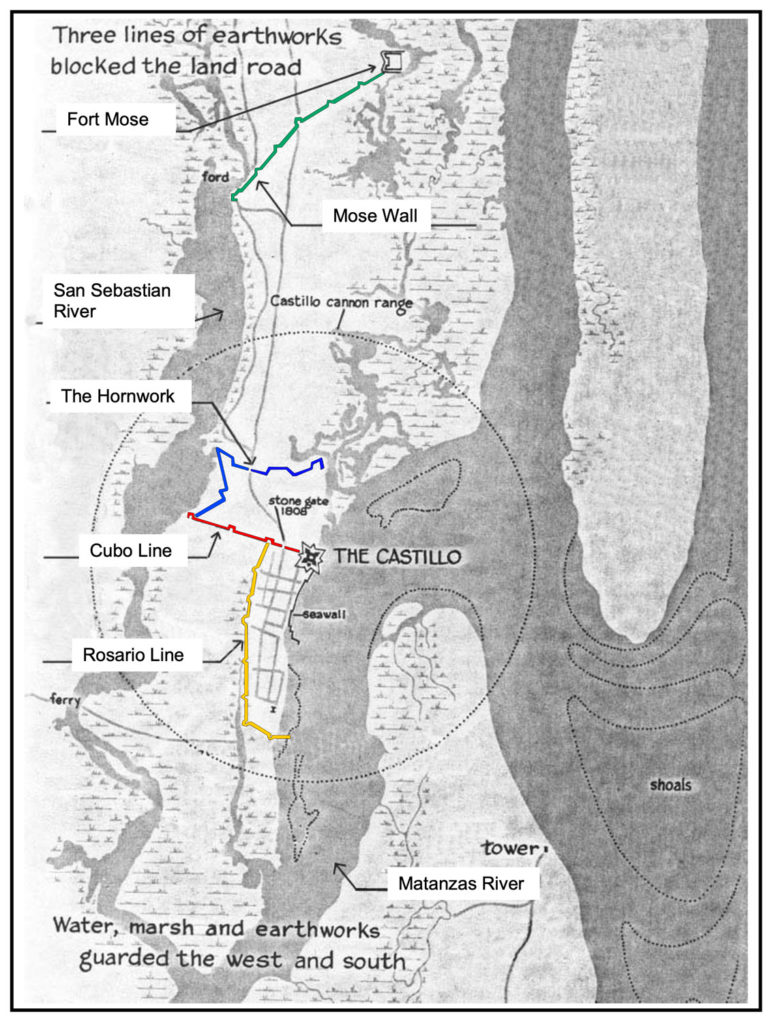
St. Augustinians erected four protective lines: the Cubo Line (1704), the Hornabeque (or Hornwork) Line (1706), the Rosario Line (1718–19), and the Mose Wall (1762). [6] Each line also included redoubts (a term that comes from Classical Latin reducere “to lead back” and medieval Latin reductus “secret place” [7]), somewhat similar in concept to the turrets of the Roman-era Hadrian’s Wall in England.) You can visit a reconstructed redoubt, the Santo Domingo Redoubt, at the corner of Orange and Cordova Streets, near the VIC.
The lines of St. Augustine. Original image from NPS, overlaid by the author with colored lines.
Colonial historian Dr. Susan R. Parker describes the construction of the lines:
“Out from the Castillo’s west side went strong earthworks in the style of medieval European walled cities to protect against siege warfare. This wall surrounded the city’s three landward sides and became the physical limits of the colonial city.
[…] Years later, about 1762, the northernmost wall was added to connect with the village of Fort Mose, the settlement established for enslaved persons who escaped from English colonies to Spanish Florida.
The lines were built of soil with coquina sometimes incorporated for strength. To raise the height of the wall, Spanish bayonets and prickly cactus were planted along its top. The walls required endless repair. The biggest threat to the wall were the hooves of free-ranging cattle that pawed away at the berms.
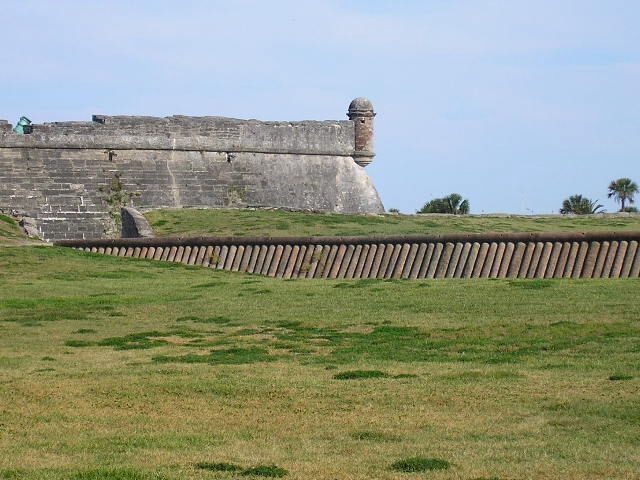
The reproduction Cubo Line that today crosses the grounds of the Castillo depicts a version of that barrier made of palm logs, built about 1808, a century after the first ‘Line.’ The City Gate was incorporated into this wall. The coquina pillars that stand today were built about the same time as the palm-log wall and replaced earlier entryways made of wood.” [8]
The Cubo line runs out of the west side of the fort, and the nineteenth-century version of palms was reconstructed in 1964 by the National Park Service. You can learn all about the materials and construction of this wall from NPS.
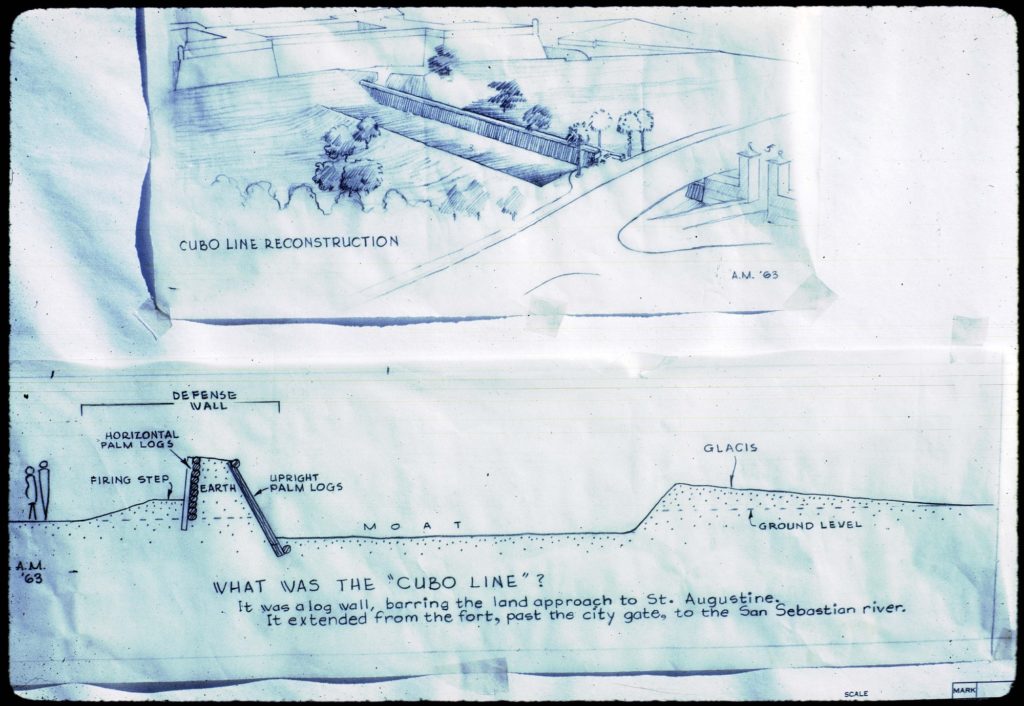
You can see more detail of the architecture of the Cubo line in the drawing below from the National Park Service.
Cubo Line Construction. Drawing by the National Park Service showing the proposed location of the replica town wall.
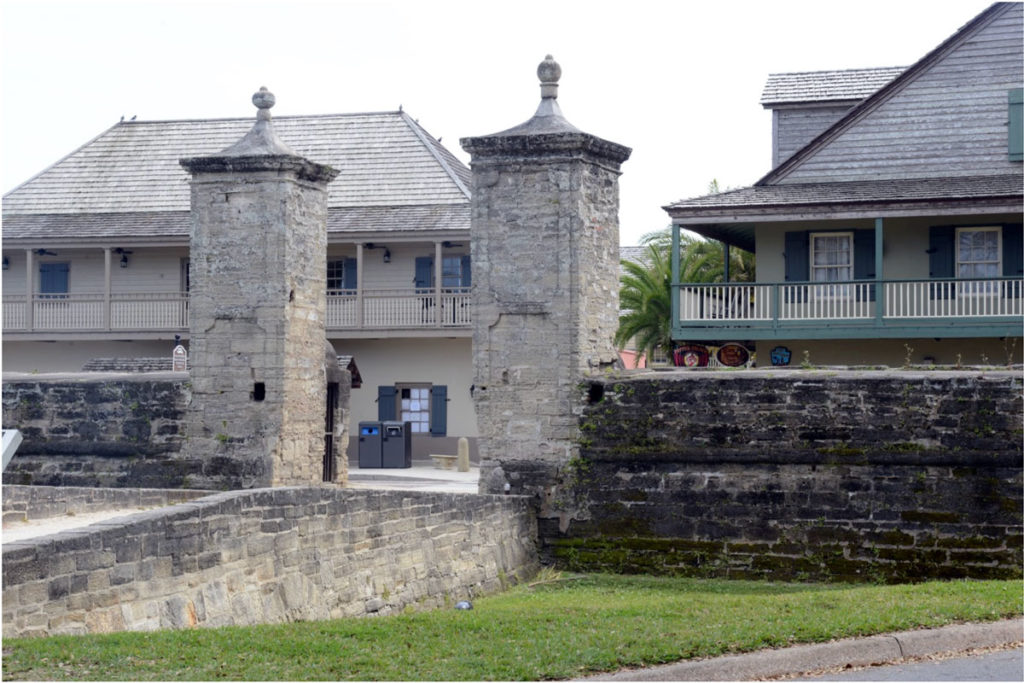
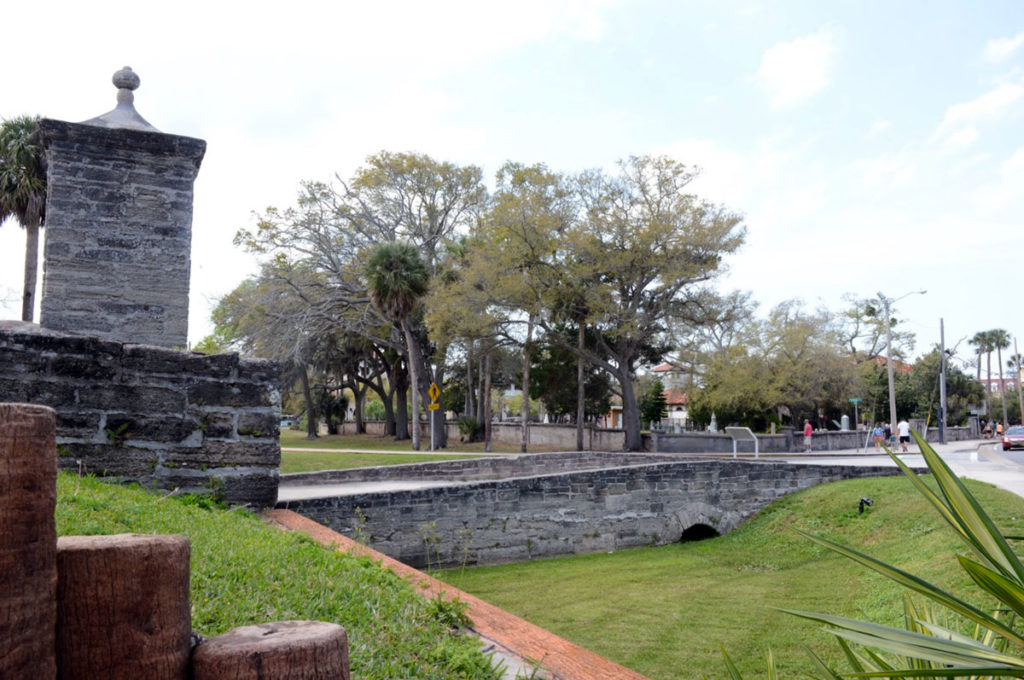
The city gates are part of the Cubo line and lie a short distance from the western fort wall. The existing gates were reconstructed in 1808.
The reconstructed City Gates, seen from the north. The Cubo line runs on either side of the gate. St. George Street, the entrance into the walled town, runs through these gates. Photo by the author.Side view of the city gates, from the east, showing the defensive earthworks, entrance bridge of St. George Street, dry moat, and palms. Photo by the author.
The city lines were, in fact, what inspired me to write these blogs on the medieval roots of St. Augustine. Wandering around the old city on one visit a few years ago, I came across a part of the city wall, running between buildings on the northwestern edge and not particularly marked or noted in any way. I stood there for a bit, playing my fingers gently over the coquina and mortar, and thinking about the medieval city walls of York (themselves much reconstructed, like St. Augustine’s), and medieval flint church walls I’d just spent a year examining in the eastern U.K.
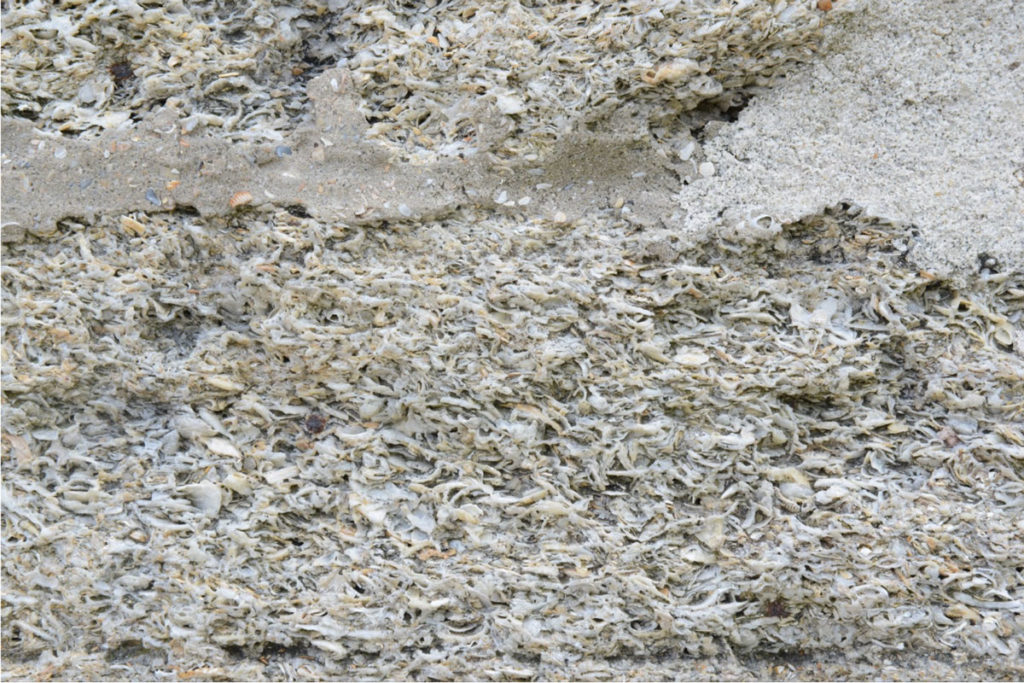
These sudden medieval encounters in the everyday world are striking, connecting us with the past physically, and showing us links with our natural environment and its long history of inspiring the construction of protective barriers, homes, and places of worship. Builders in the U.K. from the Romans to the Elizabethans relied on flint, a stone arising from the Chalk Escarpment of eastern coastal (and some of inland) Britain. The masons who made York’s medieval stone walls quarried their materials from the Magnesian Limestone formation in that area. The masons of St. Augustine drew on the native coquina, a limestone formed naturally of compressed and partially-dissolved shells of the coquina clam donax variabilis. St. Augustine’s limestone was quarried from nearby Anastasia Island.
Mortared coquina. The signature features of coquina rock—compressed shells of donax variabilis and their partially dissolved limestone—are visible here. Photo by the author.
The Historic City
While only a few reconstructed sections of the lines exist today, you can still enter the historic district of St. Augustine through its city gates, and from there step into a colonial Spanish town. Most of the city’s historic buildings are restored or reconstructed from its colonial era (First Spanish Period, 1565–1763; British Period, 1763–83; Second Spanish Period, 1783–1821) and early American period (after 1821). This lack of surviving older structures has much to do with St. Augustine’s military past: as a key outpost, the city weathered a number of massive attacks on its fort and settlement, such as Drake’s destruction of it in 1585 or the 1702 British attack that left the city burned to the ground again. Both post-Civil War Reconstruction and Henry Flagler’s investment and overhaul of the city in the late-nineteenth century meant the demolishing of many of the older buildings and construction of new ones.
The 1971 Historic St. Augustine Preservation Board’s Guidebook notes of the period of demolishment that “The old and storied inevitably gave way to the then new and modern. Many old houses and the remaining sections of the defense lines were uprooted to make way for new buildings. In those days these changes were hailed as a great improvement. Construction wasn’t the only enemy St. Augustine had, however; fire did its share of damage. In 1887 flames swept the Cathedral and much of the north block of the plaza. In 1914 a disastrous fire wiped out many of the buildings in the older section of the city between the city gates and the plaza.” [9] In the 1930s, though, St. Augustine became the focus of historic restoration, with organizing efforts to protect the historic district and return the city to its first Spanish period appearance. This Guidebook contains fascinating information from its time about the history and reconstruction of many of the buildings you can visit today.
Careful attention to the historical restoration process has resulted in a city that still reflects clearly its Spanish heritage. Albert Manucy in his book Sixteenth-Century St. Augustine writes,
“Although none of the first colonial houses of St. Augustine remain, it is clear from the later survivors that they are related to the folk architecture of northern Spain, the home of Pedro Menéndez, the town’s founder. Today in Oviedo and Santander Provinces one can see masonry houses, often with overhead balconies, front the streets. House lots are fenced to serve as corrals and stables. And in the town of Treceño there are houses with roomy ground-floor loggias, open to the yard through an arcade of two or three arches. These same styles can be seen in St. Augustine, and they have been there a long time.” [10]
This “folk architecture” itself was influenced by the medieval era (unfortunately I don’t have space to delve into this topic here.)
You can still see the city’s beginnings, though, in its layout and street plan, which has changed very little from its first formal layout in 1597. When Menendez and his group landed in the area in 1565, they first settled in cacique Seloy’s Timucuan village (the present-day Fountain of Youth Archaeological Park). After 9 months Menéndez and the settlers moved to Anastasia Island, then in 1572 moved back across the bay to the present site of St. Augustine and laid out their town. This town reflects a key feature of Classical and medieval architecture and a hallmark of Spanish urban planning: a plaza (though nascent) on the northern end of the town. To see what that town looked like, let’s step back Boazio’s 1589 map.
Close-up view of the earliest settlement of “wooden houses” with their “most pleasant gardens,” from the Boazio map of St. Augustine. The church is depicted with the letter “O,” at the northeast corner of the town (current-day corner of King and Aviles Streets). “M” is the “town house” and “N” is the watchtower. Image from the Library of Congress.
The legend for the map describes the fourteen-year-old settlement in this way:
“Opidum S. Augustini ligneis aedibus constructum, amoenissimos habuit hortos, utique solo faecundissimo”
(The town of St. Augustine, built of wooden houses, had most pleasant gardens, of course on a most fertile soil”).
Boazio’s engraving, showing Drake’s attack on the town, shows these houses and gardens, laid out to the south of the sixteenth-century fort.
Croftes describes the scene further, as the troop moved from the coast up the river:
“we might discerne on the other side of the river over against us, a fort [San Juan], which newly had bene built by the Spaniards, and some mile or there about above the fort, was a litle town or village without walls, built of wooden houses, as this Plot [Boazio’s map] here doth plainlie shew.” [11]
Boazio’s map shows a number of buildings, likely with palm- or palmetto-thatched roofs, and well-laid-out gardens. Archeological excavations have also confirmed the presence of a church, Nuestra Senora de Los Remedios (Our Lady of Remedies), since 1572 (St. Augustine, in fact, was America’s first Catholic parish). Records have confirmed the presence of a governor’s house near the water.
The open area surrounded by the church, town hall, and watchtower form a rough sort of early plaza, a plaza that was formalized shortly after by the next governor and that still exists today as the Plaza de la Constitucion, in the middle of the colonial halves of the city.
In their book, Ancient Origins of the Mexican Plaza, Logan Wagner, Hal Box, and Susan Kline Morehead discuss the importance of a central gathering place in city planning the world over, from ancient times to present. They note that “Plazas, or communal open spaces of some kind, have been at the core of every town and city in every culture on every continent.” [12] In the Western European world, the Greeks and Romans engaged in urban planning practices that provided for both sacred space (the Parthenon and Acropolis for Greeks, the Forum and Templum for Romans) and commercial and civic space (the market square).
About the development of urban planning in the Spanish New World, Wagner et al. write,
“The origins of Spanish urban layouts in the New World can perhaps be traced to urban design principles established by the celebrated Roman architect Vitruvius in the first century BCE; or possibly to ideas being discussed by the urban designers of the Italian Renaissance, especially Alberti; or even to the French bastides of the thirteenth century; or to the need to have a town layout that was expedient for military actions. The official policy of the Spanish Crown to design new towns in a grid or ‘checkerboard square’ pattern emanating from a central open space or plaza did not become official until well into the latter quarter of the first century of Spanish colonization, when grid layouts were finally made official in 1573 during the reign of Phillip II. The document in which these instructions were decreed is known as ‘The Laws of the Indies.’”
The authors note that, though the Laws were explicit and highly prescribed, in reality, settlements typically accommodated both existing native settlements and topographic features. [13]
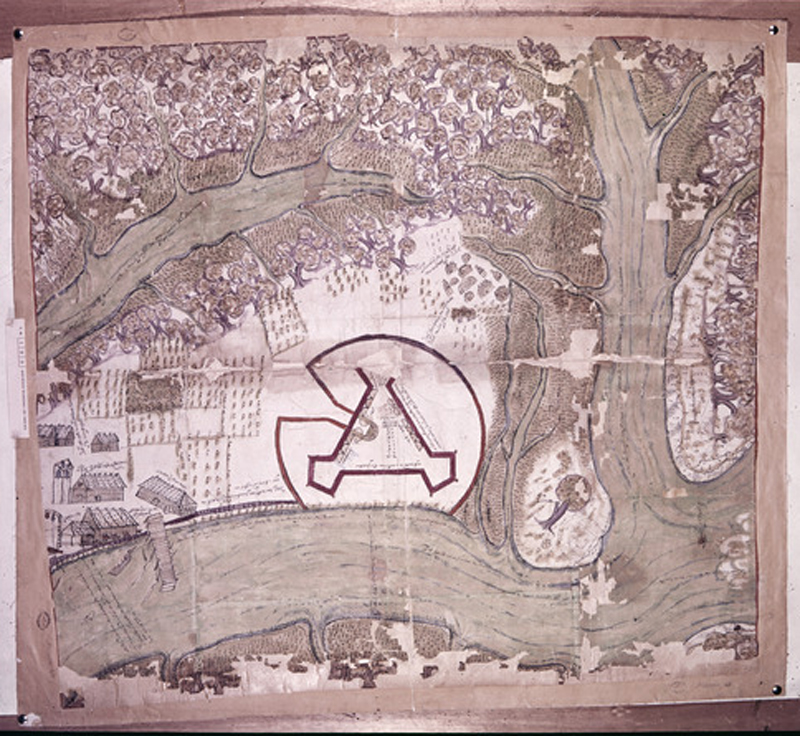
When the Spanish settlers returned after Drake and his company ended their raiding and headed north to Virginia, they had to rebuild, and put up a new wooden fort as well. Carmelite lay brother Andrés de San Miguel described the refounded settlement in 1595 as being a little over a mile long (“one-half league”), with plenty of water to drink and various crops. Of the buildings he writes, “All of the walls of the houses are of wood and the roofs of palm and the more important ones of plank. The fortress [is] made of wood backed by a rampart.” Further, “The Spaniards make the walls of their houses out of this wood of cypress (sauino) because the part of it that is in the ground does not rot.” [14] The town that Fray Andrés saw was that depicted in a map of ca. 1593, the “de Mestas map,” possibly created by Hernando de Mestas, St. Augustine emissary to Spain.
When the new governor of La Florida, Gonzalo Méndez de Canzo, arrived to St. Augustine in 1597, he carried out Phillip II’s new Laws of the Indies and overhauled the layout of the city to that effect, including establishing a marketplace in the plaza. He also moved the governor’s house westward, to the back of the plaza, “probably to have the location of the governor’s office comply with Spanish ordinances that major buildings face the main square (plaza).” [15] The Laws of the Indies blended Classical and medieval urban planning traditions with early modern sensibilities and responded to both the practical requirements of Spanish colonial outposts and the desire for a fresh, new, planned aesthetic for a new age and a New World.
Méndez de Canzo’s layout for St. Augustine was the one that stuck for the city. Though the town was severely damaged in 1599, first by a fire that burned down the Franciscan monastery at the south end of town, and then by a hurricane that swept away most of the houses and killed many inhabitants, and burned down by the British in 1702, St. Augustinians kept rebuilding on the town layout. [16]
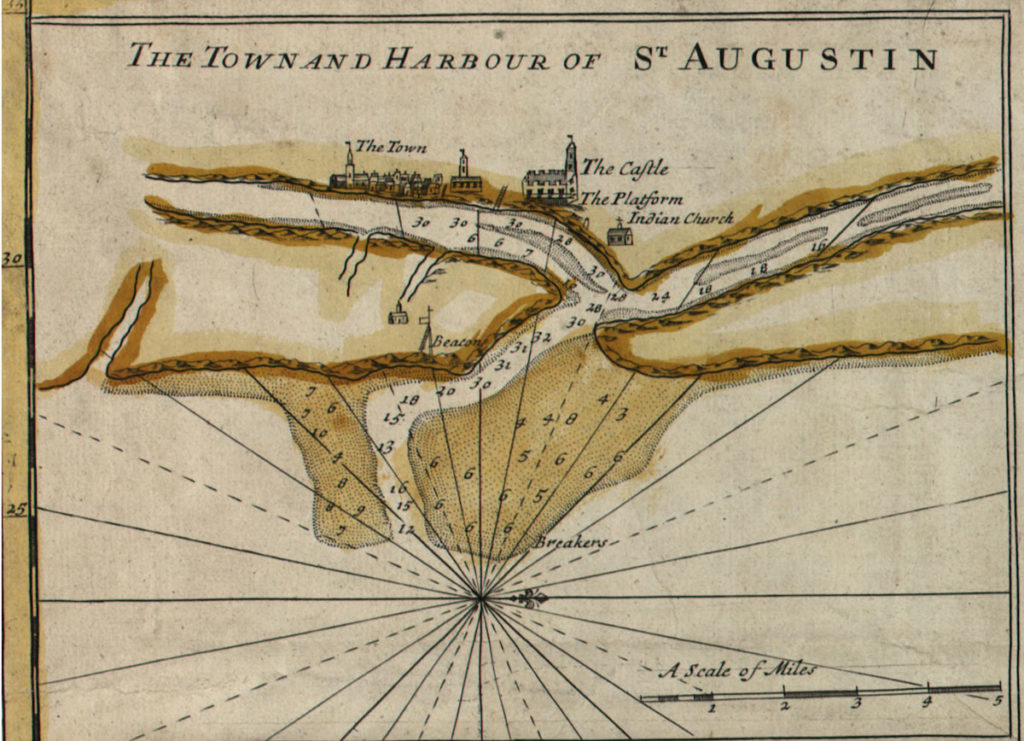
A 1711 map shows the new growth of the town, with the settlement and fort still somewhat distant from each other.
Map of St. Augustine, part of a larger map of Florida and the Carolinas, published about 1711 by Edward Crisp. Image from the Library of Congress.
By the time the British took over St. Augustine as part of the 1763 Treaty of Paris, though, the town had expanded northward and reached the area of the castillo. (From 1763-1783 Saint Augustine was a British territory, East Florida, and was its capital. In 1783 Britain gave this territory back to Spain, and in 1819 Spain gave it to the United States. )
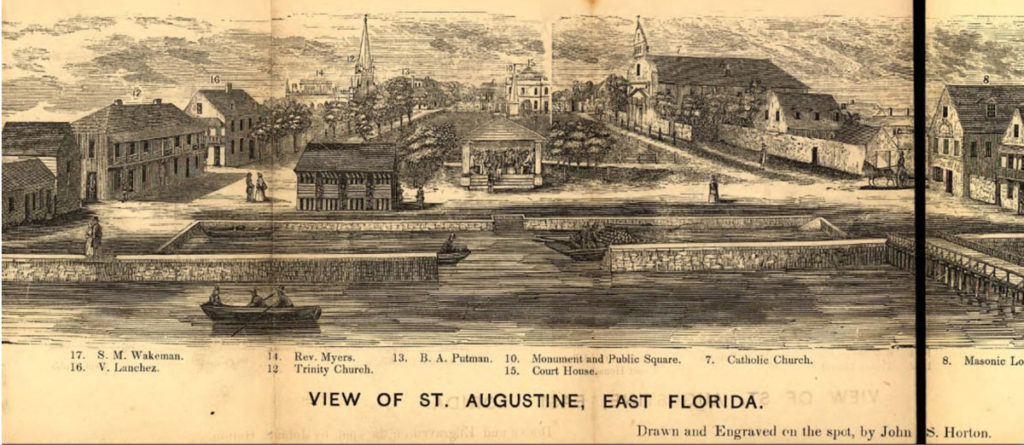
This 1855 view from the harbor shows how well-developed the plaza had become since Mendez laid it out in 1597.
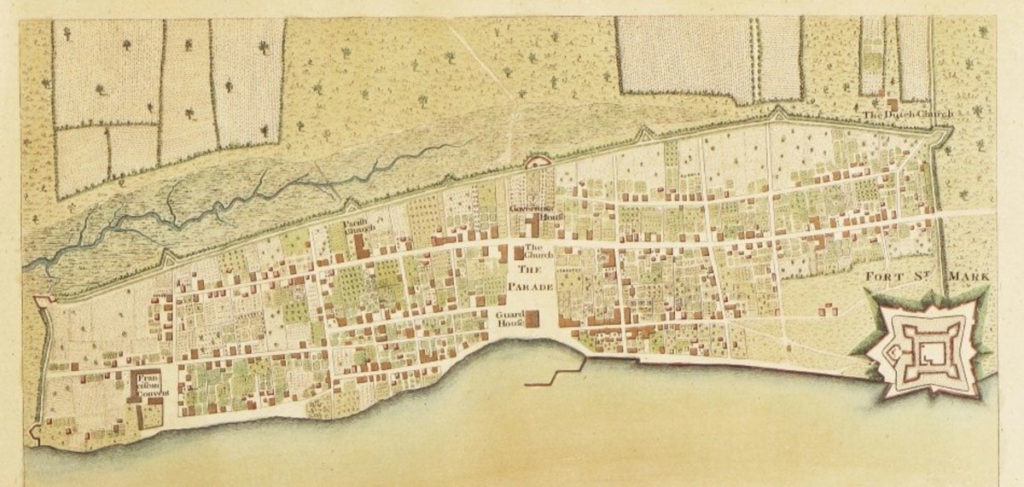
“Plan of the Town of St. Augustine, the Capital of East Florida,” by Thomas Jeffrys, published in William Faden, North American Atlas (1777). The map appeared first under a different title in William Stork, Description of East Florida (1769). Image from Boston Rare Maps Sale Catalogue.
Thomas Jeffrys’s 1769 map (above) shows that by the mid-eighteenth century, St. Augustine had grown to join with the fort, fully achieving de Canzo’s sixteenth-century plan. The Lines encompass the town, with the plaza (here formally noted as “The Parade”) at the center. This plaza was bounded by the Guard House at the harbor to the east, the church at the southwest corner, and the Governor’s House at the west end. The houses still had the “pleasant gardens” and orchards of the settlement’s earlier days. The fort appears at the northeast corner, with the Lines and their redoubts marked. The City Gate appears directly to the west of the fort, with present-day St. George Street running through the gates’ entrance into the walled city.
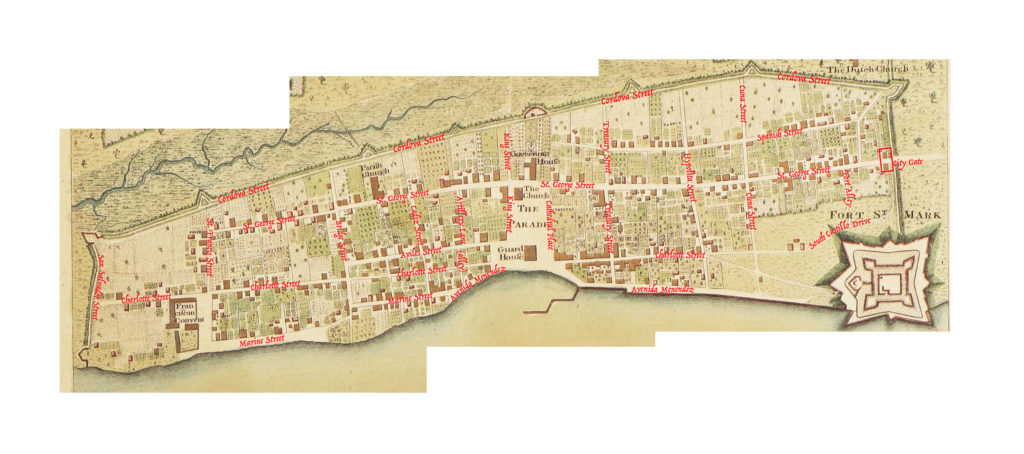
In the overlay I’ve done below, you can see how precisely the modern historic district maps onto Jeffrys’s eighteenth-centrury engraving of the town:
The Jeffrys map, with overlay in red by the author.
Remarkably, between this 1769 map and one of today, only a few of the streets have been swallowed up by development.
Walking through the streets of historic St. Augustine today is a treat for any lover of history. The careful reconstruction, street cobbles, balconies, and low buildings all create an atmosphere that is both medieval, European, and also distinctly Floridian. To see photos of more of the colonial buildings, check out this site.
The city claims to have currently “thirty-six buildings of colonial origin and another forty that are reconstructed models of colonial buildings.” Why not take a break from Disney World and visit something of Florida’s medieval history instead? You won’t regret it.
[1] Albert Manucy, Sixteenth-Century St. Augustine: The People and Their Homes (Gainesville: U P of Florida, 1997), pg. 36.
[2] It was first published in Latin and French in 1588 and then in English in 1589 (in two different editions) as A Summarie and True Discourse of Sir Frances Drakes West Indian Voyage (S.T.C. 3056 and 3057). Side note for lovers of book history: the second English edition of 1589 directs readers where to insert the maps, sold separately, into their copy of the book, and each of the four town maps has additional “textual keys, separately printed on broadside sheets intended to be cut and pasted at the bottoms of the four town maps.”
Mary Frear Keeler notes of the text and maps that “Richard Hakluyt reprinted the Summarie in his Principal Navigations, 3 vols. (London, 1598–1600); 12 vols. (Glasgow, 1903–1905). The engraved maps, printed with texts in three languages to correspond with the editions of the Summarie, are clearly associated with the publication of that narrative, and are referred to on the title page of the Ward edition (1589). A complete set of the Boazio maps is bound with the British Library’s copy of the Summarie (Field edition), numbered G. 6509” (“The Boazio Maps of 1585–86,” Terrae Incognitae 10 (1978): 71–80, at pg. 71).
[3] Croftes, A svmmarie and trve discovrse of Sir Frances Drakes West Indian voyage (London, 1589), p. 32.
[12] Logan Wagner et al., Ancient Origins of the Mexican Plaza: From Primordial Sea to Public Place (Austin: U of Texas P, 2013), pg.41.
[13] Wagner et al, pg.46.
[14] Fray Andrés de San Miguel, An Early Florida Adventure Story, trans. John H. Hann (Gainesville: U P of Florida, 2000), pp.76-7.
[15] Susan Richbourg Parker, “St. Augustine in the Seventeenth-Century: Capital of La Florida,” The Florida Historical Quarterly 92.3 (2014): 554–76, pg.556.
[16] Parker, “St. Augustine in the Seventeenth-Century,” pg.557.