When the Vikings invaded the northeastern coast of Britain in 793, they raided the monastery at Lindisfarne. The monks fled – and they carried with them the remains of Saint Cuthbert.
His coffin not only contained a corpse but also material relics, the Saint Cuthbert Gospel among them. The book so well preserved in his coffin has been recognized as a marvel among medieval manuscripts, along with the Lindisfarne Gospels, which the monks also saved from destruction by the Danes. Much like these extraordinary books, the embroidery that survived alongside Saint Cuthbert’s body is remarkable for its rarity.
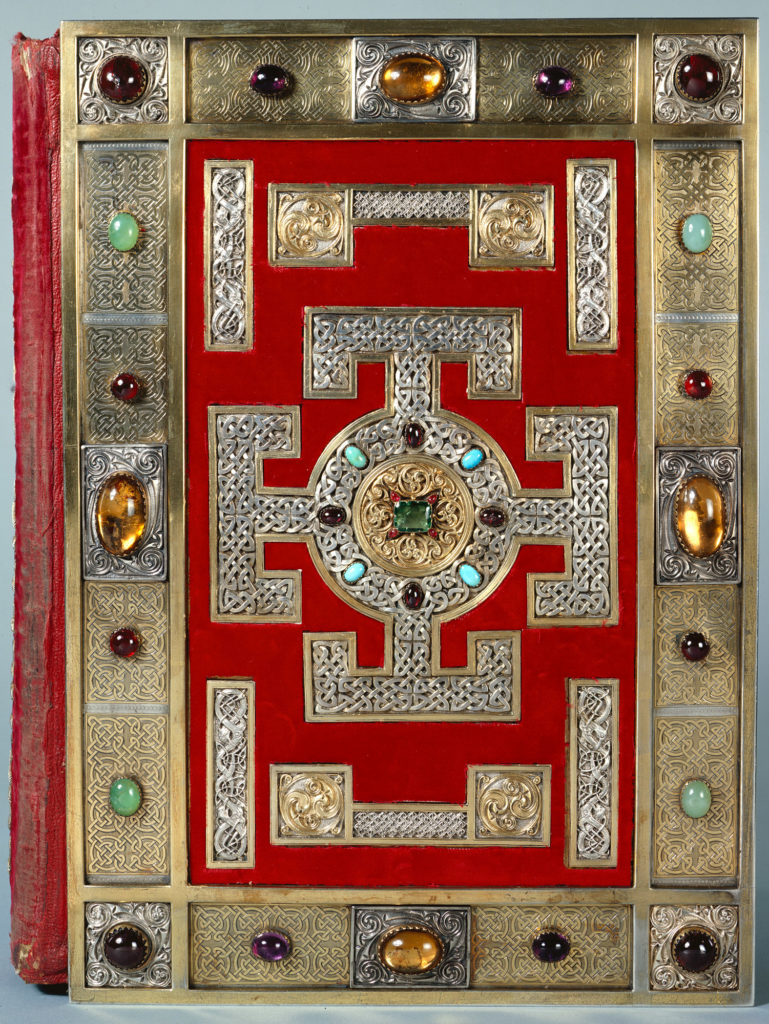
The Lindisfarne Gospels has, as the British Library says, “long been acclaimed as the most spectacular manuscript to survive from Anglo-Saxon England.” Created circa 700, the elaborately decorated manuscript contains the four Gospels, which recount the life of Christ, as well as other associated texts. Photo of the front cover of the Lindisfarne Gospels, courtesy of the British Library.
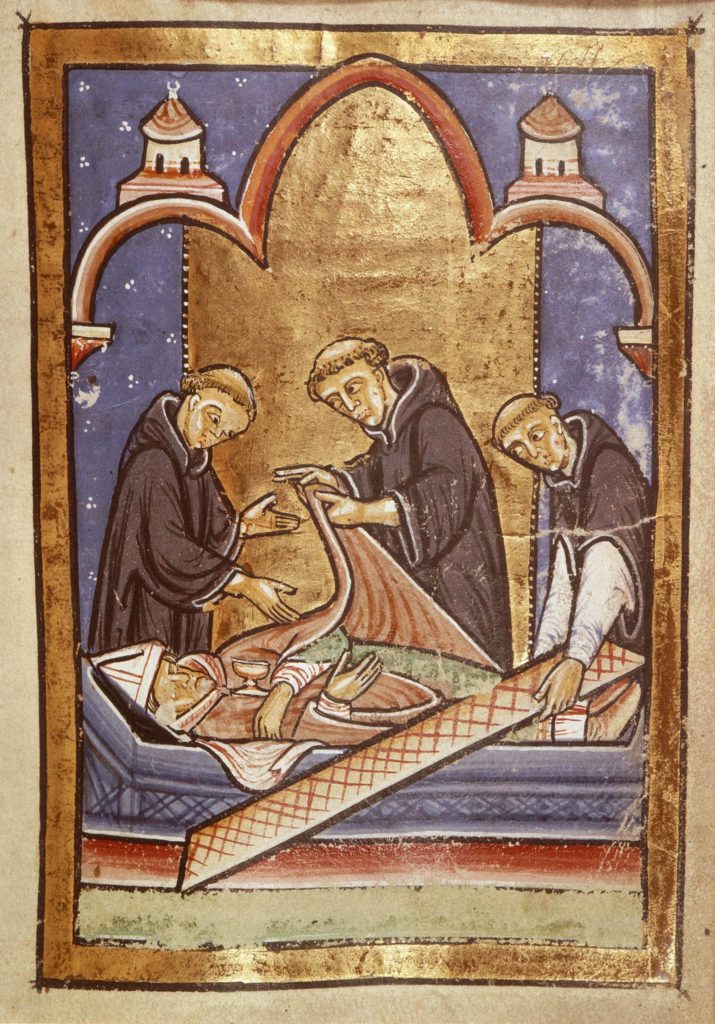
Cuthbert of Lindisfarne was born in 634 and spent his life as a monk, bishop, and hermit in the Kingdom of Northumbria. When he died in 687, he was buried at Lindisfarne. As the Venerable Bede recounts the story, Saint Cuthbert’s coffin was opened again 11 years later with the intention of removing his bones to a reliquary, but his body was found to be perfectly preserved.
From Bede’s “Life of Saint Cuthbert,” British Library MS 39943, dated 1180.
Under the duress of Danish attack, it was more than 100 years before the monks laid Saint Cuthbert to rest in Durham, where they settled in 995. Several artifacts accompanied Saint Cuthbert as he traveled posthumously around the English countryside, and the book and embroidery are very special for their survival.
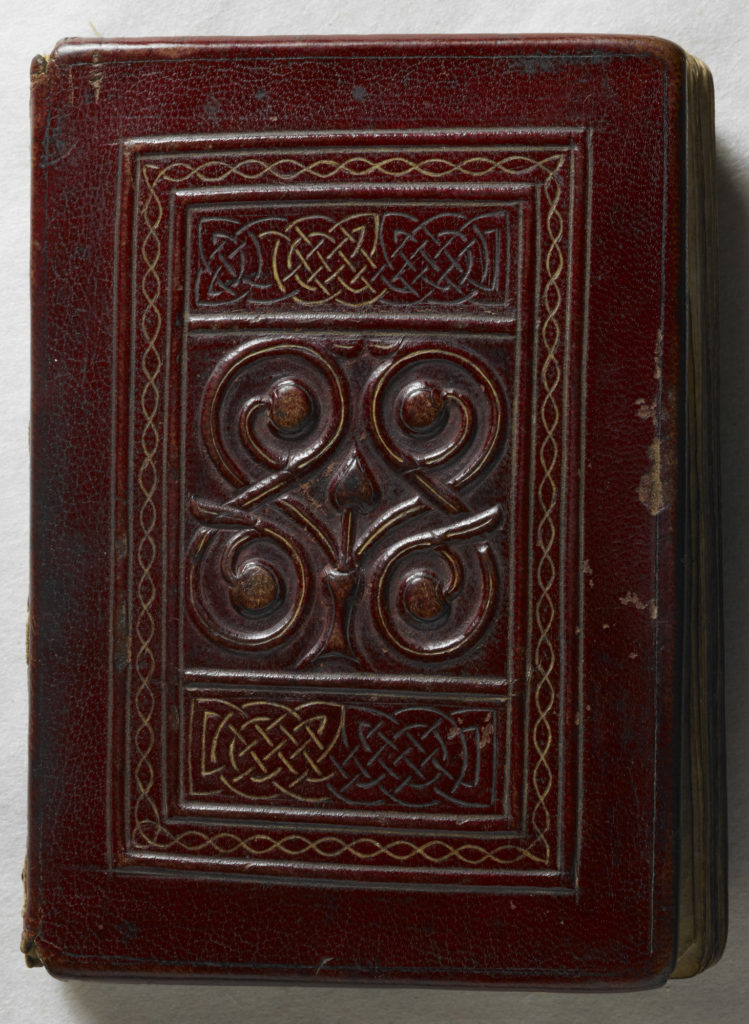
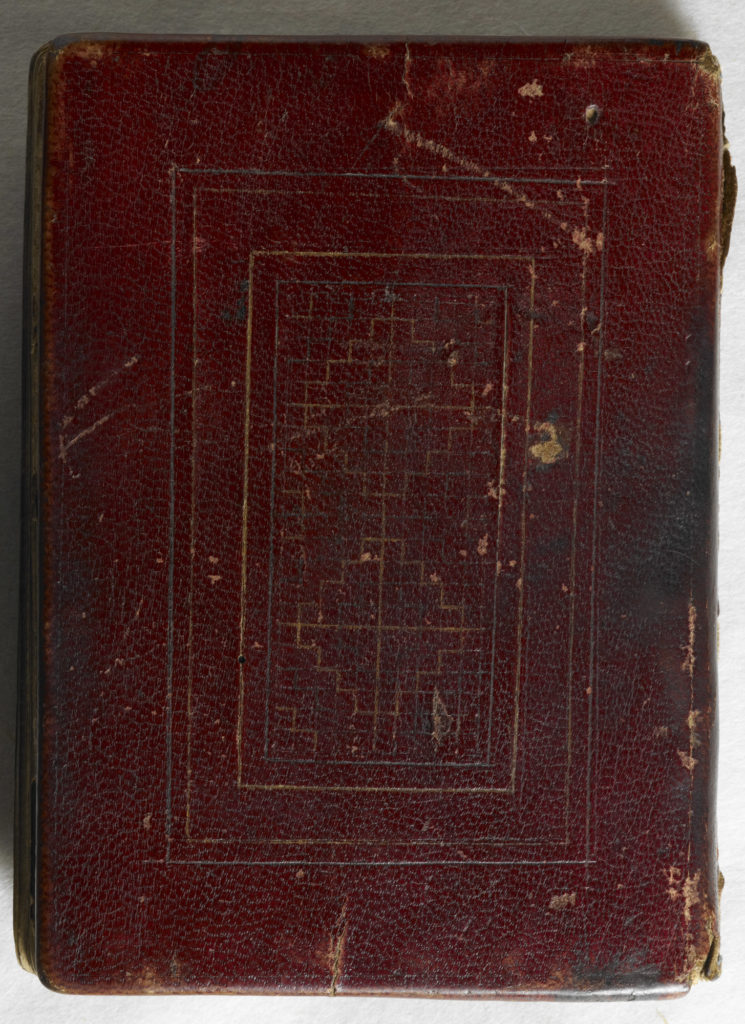
The Saint Cuthbert Gospel was discovered when the coffin was opened at Durham Cathedral in 1104, and like the body of its patron, the book remained incredibly well preserved. Dated to the early 8th century, it is the earliest European book to retain an original, intact binding.[1] The covers are made from goatskin that has been dyed red and decorated; the tooled leather is stretched over wooden boards, most likely birch. It is a pocket-sized book measuring 5.4 by 3.6 inches, and the manuscript contains the Gospel of Saint John.
Housed at the British Library in London, the Saint Cuthbert Gospel can sometimes be seen on display in the Treasures of the British Library exhibition, sometimes alongside the Lindisfarne Gospels. Photo of the front cover of the Saint Cuthbert Gospel, courtesy of the British Library.
The British Library’s description of the binding beautifully correlates the book’s cover with its content. On its front cover, “the central motif of a stylised vine sprouting from a chalice reflects Christian imagery from the eastern Mediterranean. The plant on the cover of the Gospel has a central leaf or bud and four fruits, echoing the text, ‘I am the vine, you are the branches’, from St. John’s Gospel 15:5.”[2] On the back cover appears “rectangular borders containing a geometric, step-pattern double-armed cross, recalling John’s central role in the Crucifixion narrative.”[3]
Back cover of the Saint Cuthbert Gospel, courtesy of the British Library.
The other relics were discovered much later when Saint Cuthbert’s tomb was opened in 1827. In addition to the saint’s body, Canon James Raine found a pectoral cross, a portable altar, an ivory comb, and a set of embroidered vestments.[4] The vestments, or religious robes, date between 909 and 916 and are the earliest pieces of embroidery that survive from the medieval period in England.
Only a few pieces of Anglo-Saxon embroidery survive at all, and these pieces are unique among the extant examples in that they feature full-length human figures. The vestments include a stole decorated with figures of Old Testament prophets and Apostles, as well as a maniple, a girdle, and bracelets. They are made from Byzantine silk with silk and gold thread decoration. According to inscriptions on the fabric, the vestments were commissioned by Queen Aelfflaed for the Bishop of Winchester and produced between 909 and 916. Her stepson, King Athelstan, who ruled England from 927 to 939, placed them in Saint Cuthbert’s tomb when he visited the shrine in 934.
The style of embroidery called Opus Anglicanum, or English Work, was used on clothing, hangings, and other textiles, often created with silk and gold or silver-gilt threads stitched on linen or velvet backgrounds. Between the late 12th and mid-14th centuries, these luxury goods were in great demand across Europe. Often they were procured as diplomatic gifts, and they were very expensive. They were produced for both secular and ecclesiastical use, but most of the surviving examples were designed for liturgical use like those found alongside Saint Cuthbert.
Although English embroidery was renowned for its beauty during the medieval period, the majority has been lost to neglect or destroyed for the extraction of precious metals or stones, such as pearls and other jewels mentioned in inventory descriptions. Fragments, however, can be found in museums, and one of the most substantial collections of Opus Anglicanum can be found at the Victoria and Albert Museum in London.
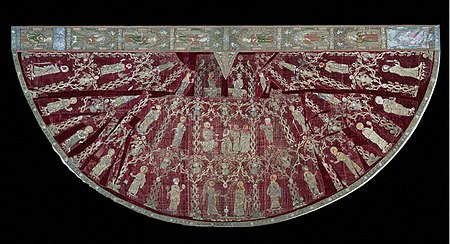
Embroidered in the Opus Anglicanum style, the Butler-Bowdon Cope is a ceremonial cloak that was created circa 1330-50 for use in church services and processions. The embroidery incorporates gold, silver, and colored silks, as well as freshwater seed pearls and glass beads, and depicts events from the life of the Virgin Mary. Photo of the Butler-Bowdon Cope, courtesy of the Victoria and Albert Museum.
The vestments recovered from Saint Cuthbert’s tomb can be seen on display at Durham Cathedral, where visitors can view the entire Treasures of Saint Cuthbert collection. The oak coffin made to cradle the saint’s body when he was found incorrupt in 698 also resides among the relics, its own fragmented body a reminder of what arduous travels medieval artifacts endure to remain with us in our own time.
Emily McLemore, Ph.D. Department of English University of Notre Dame
American mythology is filled with larger-than-life figures, like the axe-wielding Paul Bunyan and the rattlesnake-handling Buffalo Bill. Some of them are historical or pseudo-historical, such as Davy Crocket and Daniel Boone (who both famously die in the Alamo siege during the Texas revolution). Of course, there is little ground more fertile for American mythology than the colonial and revolutionary historical periods, with George Washington’s cherry tree and Paul Revere’s famous midnight ride to alert colonists in Lexington and Concord of the British army’s approach. Both of my latter examples demonstrate how historical figures are imagined and reimagined by subsequent generations of Americans, considering that Washington probably never actually chopped his cherry tree, nor did Paul Revere quite make it to Lexington or Concord to warn that the redcoats were coming toward the rebel munitions stored there. Indeed, all of the aforementioned mythic American figures and stories are somewhat less invested in historical fact and more in the self-fashioning of a European ethnonationalist identity in the United States.
In early America as elsewhere, storytellers and mythographers, such as Washington Irving (who famously wrote “The Legend of Sleepy Hollow” about a little haunted town in New York), begin not only looking to the colonial period but also across the pond to European ethnonationalist antiquarianism in the construction of distinctly American mythology following a successful revolutionary war overthrowing the British government. This is observable in another of Irving’s works, “Rip Van Winkle” which tells the tale of a man who meets with a dwarvish fairy in the Catskill Mountains and falls magically asleep for the bulk of his life, only to awaken as an old man and find his children grown. This fantastic story brings early medieval fairy lore—elves, dwarves and the like—into the American frontier and invites these supernatural beings from the “old world” into the newly formed United States.
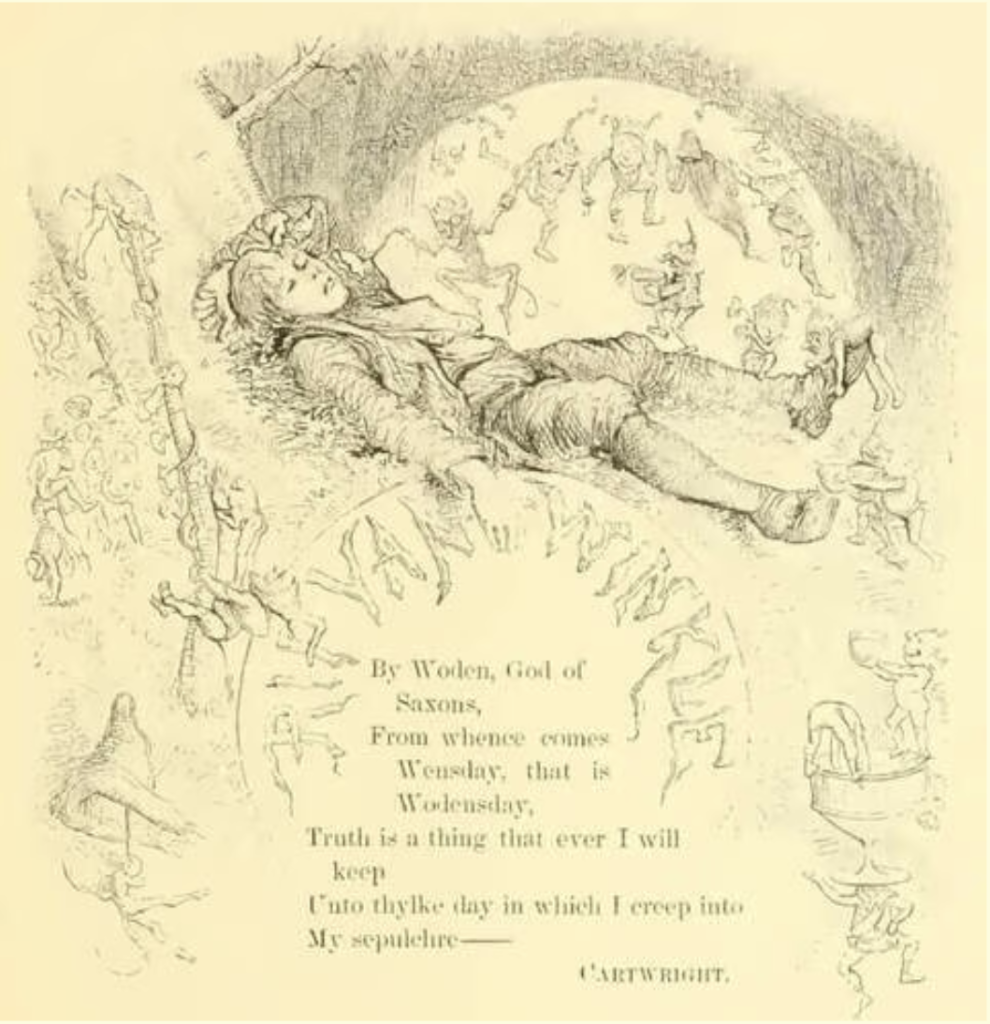
Illustration from Washington Irving’s The Sketch Book of Geoffrey Crayon, Gent. prior to the start of the short story, “Rip Van Winkle” (1848).
The story begins with an explicit epitaph from the tomb of one Diedrich Knickerbocker that invokes the pre-Christian Germanic mythic figure “Woden, God of Saxons” (1):
By Woden, God of Saxons, From whence comes Wensday, that is Wodensday, Truth is a thing that ever I will keep Unto thylke day in which I creep into My sepulchre
(Irving , “Rip Van Winkle” 1-5).
In order to grow, myths need both substance and storyteller—in other words both the story itself and persons to pass the tale along to others. The art of storytelling and oral narratives are seemingly as old as humankind, but storytelling as a pastime is regularly associated with the medieval period, made famous by late medieval works of literature such as Giovanni Boccaccio’s Decameron and Geoffrey Chaucer’s Canterbury Tales. Indeed, in the tradition of English literature, Chaucer’s work looms large, and has inspired numerous imitators and allusions even in recent years.
Margaret Atwood’s book, The Handmaid’s Tale (1985), follows in this tradition, and her novel’s name serves both as a pejorative toward the historical period—suggesting the future could go backwards in time in terms of social progress with respect to religiosity, intellectual freedom and gender equality—and as a simultaneous homage to the literary influence of Chaucer’s Canterbury Tales. Atwood, whose novel is understood by the reader to be an academic transcription of a personal diary, logged on a voice recorder and being discussed centuries later after the log is transcribed and analyzed by a scholar who gives the book its editorial title included in the back “Historical Notes” section of the book:
“The superscription ‘The Handmaid’s Tale’ was appended to it by Professor Wade, partly in homage to the great Geoffrey Chaucer…I am sure all puns were intentional, particularly that having to do with the archaic vulgar signification of the word tail…”
(Atwood, The Handmaid’s Tale 300-301).
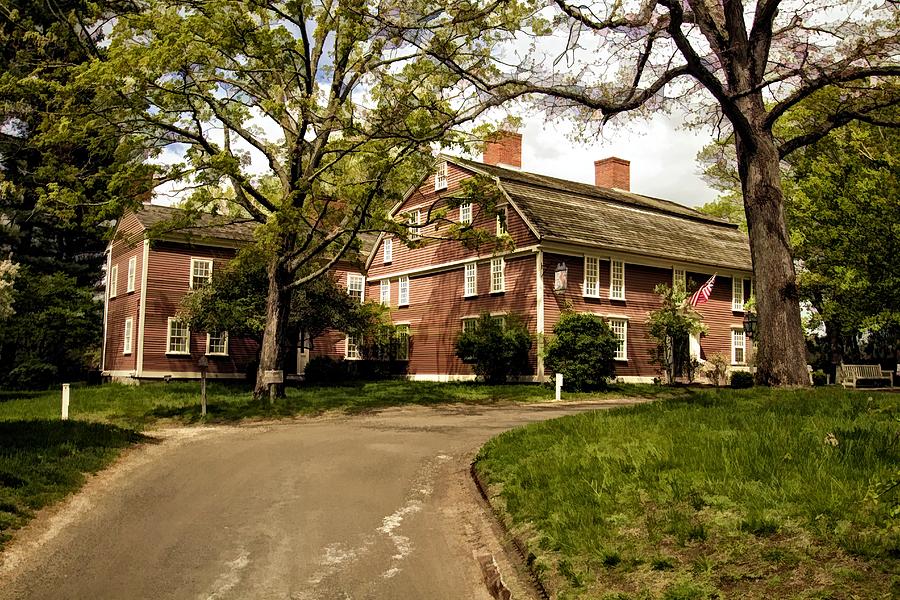
“America’s Oldest Inn, Longfellow’s Wayside Inn in Sudbury Massachusetts,” photograph by Constantine Gregory (April 29th, 2014).
Similarly, Harvard professor and early American poet, Henry Wadsworth Longfellow, follows Chaucer’s model in his collection of poems, Tales of the Wayside Inn, where a group of fictitious European colonialists meet for some storytelling at what is now a famous inn in Sudbury, Massachusetts. As fate would have it, my maternal grandparents happened to live right down the road from the Wayside Inn in Marlborough and as a child they would take me and my siblings to play in the nearby woods and explore the nearby grist mill where I would search for dinosaurs and dragons with my twin brother and younger sister. So, you can imagine, I’ve had my share of meals and heard my own share of tales at the Wayside Inn—in fact my father’s second marriage held its reception there—so the place has special meaning to me, a sort of gravitas. Having grown up a few towns over in Massachusetts, I always found the inn and surrounding area charming, but the historical and literary influence of the space in which I have lived most my life continues to find new ways of inspiring me, especially as I have recently returned to work and teach in Marlborough and have begun to reconnect once again with the area. This brought my mind back to Longfellow’s tales.
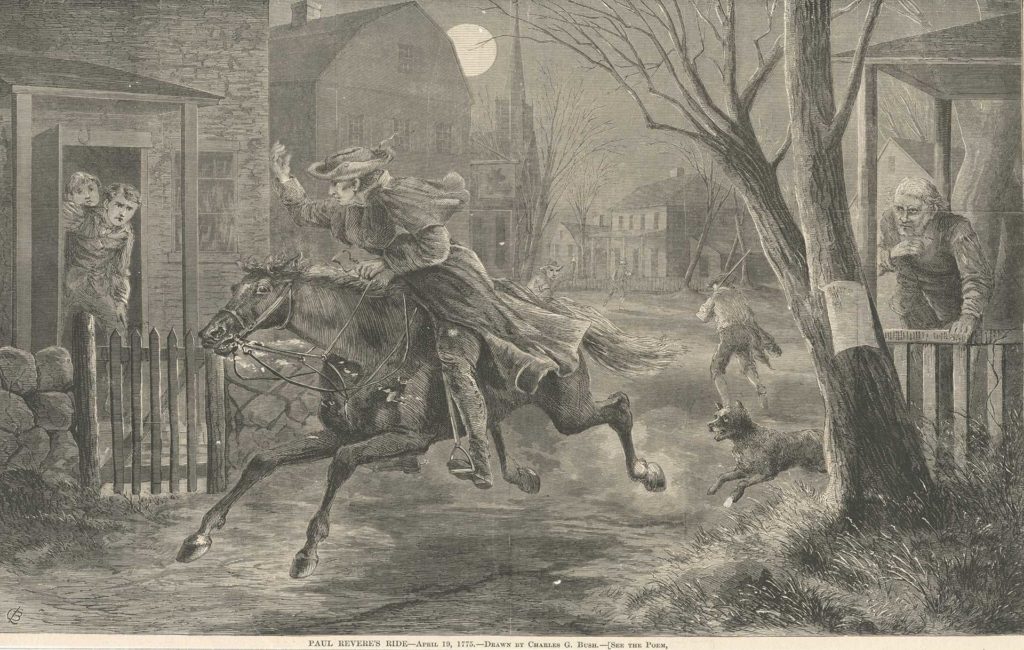
Longfellow writing on the eve of the American Civil War is none other than the author credited with reimagining the story of Paul Revere’s midnight ride, in his “The Landlord’s Tale” also known as “The Midnight Ride of Paul Revere” in which American revolutionary figure, Paul Revere, is the dashing hero who delivers the all-important message, undercutting Samuel Prescott’s successful journey out of the story entirely, and erasing Revere’s capture and partial failure by replacing it with a version of events in which Revere is victorious in his epic quest.
So through the night rode Paul Revere; And so through the night went his cry of alarm To every Middlesex village and farm,— A cry of defiance and not of fear, A voice in the darkness, a knock at the door, And a word that shall echo forevermore! For, borne on the night-wind of the Past, Through all our history, to the last, In the hour of darkness and peril and need, The people will waken and listen to hear The hurrying hoof-beats of that steed, And the midnight message of Paul Revere!
(Longfellow, “The Landlord’s Tale: The Midnight Ride of Paul Revere” 199-130).
“Paul Revere’s Ride, April 19, 1775” by Thomas Addis Emmet, 1828-1919, New York Public Library.
Other tales told by European colonials at the Wayside include: “The Student’s Tale” “The Spanish Jew’s Tale” “The Sicilian’s Tale” “The Musician’s Tale” “The Theologian’s Tale” and “The Poet’s Tale”. These titles chime with Chaucer’s titles named for each distinct pilgrim on the road to Canterbury, some of which include “The Knight’s Tale,” “The Miller’s Tale,” “The Wife of Bath’s Tale,” “The Nun’s Priest’s Tale,” and “The Pardoner’s Tale.”
My blog today will end with a brief introduction to Longfellow’s “The Musician’s Tales” which is also called “The Saga of King Olaf” in reference to Old Norse-Icelandic Saga Olafs konungs Tryggvasunar. Structurally, the tale is the longest tale—a sort of epic poem—with subtitled chapters.
i. The Challenge of Thor ii. King Olaf’s Return iii. Thora of Rimol iv. Queen Sigrid the Haughty v. The Skerry of Shrieks vi. The Wraith of Odin vii. Iron-Beard viii. Gudrun ix. Thangbrand the Priest x. Raud the Strong xi. Bishop Sigurd at Salten Fiord xii. King Olaf’s Christmas xiii. The Building of the Long Serpent xiv. The Crew of the Long Serpent xv. A Little Bird in the Air xvi. Queen Thyri and the Angelica Stalks xvii. King Svend of the Forked Beard xviii. King Olaf and Earl Sigvald xix. King Olaf’s War-Horns xx. Einar Tamberskelver
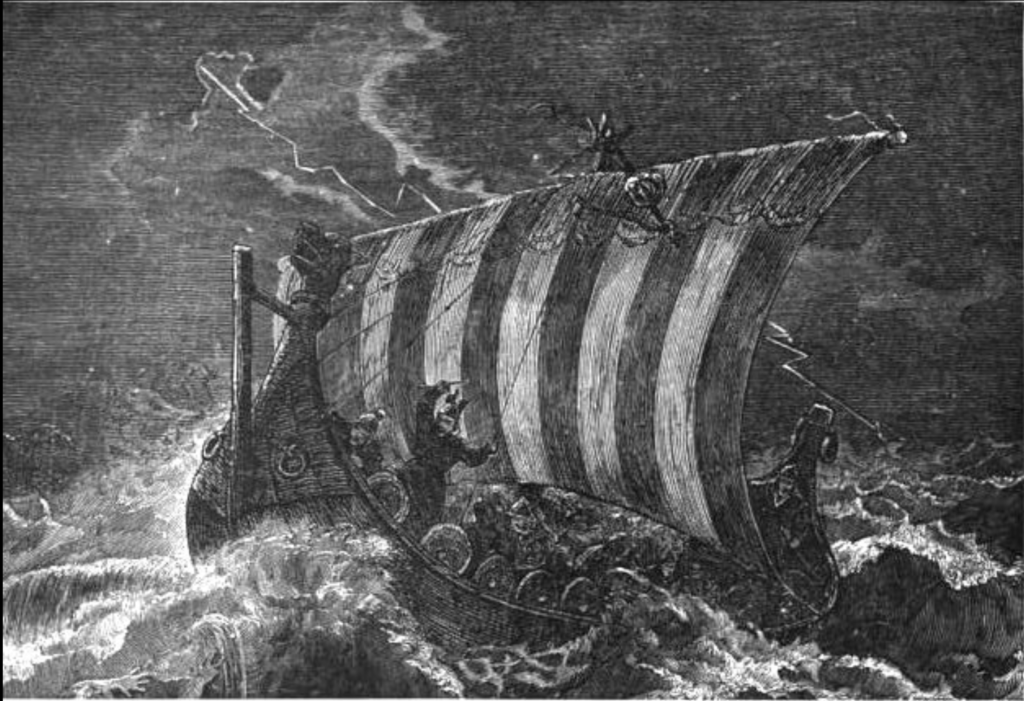
Illustration for Henry Wadsworth Longfellow’s “The Saga of King Olaf” from Tales of a Wayside Inn. Titled “And his ships went sailing, sailing,” from section II: “King Olaf’s Return.” From The Complete Poetical Works of Henry Wadsworth Longfellow (Boston: Houghton, Mifflin & Company, 1899).
This heavily alludes to Old Norse-Icelandic Heimskringla which Longfellow had access to via Samuel Laings’ modern English translation published in 1844. In doing so, this tale draws directly from Old-Norse Icelandic saga literature and serves to connect early American literature and mythography with early medieval Europe and antiquarian notions of “The Germanic” and “Anglo-Saxon” ethnonationalist identities. The first poem, “The Challenge of Thor” demonstrates how Viking warrior ethics and mythology are interwoven directly into early American literature and mythography. The challenge reads almost as an invocation to the pagan god of Northern medieval Europe in a romantic display of American eurocentrism:
I am the God Thor, I am the War God, I am the Thunderer! Here in my Northland, My fastness and fortress, Reign I forever!
Here amid icebergs Rule I the nations; This is my hammer, Miölner the mighty; Giants and sorcerers Cannot withstand it!
These are the gauntlets Wherewith I wield it, And hurl it afar off; This is my girdle; Whenever I brace it, Strength is redoubled!
The light thou beholdest Stream through the heavens, In flashes of crimson, Is but my red beard Blown by the night-wind, Affrighting the nations!
Jove is my brother; Mine eyes are the lightning; The wheels of my chariot Roll in the thunder, The blows of my hammer Ring in the earthquake!
Force rules the world still, Has ruled it, shall rule it; Meekness is weakness, Strength is triumphant, Over the whole earth Still is it Thor’s-Day!
Thou art a God too, O Galilean! And thus single-handed Unto the combat, Gauntlet or Gospel, Here I defy thee!
(Longfellow, “The Musician’s Tale: The Challenge of Thor” 1-42).
The references to hazardous weather and natural disasters, such as earthquakes, lightning and thunder, and allusions to Mjölnir (10) and Thor’s girdle (16), are enveloped in the themes of “Force rules the world still” (31) and “Meekness is weakness” (33) in the poem. Additional references to Thor’s “red beard” (22), his goat-drawn “chariot” (27) and his syncretism with Thor and Zeus is dramatized in the line “Jove is my brother” (25). As Irving does with Wednesday as “Wodensday” (2) in “Rip Van Winkle,” Longfellow too emphasizes how Thursday derives from “Thor’s-Day” (36) and thus highlights the pervasive cultural resonance rooted in the medieval lore sung by the musician in their tale. The challenge ends with a direct conflict between Thor and Christ, the “Galilean” (38). Thor names Christ a “God too” (37) but stresses his own continued cultural influence which Thor frames as an affront to Christianity, juxtaposing “Gauntlet or Gospel” (42) and adamantly opposing Christian virtues by challenging Christ’s ethical superiority. This rhetorical move reminds the reader, and perhaps also many early Americans living in the antebellum United States, that United States’ cultural inheritance was repeatedly upheld as distinctly European, and that eurocentric ethnonationalism would remain a shared legacy in both the “old” and “new” worlds thereby helping to erase and ignore indigenous and non-white perspectives.
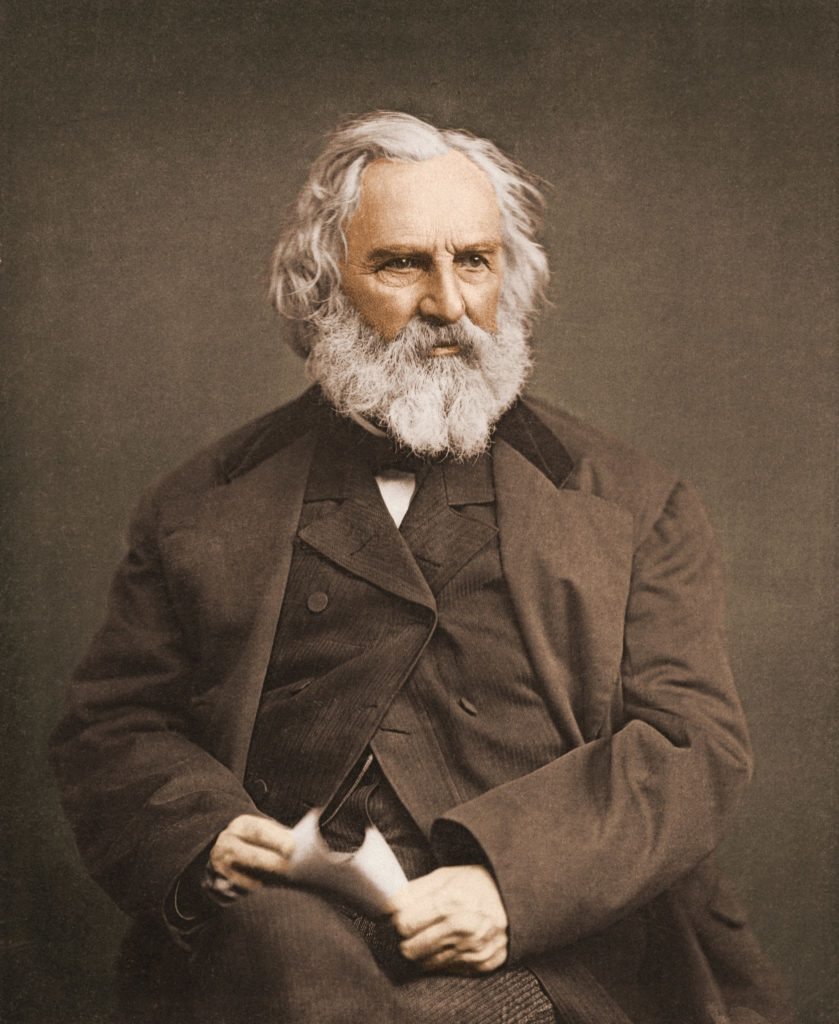
Colorized photograph of American poet, Henry Wadsworth Longfellow (1807 – 1882), late 1800s (photo by Stock Montage/Getty Images).
Further discussion of Henry Longfellow’s medievalism in “The Saga of King Olaf” centered on some of the subsequent sections will be featured in a blog later this spring, so check back soon!
Richard Fahey, Ph.D. Medieval Institute University of Notre Dame
Works Cited:
Atwood, Margaret. The Handmaid’s Tale. McClelland and Stewart Houghton Mifflin Harcourt, 1985.
Boccaccio, Giovanni. The Decameron, trans. by John Payne. The Villon Society, London, 1886.
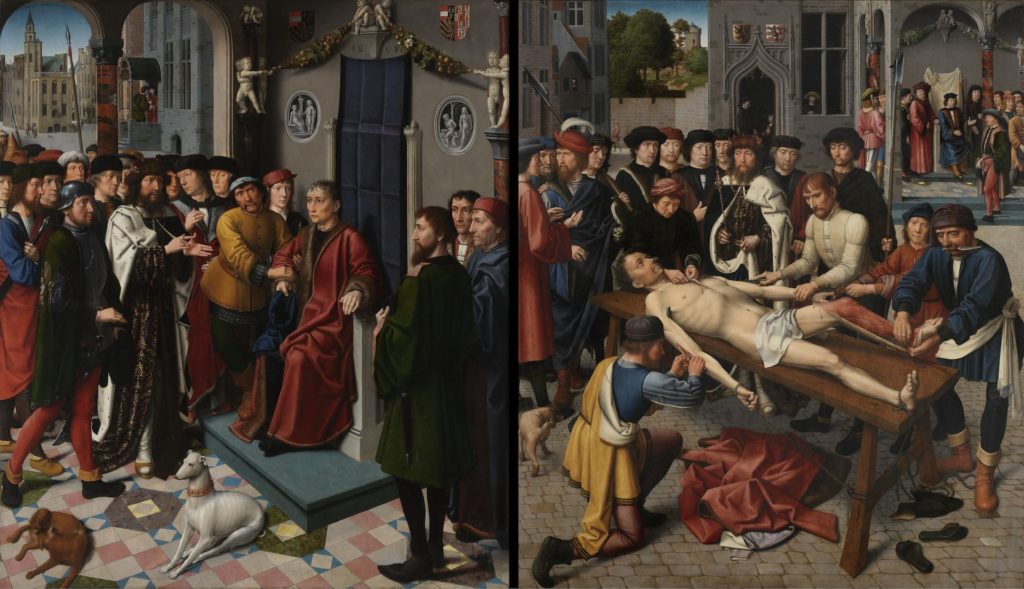
Gerard David’s painting The Judgment of Cambyses was placed in the town hall of Bruges at the end of the fifteenth century. This diptych graphically depicts a gruesome tale from Herodotus in which King Cambyses II ordered a corrupt judge named Sisamnes to be flayed alive and the detached skin draped over his chair, as seen in the background of right panel. The image and its placement were part of the tradition of exempla iustitiae, providing moral lessons (or warnings) to urban administrators through images from legend and history.[1] As a late medieval alderman, one should strive for impartiality so that one does not end up in Sisamnes’s position!
Gerard David, The Judgement of Cambyses, Groeninge Museum, Bruges, Belgium.
To my knowledge, no corrupt judges were even flayed alive in Bruges. Nor did the judges themselves ever sentence anyone to be flayed. However, rituals of bodily punishment could still involve visual spectacle. In 1488, around the time the town commissioned this painting and in the midst of a revolt against the Holy Roman Emperor Maximilian I (himself briefly imprisoned in the city), Bruges executed several high-ranking officials who had been loyal to Maximilian. Some suggest that the likeness of one such official, Pieter Lanchals, appears in this painting as Sisamnes.[2] Although the real Pieter Lanchals was not flayed, his decapitated head was displayed on the city gates.[3]
A rebellious city displaying the decapitated head of a detested politician fits well into popular stereotypes about the brutality of medieval justice. But was this representative of everyday judicial practice in Bruges and other Flemish cities in the fifteenth century? My research project is interested not in the infamous executions of political figures, or the iconography of imagined justice, but instead, ordinary judicial procedures and quotidian violence.
Late medieval cities in Flanders did practice capital punishment, but relatively few criminal cases ended at the gallows. Instead of bodily punishments, the urban aldermen who served as judges sentenced many of those who most passed through their courts to fines, temporary banishments, or penitential pilgrimages.[4] Medieval justice was characterized by multiple routes of resolution and not all disputes ended in this type of formal sentence. Many cities had designated legal officials who helped disputing parties negotiate peace agreements, both temporary and perpetual. In the Low Countries, formal reconciliations (called verzoening) culminated in a ceremony where both sides swore friendship, resolving enmity even after a feud had escalated to homicide.[5]
Additionally, many cases did not end up before an urban court because a composition payment halted the prosecution.[6] A composition payment was a type of financial settlement that bailiffs accepted from a suspect on behalf of the state in exchange for not bringing formal charges against them. The amount of this payment varied because it depended on a negotiation between the bailiff and the suspect. Composition could resolve a wide variety of offenses, including those eligible for capital punishment. Homicide cases, in fact, appear in records of bailiff composition far more often than they do in records of execution.[7]
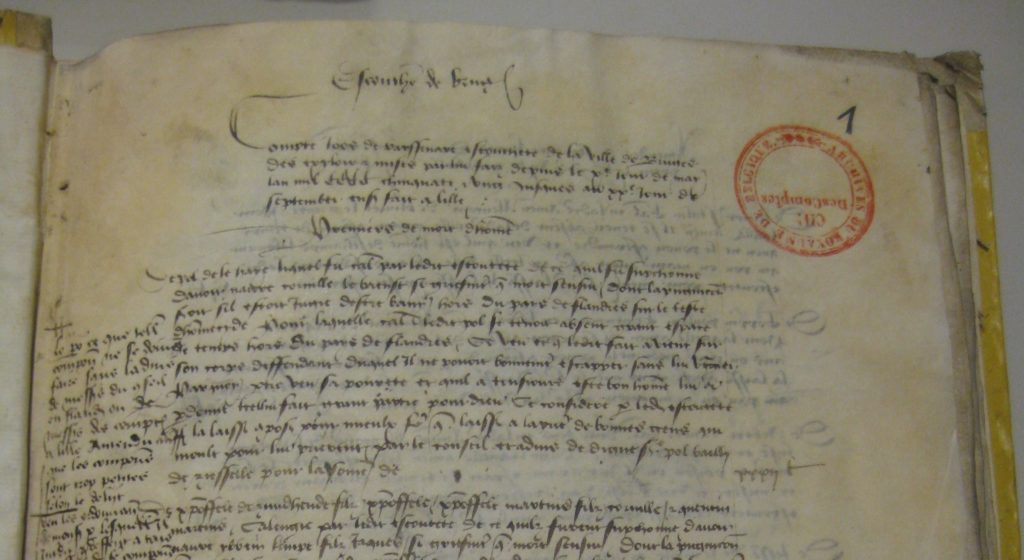
A successful composition payment for homicide depended on several factors: the good reputation of the accused, the context of the killing (self-defense or revenge), the bad behavior of the victim (he started it), and, most importantly, that peace had been made with the family of the victim. In 1451 in Bruges, the bailiff (called the schout in Bruges) accepted a composition payment of 32 livres from Pol de le Haye because “he was suspected of having injured Cornille le Baenst so grievously that death ensued”. The record notes that if convicted the punishment would have been banishment on pain of death. However, an agreement to pay a composition payment was reached because the event “happened in defense of his body from which he could not easily escape without avenging himself” and the opposing party forgave him “in view of his poverty and because he had always been a good man.”[8]
Bailiff account from Bruges, May 10, 1451 – September 20, 1451.
At the end of the fifteenth and beginning of the sixteenth centuries, these patterns were changing, and composition payments and peace agreements gradually lost their importance in Flemish urban justice.[9] The more “medieval” practices that emphasized negotiation and peacemaking were gradually edged out by formal judicial procedures more oriented towards punishment than reconciliation. My book project, The Invention of Homicide, examines this transition and shows how changing cultural perceptions of honor, killing, and the common good contributed to the rise of early modern punitive justice. Though the flaying of Sisamnes was allegorical and not representative, the painting was created in a time when judicial spectacle was beginning to play a larger role in everyday legal practice.
Mireille J. Pardon, Ph.D. Mellon Junior Faculty Fellow Medieval Institute
[1] Hugo van der Velden, “Cambyses for Example: The Origins and Function of an exemplum iustitiae in Netherlandish Art of the Fifteenth, Sixteenth and Seventeenth Centuries,” Simiolus 23, no. 1 (1995): 5-62.
[2] Helene E. Roberts, ed. Encyclopedia of Comparative Iconography: Themes Depicted in Works of Art (New York: Routledge, 1998), 457.
[3] Marc Boone, “La justice en spectacle. La justice urbaine en Flandre et la crise du pouvoir « bourguignon » (1477-1488),” Revue historique 625, no. 1 (2003): 59-62.
[4] Ellen E. Kittell, “Travelling for Atonement: Civilly Imposed Pilgrimages in Medieval Flanders,” Canadian Journal for Netherlandic Studies 31, no. 2 (2010): 21-37; Marc Boone, “Mécanismes de contrôle social: pèlerinages expiatoires et bannissements,” in Le prince et le peuple : Images de la société du temps des ducs de Bourgogne 1384-1530, ed. Walter Prevenier (Amsterdam: Fonds Mercator, 1998), 287-293.
[5] Hans de Waardt, “Feud and Atonement in Holland and Zeeland: From Private Vengeance to Reconciliation under State Supervision,” in Private Domain, Public Inquiry: Families and Life-styles in the Netherlands and Europe, 1550 to Present, ed. Anton Schuurman and Pieter Spierenburg (Hilversum: Verloren, 1996), 15-38.
[6] Guy Dupont, “Le temps des compositions. Pratiques judiciaires à Bruges et à Gand du XIVe au XVIe siècle (Partie I),” in Préférant miséricorde à rigueur de justice: Pratiques de la grâce (XIIIe-XVIIe siècles), ed. Bernard Dauven and Xavier Rousseaux (Louvain-la-Neuve: Presses universitaires de Louvain, 2012), 53-95.
[7] Mireille Pardon, “Necessary Killing: Crime, Honour, and Masculinity in Late Medieval Bruges and Ghent,” in Patriarchy, Honour, and Violence:Masculinities in Premodern Europe, ed. Jacqueline Murray (Toronto: Centre for Renaissance and Reformation Studies, 2022), 71-91.
[8] Archives générales du Royaume, Chambres des comptes, 13776, f. 1r.
[9] Mireille Pardon, “Violence, The Nuclear Family, and Patterns of Prosecution in Late Medieval Flanders,” Medieval People 37, no. 1 (2022): 37-59.