Imagining the Medieval Bestiary

Medieval bestiaries, which flourished during the twelfth and thirteenth centuries, particularly in England, are compendia of brief descriptions of various animals (sometimes plants and stones are included as well), which offer moral or allegorical lessons, and are often colorfully illustrated.

Basic modern definitions often suggest a sort of binary, ontological taxonomy for the creatures in these texts: bestiaries feature โ€œrealโ€ animals (or โ€œactualโ€ or โ€œfactualโ€ ones, such as dogs, crocodiles, beavers, and elephants), but also โ€œimaginaryโ€ ones (or โ€œmythical,โ€ โ€œlegendary,โ€ or โ€œfabulousโ€ ones, etc., such as unicorns, phoenixes, and manticores).
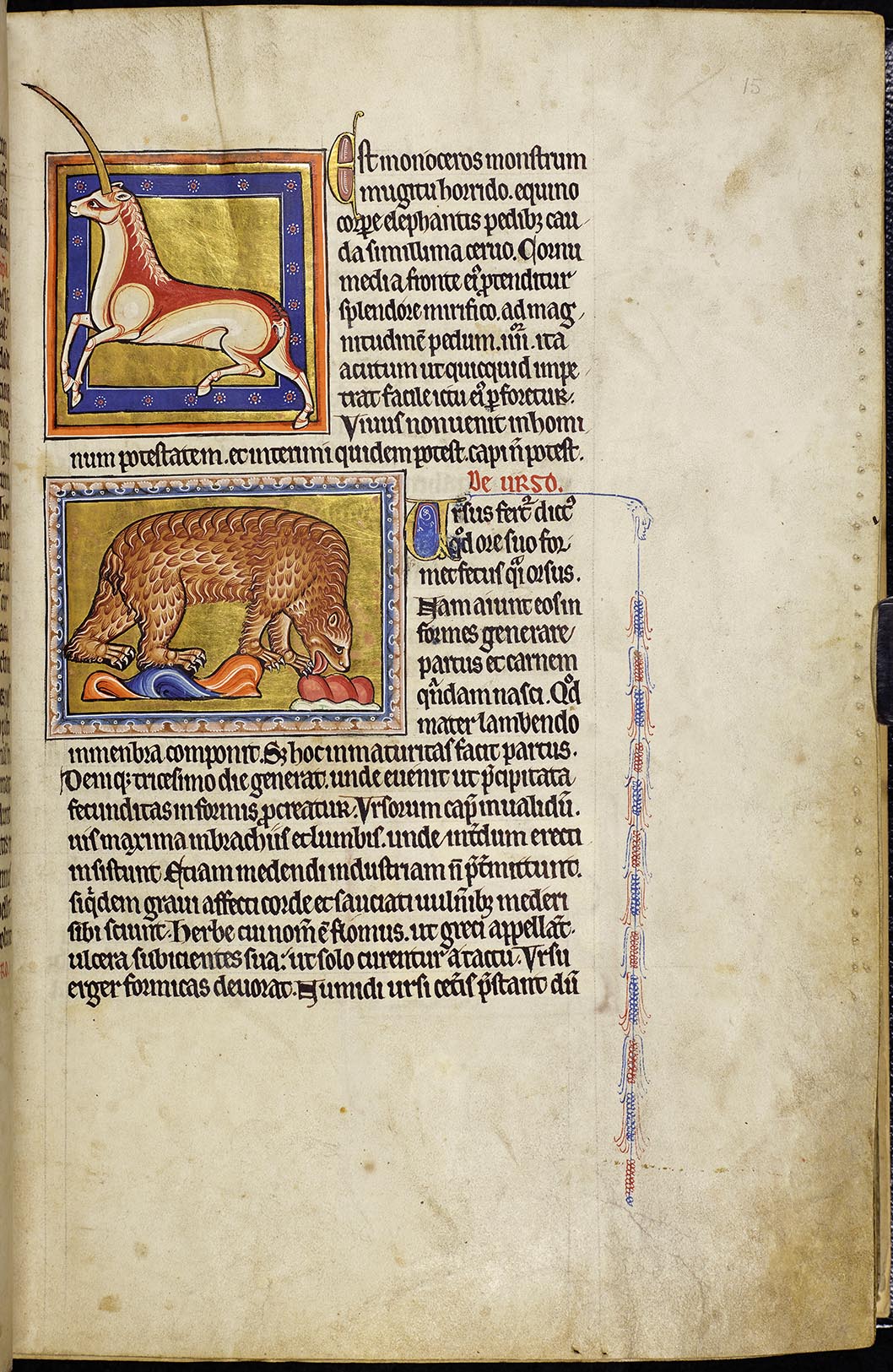
Unicorn from Aberdeen Bestiary (Aberdeen, Aberdeen University Library MS 24, f15r).

Bestiaries themselves donโ€™t appear to distinguish between โ€œrealโ€ and โ€œimaginaryโ€ animals, in terms of the arrangement of entries or the way that creatures from these two categories are verbally described or artistically depicted;[1] the distinction is a modern and anachronistic one. Furthermore, bestiariesโ€™ inclusion of hard-to-believe anecdotes about well-known creatures who actually do exist (e.g., the stagโ€™s alleged habit of drowning snakes) renders the boundary between โ€œrealโ€ and โ€œimaginaryโ€ animals, as we might consider it, less firm in these texts. At stake in the discourse of the โ€œrealโ€ versus the โ€œimaginaryโ€ in bestiaries is our view of medieval thinkers.

One approach to the โ€œimaginaryโ€ animals in bestiariesโ€”a very old approach to interpreting mythical creatures, in factโ€”is rationalistic: positing that even the legends have some basis in reality, and that real animals were, through a combination of misunderstanding and literary transmission, rendered (almost) unrecognizable. Notable proponents of this view in modern times have included T. H. White (1954), and more recently, zoologists Wilma George and Brunsdon Yapp (1991).
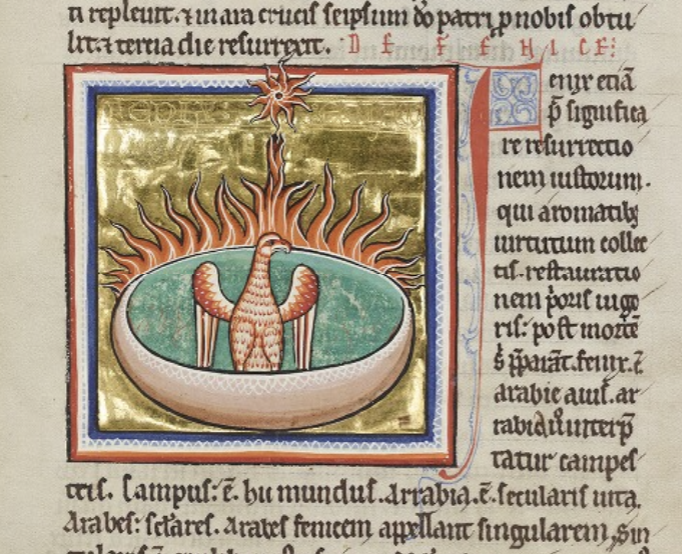
Phoenix from Ashmole Bestiary (Oxford, Bodleian Library, MS Ashmole 1511, f68r).

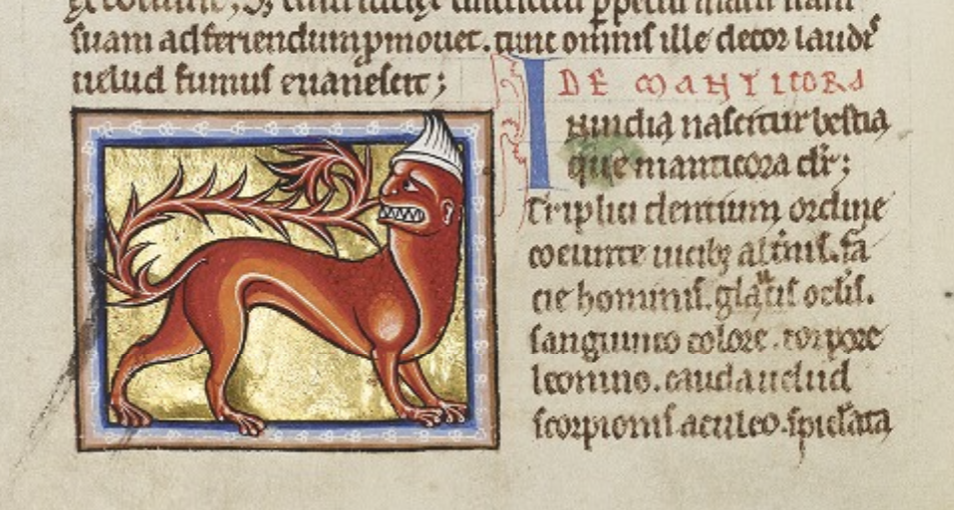
Bestiaries, for these scholars, can be read as works of natural history, albeit flawed ones, and we should perhaps extend some generosity to their creators, in light of the limitations of their knowledge. George and Yapp characterize the bestiary as โ€œan attempt, not wholly unsuccessful or discreditable for the time at which it was produced, to give some account of some of the more conspicuous creatures that could be seen by the reader or that occurred in legends.โ€[2] They suggest, for instance, that the manticoreโ€”described in bestiaries as a creature with a manโ€™s face, a lionโ€™s body, three rows of teeth, and a tail like a scorpion stingerโ€”was based on the cheetah; that the unicorn could actually be an oryx; and that the half-human, half-fish siren could be a Mediterranean monk seal.

Reading bestiaries as genuine, sometimes highly faulty attempts at something comparable to modern natural history is not a popular position amongst medievalist scholars of bestiaries. However, the idea of bestiaries as failed pre-modern zoology lingers in some sources aimed at popular audiences. The entry on bestiaries in the Encyclopaedia Britannica, for example, claims that the โ€œfrequently abstruse storiesโ€ in these works โ€œwere often based on misconceptions about the facts of natural history.โ€

Manticore from Ashmole Bestiary (Oxford, Bodleian Library, MS Ashmole 1511, f22v).

As for the ontological status of โ€œimaginaryโ€ bestiary creatures to medieval readers, i.e., whether they believed unicorns, etc. actually existed, this is hard to ascertain, and perhaps of less interest to many scholars than the prospect of examining the messages these rich works articulate on their own terms. Still, the unsupported assertion that bestiary stories were โ€œgenerally believed to be trueโ€ in the Middle Ages, as the Wikipedia page for bestiaries claims, is very much in line with widespread perceptions of the period.

It is an appealing contemporary fantasy, not so much to believe in dragons or unicorns, but to believe that people really believed in them, onceโ€”a sort of vicarious experience of enchantment, accomplished not simply by imaginatively engaging with medieval works that depict fantastic animals, but by imagining more credulous medieval readers, and perhaps even by imagining oneself in their place.
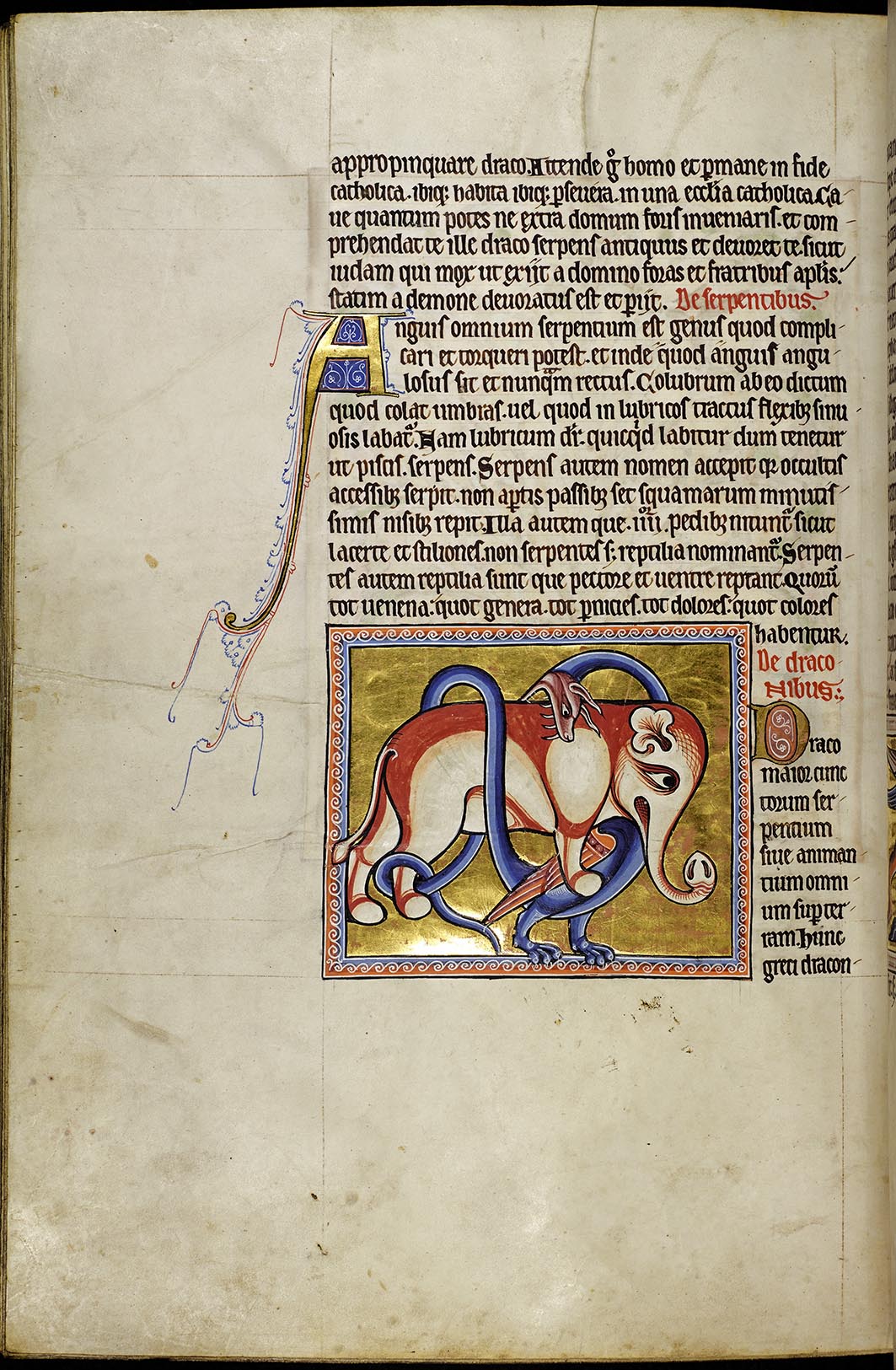
Dragon from Aberdeen Bestiary (Aberdeen, Aberdeen University Library MS 24, f65v).

To take both โ€œrealโ€ and โ€œimaginaryโ€ bestiary creatures as the texts present themโ€”not seeking to sieve the factual from the fabulous, not seeking an ordinary, well-known animal behind the remarkable verbal and visual depictions that bestiaries offerโ€”allows for, amongst other things, a certain defamiliarization of the natural world we inhabit.

Playing on the fertile ambiguities of bestiary accounts is a project by The Maniculum (a podcast series which brings together medieval texts and modern gaming, co-hosted by E. C. McGregor Boyle, a PhD Candidate at Purdue University, and Zoe Franznick, an award-winning writer for Pentiment). On the Maniculum Tumblr, readers are offered โ€œanonymizedโ€ selections from the Aberdeen Bestiary (i.e., the name of the animal being described is replaced with a nonsense-word to disguise its identity). Contributors are invited to create artwork inspired by the bestiary description itself, rather than their knowledge of what the animal is โ€œsupposedโ€ to look like. The results are diverse; the โ€œhyenaโ€ entry, for instance, yielded representations of creatures resembling everything from pigs to predatory snails, in a wide range of styles.
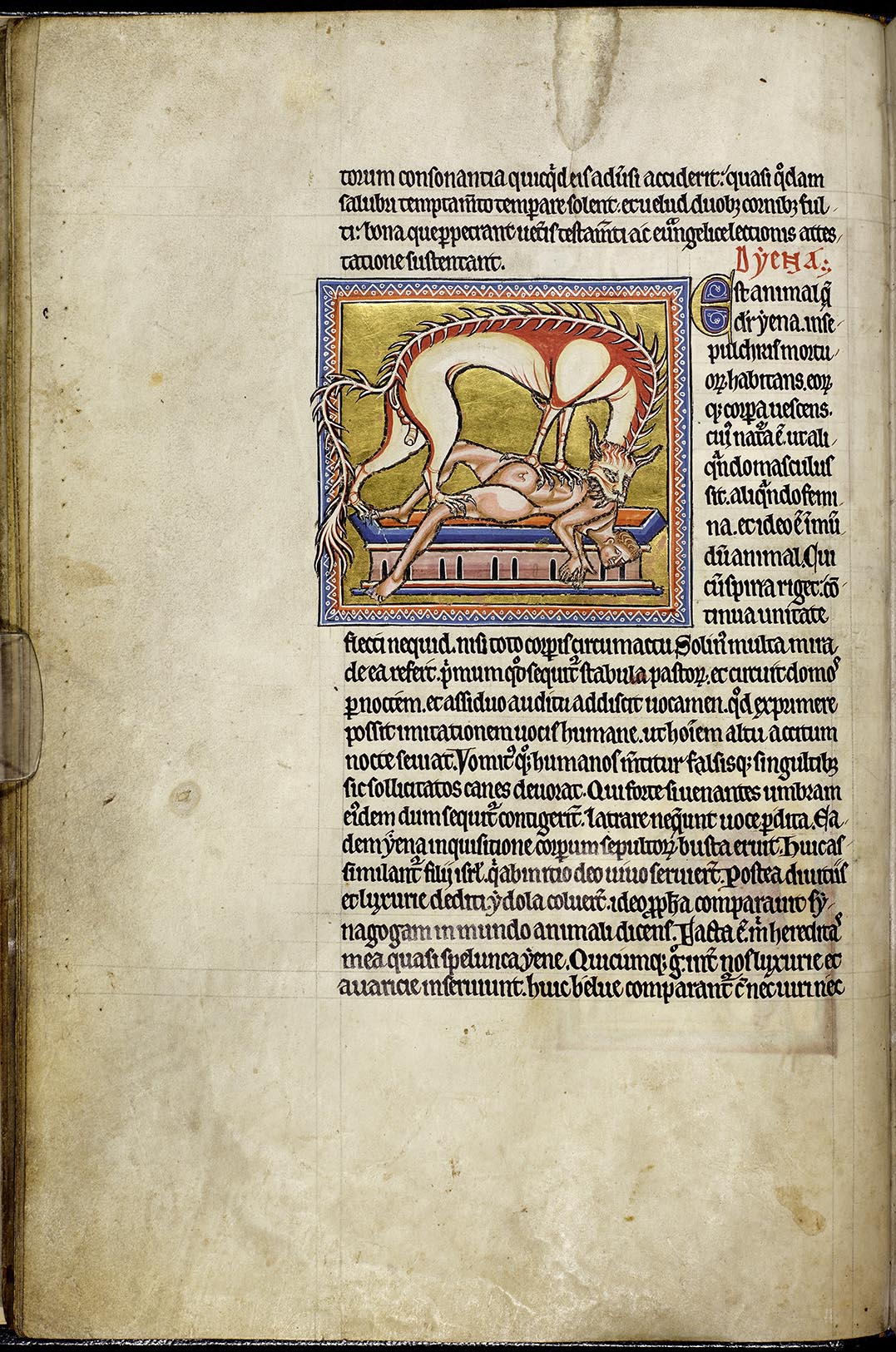
Hyena from Aberdeen Bestiary (Aberdeen, Aberdeen University Library MS 24, f11v).

Bestiaries continue to fascinate and inspire, centuries after their creation. Below are some medieval bestiary facsimiles and related resources to explore:

  • The Aberdeen Bestiary (Aberdeen, Aberdeen University Library MS 24), written and illustrated in England ca. 1200. Digital facsimile, accompanied by commentary, and Latin transcriptions and modern English translations of each folio.
  • The Ashmole Bestiary (Oxford, Bodleian Library, MS Ashmole 1511), early 13th century, England, possibly derived from the same exemplar as the Aberdeen bestiary. Digital facsimile.
  • The Worksop Bestiary (New York, Pierpont Morgan Library, MS M.81), ca. 1185, England. Digital facsimile.
  • The Medieval Bestiary: Animals in the Middle Ages, a website on bestiaries by independent scholar David Badke. Includes indices of bestiary creatures, cross-referenced with manuscripts and relevant scholarship, as well as galleries of medieval illustrations.
  • Into the Wild: Medieval Books of Beasts, YouTube video by The Morgan Library & Museum.

Linnet Heald
PhD in Medieval Studies
University of Notre Dame


[1] Pamela Gravestock, โ€œDid Imaginary Animals Exist?โ€ in The Mark of the Beast: The Medieval Bestiary in Art, Life, and Literature, ed. Debra Hassig (New York: Garland, 1999), 120.

[2] Wilma George and Brunsdon Yapp, The Naming of the Beasts: Natural History in the Medieval Bestiary (London: Duckworth, 1991), p. 1.

Discussing Donkeys in Lion-suits with Dr.ย Linnet Heald

This month we chat with Dr.ย Linnet Heald [Emily Mahan], who recently received her PhD from Notre Dame’s Medieval Institute. We talked with her about the power of medieval fables, the value of a postdoctoral fellowship, and how writing poetry led her to writing creatively in her dissertation.

Speaking with Dr. Healdย this month was illuminating. Her research demonstrates the breadth of Medieval Studies, drawing from animal studies, literary criticism, manuscript studies (though perhaps less than she initially expected!), and linguistics. Yet again, the researchers that we speak to remind us that to be a medievalist can mean so many different things. Dr. Healdย brings a unique historical perspective to animal studies, drawing on Classical and medieval texts to try and discover more about animals and our relationship with them. Medievalists donโ€™t need to be isolated from other disciplines or scholars of other periods. The humanities enriches itself when walls are kept low and gates kept open; scholars can benefit from meeting in the middle.

Dr. Healdย spoke about her passion for creative writing, and her route into Medieval Studies through an MFA. Though we rarely talk about it as such, a dissertation is as much a creative piece as poetry or prose. You need to be able to tell a story, albeit one rooted firmly in the evidence. Dissertating is creative writing, even if we have to think about time constraints and deadlines. Dr. Heald’s decision to pursue a Medieval Studies PhD was not a shift away from creativity. Far from it. In those days when writing feels like a grind and the ideas just arenโ€™t coming, weโ€™ll think about her experiences and allow ourselves to get a little creative.ย 

Thanks for listening. See you next time in the Middle Ages.

Will Beattie & Ben Pykare
Medieval Institute
University of Notre Dame

Aรพum Swerian: Swearers of Oaths?

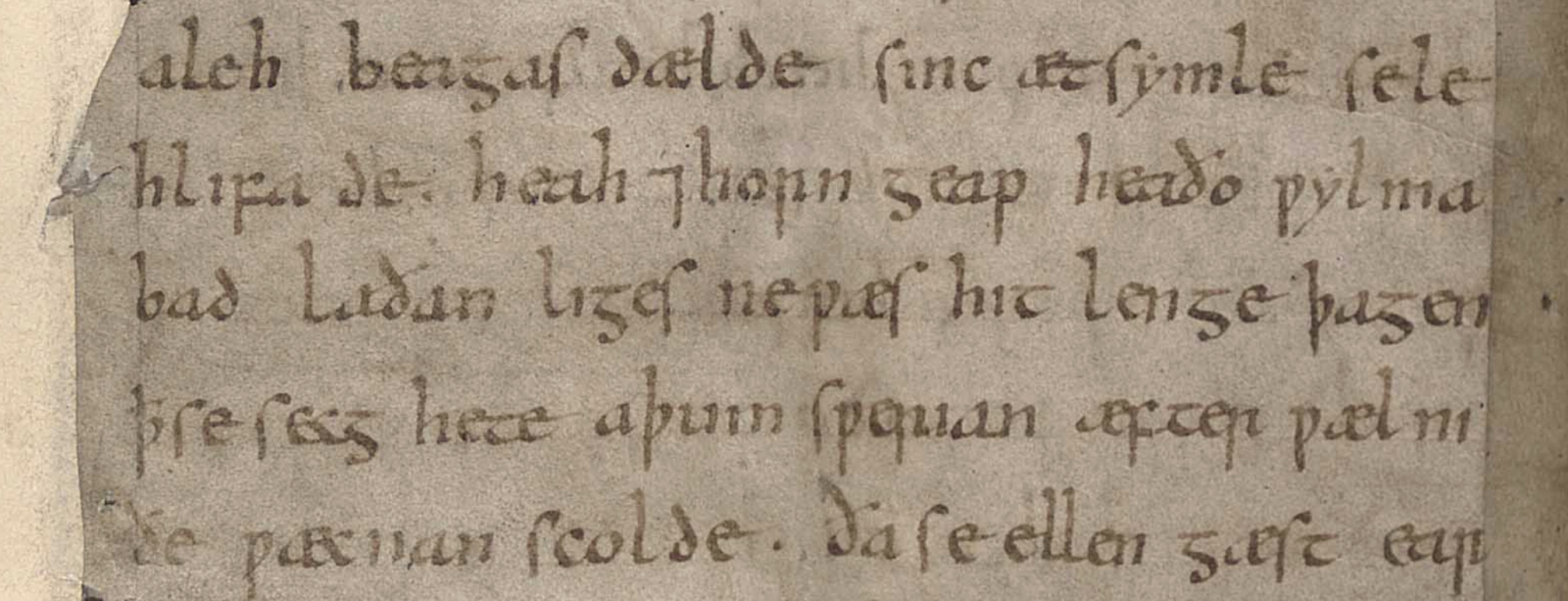
Beowulf is a story about a doomed people who are destined for annihilation as a result of depredation, feuding, and cyclical inter-tribal violence. Yet, the violence described in the poem is not always outward but often occurs from within, as acts of intra-tribal violence frame much of the narrative. Even seemingly positive events are thus generally short-lived. Accordingly, in the eminence of King Hrothgar’s glorious construction of Heort, the narrator reveals the hall’s imminent doom:  

Sele hlifade  
heah ond horn-geap.   Heaรฐo-wylma bad
laรฐan liges.                Ne wรฆs hit lenge รพa gen  
รพรฆt se ecg-hete aรพum swerian 
รฆfter wรฆl-niรฐe wรฆcnan scolde. (81-5)

The hall sheared upward, high and horn-vaulted. For the battle-surge it waited, loathsome fire. Nor was it long before the edge hate of aรพum swerian must awaken for slaughter-spite.

Beowulf Manuscript, excerpt with aรพum swerian.โ€ BL, Cotton Vitellius a.vx. MS 130v, BL 133v.

This dire prediction identifies the causal agents of disaster as aรพum-swerian. But given that this term is unattested and grammatically invalid, we are bound to ask: Who are these aรพum-swerian? The conventional approach solves this conundrum by creating a new term in imitation of such copulatives as suhtergefaedaran (โ€œnephew and uncleโ€ from Beowulf), gisunfader (โ€œson and fatherโ€ from Heliand), and sunufatarungo (โ€œson and fatherโ€ from Hildebrandslied). Following these models, the editors of Klaeber 4 (120, 350, 437) emend the term to aรพum-sweoran, thereby conjoining aรพum (sons-in-law) and sweoran (fathers-in-law). Because this solution apparently predicts the sundering of vows between Ingeld and Hrothgar (2022-66), this emendation has become the dominant convention. 

Nevertheless, there are problems. First, the emended term, glossed as โ€œsons-in-law and fathers-in-law,” differs markedly from the models, which are glossed as โ€œnephew and uncleโ€ and โ€œson and father.โ€ And though the term aรพ is indeed attested with the gloss โ€œson-in-law,โ€ the rendering aรพum-sweoran is a hapax legomenon attested nowhere in the extant corpus of Old English literature. Making the invention yet more suspect is the well-attested phrase, sweor ond aรพum (father-in-law and son-in-law), which would seem to preclude a need for the copulative. 

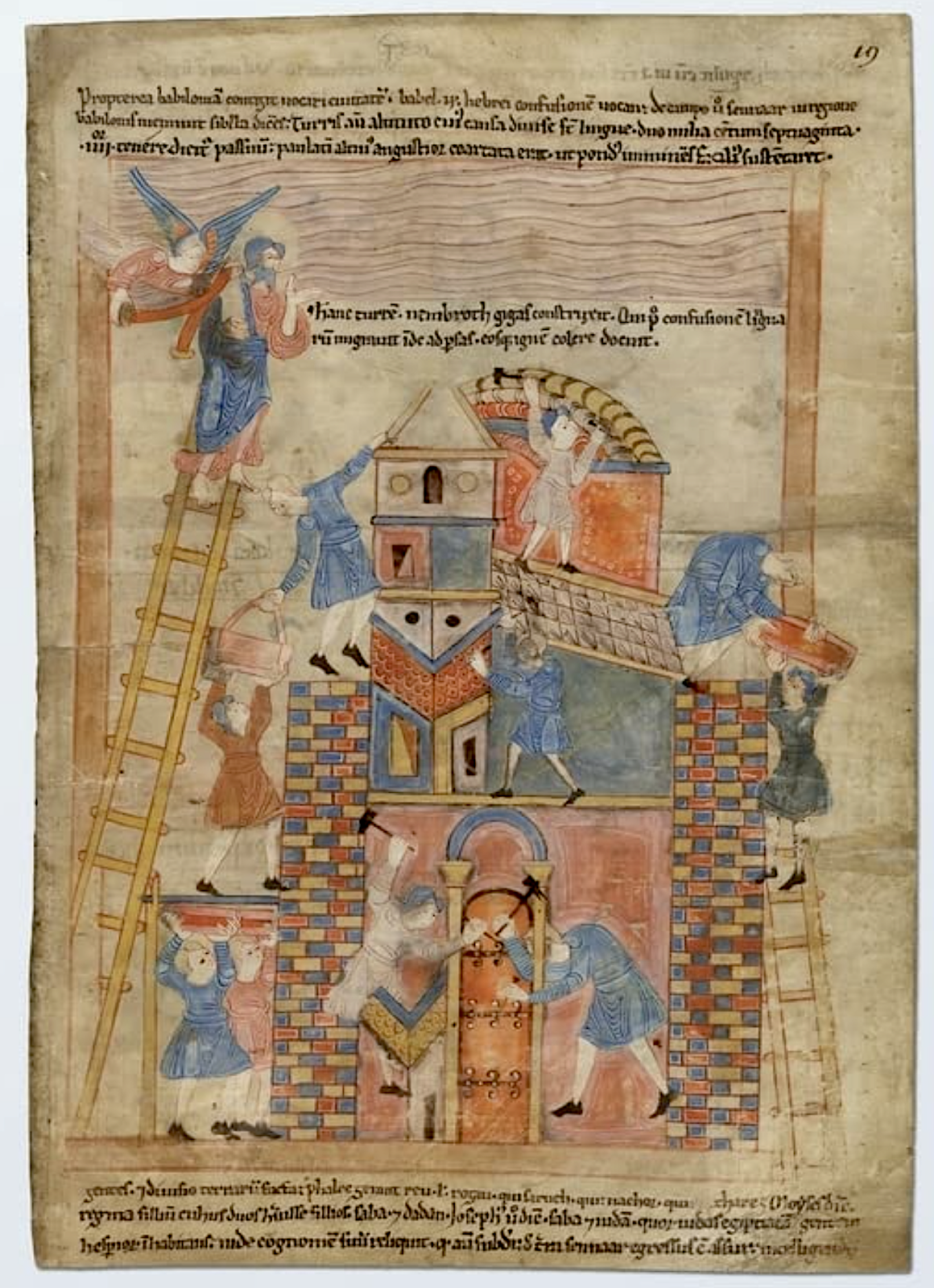
The proposed term also falls short in its narratological salience. There are no โ€œsons-in-lawโ€ implicated in the violence that erupts at Ingeldโ€™s wedding, only one โ€œson-in-law.โ€ Yet more problematic, this single crisis cannot account for the apocalyptic imagery that frames Heorotโ€™s catastrophe. Prior to the prediction of calamity, the hall’s construction is marked by an array of tropes that suggest the Tower of Babel. As Tristan Major observes, โ€œHrothgarโ€™s rise to power [64-79] and the building of his hall, Heorot, echoes Nimrod and the Tower of Babelโ€ (242).โ€ Likewise, as Daniel Anlezark observes, the hall’s destruction is marked by retributive images of Flood and Hellfire (336-7). In sum, the proposed solution leaves important problems unresolved. It inaccurately predicts “sons-in-lawโ€ in respect to Ingeld. And it does not account for the apocalyptic imagery of idolatry, flame, and fire that marks Heorot’s doom.

The Tower of Babel. London, British Library, Cotton Claudius B.IV, fol 19r. 

In this review, we promote an alternative initially proposed by Michael Alexander. This alternative interprets aรพum as the plural dative โ€œoathsโ€ and emends swerian to the plural dative -swaran (swearers). The rendering โ€œswearers of oaths,โ€ acknowledged by Klaeber 4 as possible, has the advantage of relying on attested terms. The plural dative form aรพum (oaths) occurs not only in the corpus but also in Beowulf, and the second term (-swara) occurs in a similar compound, man-swaran (criminal swearers). Yet more support for this construct can be found in the oath-swearing between Hengest and Finn. Here the term aรฐum also occurs as a plural dative, framing a parallel scenario in which oaths will be broken and a hall destroyed:

Fin Hengeste
elne, unflitme aรฐum benemde
รพรฆt he รพa wealafe weotena dome 
arum heolde, รพรฆt รฐรฆr รฆnig mon 
wordum ne worcum wรฆre ne brรฆce . . . .  (1097-100)

“Fin with Hengest without quarrel declared his oath that he would by his councilโ€™s judgment hold [the truce] with honor that any man there by word or deeds should not break the covenant . . . .”

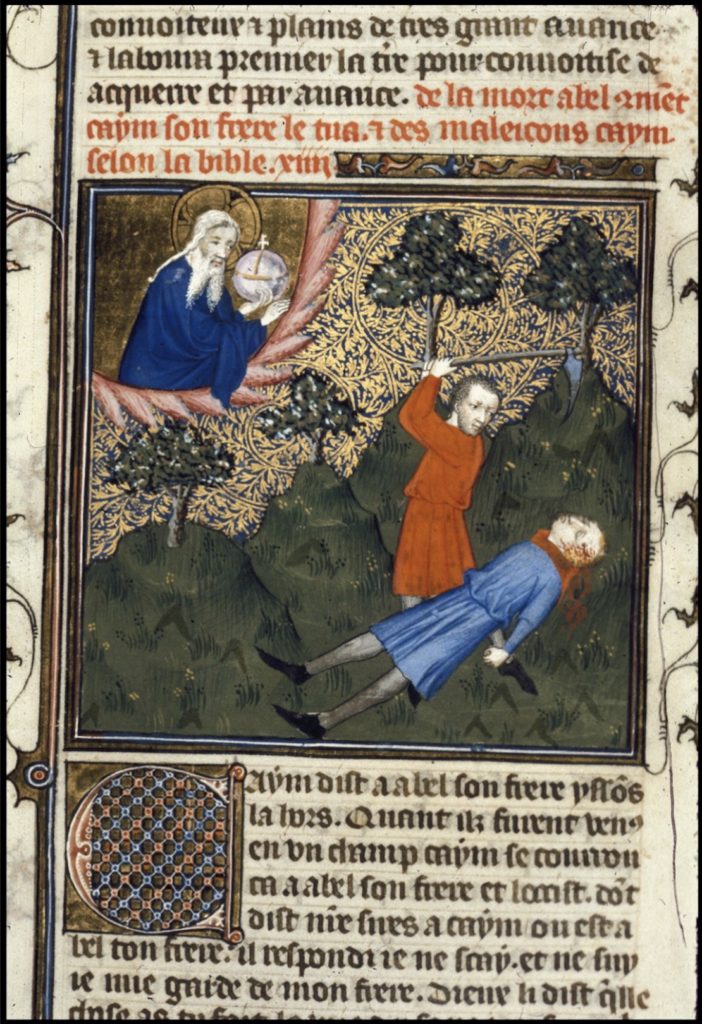
The emendation to aรพum-swaran also offers much stronger alignment with the narrative arc. Notably, this alignment begins with the paired disclosures that define Fitt I: Whereas the history of Grendelโ€™s origin locates Cainโ€™s act of murder as a calamity in the past, the prediction of murderous oath-swearers locates Heorotโ€™s destruction as a calamity in the future. This parallel design is highly significant: In effect, it forges a link between Cainโ€™s crime of kinship murder and the internecine violence that spells Heorotโ€™s doom. This linkage, moreover, not only intimates the Danesโ€™ ongoing state of iniquity but also explains the apocalyptic tropes that frame the hallโ€™s calamity. Accordingly, Heorotโ€™s doom emerges not as a circumstantial event caused by brawling Danes and Heathobards but as an in-kind retributive event that aligns perfidious Nordic warriors with the curse of exile from human joys, entailed in Cainโ€™s crime and punishment.

Cain killing Abel with a scythe. Bible Historiale. British Library, MS Harley 4381, f.10r, 1403-1404.

Notably, also, the intimation of Danish perfidy is borne out across the narrative arc. Beowulf and the narrator declare Unferthโ€™s fratricidal treachery; the narrator insinuates Hrothulfโ€™s possible resentment against his uncle, Hrothgar; the lay of Finn and Hildeburh recounts the Danesโ€™ violation of peace oaths in favor of murderous revenge; Hrothgarโ€™s adoption of Beowulf sparks Wealhtheowโ€™s resistance and her appeals to warriors in the hall; and Hrothgar violates his promise of protection to the Geats, potentially inciting Beowulfโ€™s revenge. This surfeit of Danish treachery, in other words, aligns perfectly with the narratorโ€™s revelation that โ€œswearers of oathsโ€ will soon incite violence.

For this reason, also, the reference to oath-swearers functions as a formula for suspenseโ€”a design that impels the audience to consider, in a fictive world replete with perfidy and oath-making, which of the oath-swearers will incite a conflagration? Will Unferth the fratricide murder again? Will Hrothulf avenge his displacement from the throne? Will one of the Danes retaliate against Hrothgarโ€™s covenant with Beowulf, the foreigner? Will Wealhtheow incite the same kind of intertribal violence that erupts in the Frisians’ hall? Will Beowulf retaliate against Hrothgar for deserting his men?

The emendation to aรพum-swaran presents a solution that is better attested and more meaningful than the conventional emendation to aรพum-sweoran. As noted above, the gloss of “sons-in-law” does not possess predictive value regarding Ingeld, and the sundering of vows between Ingeld and Hrothgar cannot explain the apocalyptic imagery surrounding the disclosure of Heorot’s doom. Conversely, that same apocalyptic imagery aligns perfectly with a depiction of Danish society as inherently unstable, doomed to self-destruction, as the unchecked impulses of egoistic aggrandizement overcome the covenants that bind social order. Likewise, the depiction of Danish perfidy permeates the narrative arc. Accordingly, the disclosure of violent oath-swearers functions within an ingenious narrative design. It affords the schadenfreude of dramatic irony, as the audience anticipates a disaster the characters know not of. And it thus generates a game of blind corners, in which the audienceโ€™s knowledge of impending violence from oath-swearers charges subsequent events with anticipation and suspense. 

Chris Vinsonhaler & Richard Fahey
Medieval Institute
CUNY University & University of Notre Dame


Selected Bibliography & Further Reading

Alexander, Michael. Beowulf: A Glossed Text.ย Penguin Classics, 1995.

Anlezark, Daniel. Water and Fire: The Myth of the Flood in Anglo-Saxon England. Manchester U Press, 2006.ย 

Major, Tristan. Undoing Babel: The Tower of Babel in Anglo-Saxon Literature. U Toronto Press, 2018.ย