Medieval Rabbits: Ancient Symbolism, English Migration, and Manuscript Marginalia

From its earliest recordings in African, Indian, and Egyptian cultures, the hare, which later became interchangeable with the rabbit, has been recognized as a symbol of generative powers.

In the ancient Greco-Roman world, the hare symbolized fertility, as well as love and lust. The hare was the favored sacrifice to the gods of love, Aphrodite and Eros.[1] Consumption of the animalโ€™s flesh was thought to enhance the beauty in the eater for several days. The animalโ€™s body was also incorporated into medicines meant to cure conditions connected with sex.
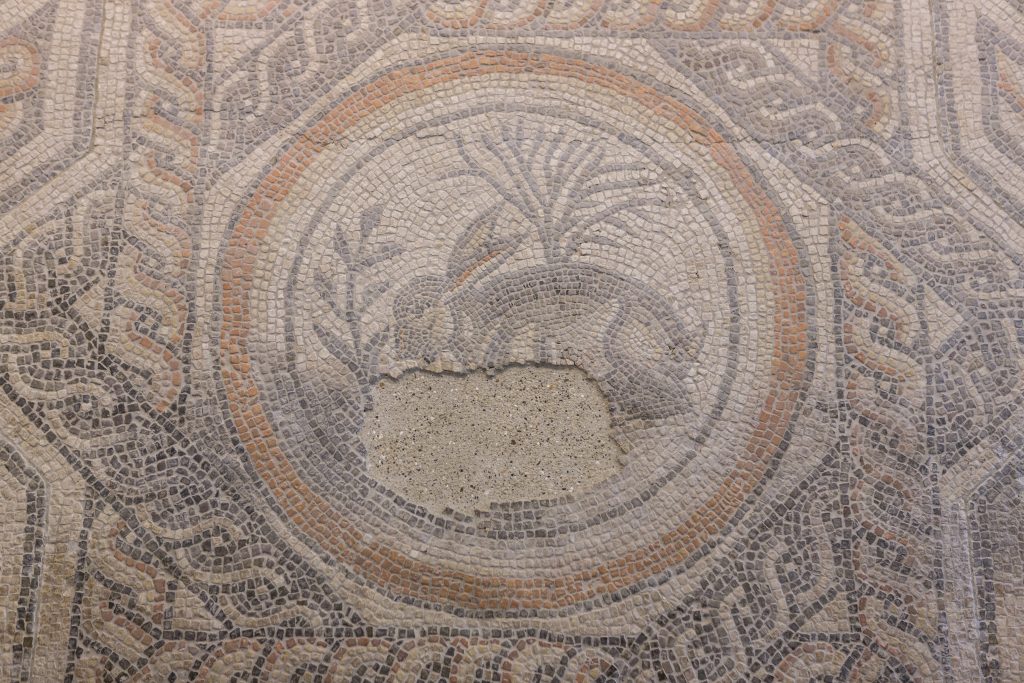
Roman mosaic depicting a hare, dated to the 4th century and discovered in Cirencester, England. The mosaic was excavated in 1971 and is housed at the Corinium Museum. Photo credit: Isobel Wilkes, โ€œHares in Roman Artโ€.

Hares and rabbits were known as prolific breeders, but the classical world often exaggerated the creatureโ€™s capacity for reproduction. Aristotle, for example, believed the rabbit was capable of superfetation โ€“ that is, he thought a pregnant rabbit could become pregnant again, thereby gestating multiple litters at once. These ideas persisted into the Middle Ages, passed down by Aristotle and other philosophers such as Herodotus, as well as Pliny the Elder.

In his Naturalis historia, written during the first century, Pliny the Elder characterizes hares and rabbits as the only animals that superfetate, โ€œrearing one leveret while at the same time carrying in the womb another clothed with hair and another bald and another still an embryo.โ€ He also discusses how wild rabbits laid waste to Spain. Describing their fertility as โ€œbeyond counting,โ€ he says that โ€œthey bring famine to the Balearic Islands by ravaging the crops.”[2]

England, however, did not share Spainโ€™s poor experience with rabbits. Although hares are indigenous to the British Isles, rabbits are not. They were introduced to England by the Normans in the 13th century and were raised for their meat and fur.[3] They were also kept as pets and were a particular favorite of nuns.[4]
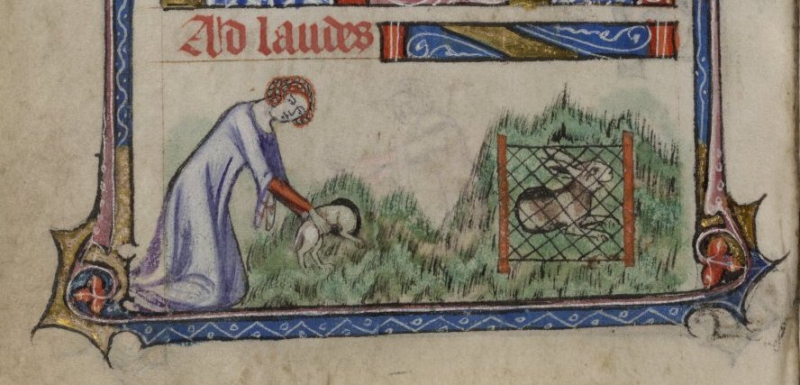
Woman flushes a rabbit from its warren using a ferret or a small dog in the Taymouth Hours, England, c. 1260, British Library, Yates Thompson MS 13, f. 70v.

Rabbits did not initially thrive in the British climate, and they required careful tending by their owners, who constructed warrens for them. As Mark Bailey explains, โ€œIn modern usage the rabbit-warren refers to a piece of waste ground on which wild rabbits burrow, but in the Middle Ages it specifically meant an area of land preserved for the domestic or commercial rearing of game.โ€[5] These artificial burrows called โ€œpillow-moundsโ€ protected domestic rabbits from the elements and provided a dry, earthen enclosure that supported both survival and breeding.  
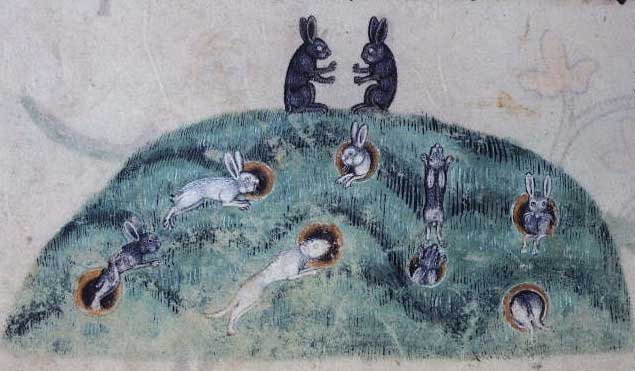
Rabbit warren depicted in the Luttrell Psalter, c. 1320-40, Lincolnshire, England, British Library, Add MS 42130, f. 176v.

Despite their modern reputation as pests, rabbit populations were primarily confined to privately owned warrens in medieval England. They were not considered vermin but, rather, valuable commodities, and they were protected by law. Poachers were a problem, as were the rabbitโ€™s natural predators, which included the fox, stoat, weasel, polecat, and wildcat.
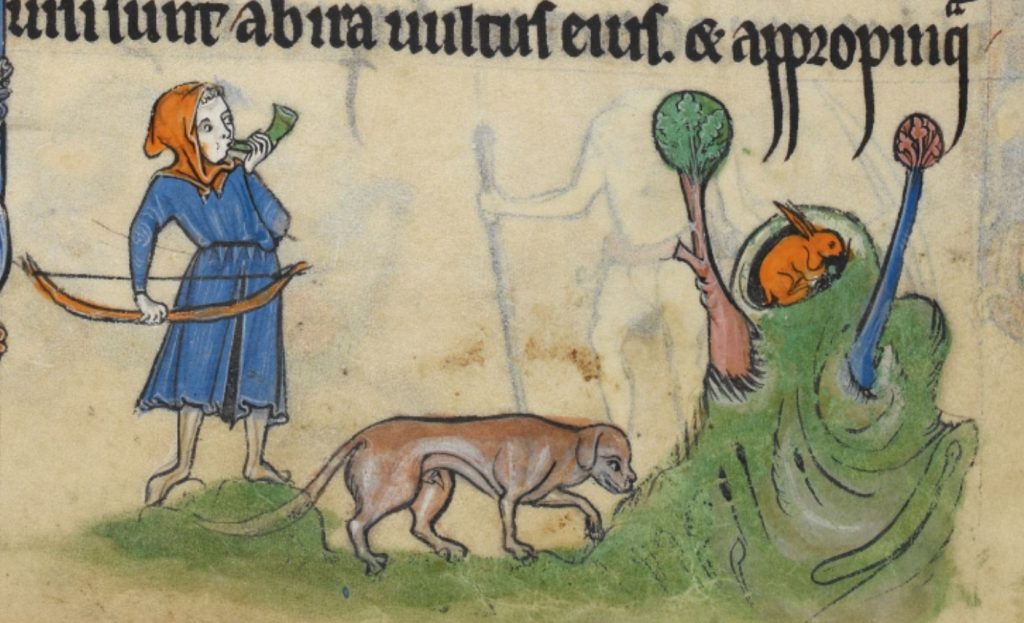
Hunter approaches a rabbit warren with his dog in the Rutland Psalter, c. 1260, England, British Library, Add MS 62925, f. 57v.

Yet in medieval English literature, rabbits retain their symbolic association with reproduction, as exemplified by Geoffrey Chaucerโ€™s Parliament of Fowls, a Middle English poem dated to the mid-14th century. Set in a garden during springtime, the poem centers a congregation of birds that meets to select their mates and explores themes related to love and marriage, as well as breeding.

Rabbits, or โ€œconyes,โ€ are depicted at play amidst the gathering of birds:  

On every bough the briddes herde I singe,
With voys of aungel in hir armonye,
Som besyed hem hir briddes forth to bringe;
The litel conyes to hir pley gonne hye. (Chaucer 190-93)[6]

I heard the birds on every branch singing
Like the voice of an angel in their harmony,
Some had their young beside them;
The little rabbits were busy at their play. (my translation)

Now virtually obsolete, the term coney was used in medieval England to differentiate an adult rabbit from a younger one. Deriving from the pun made possible by the Latin word for rabbit, cuniculus, and the Latin word for the female genitalia, cunnus, the term was also used as sexual slang in the medieval period and well beyond.[7] Essentially, coney, or cunny, was a crass term that referred to the vulva or vagina, to a woman or women, or to sexual intercourse.[8]
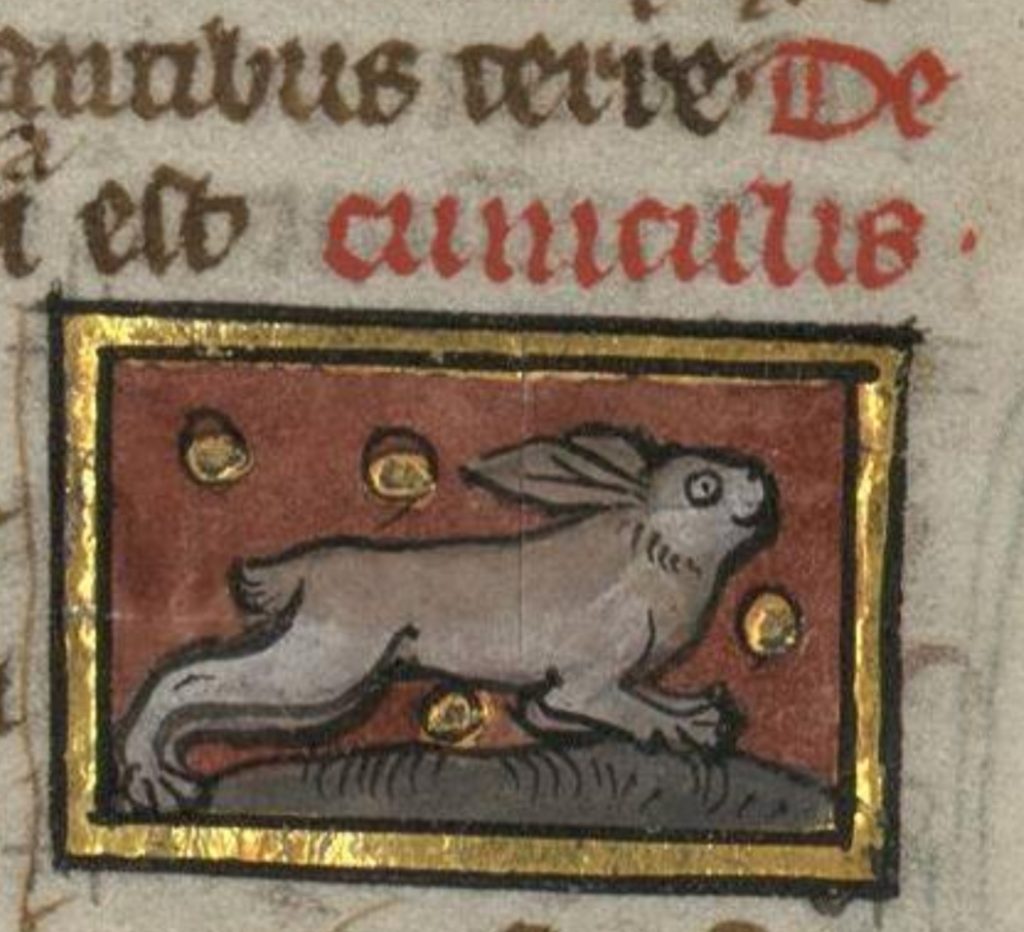
Bestiary rabbit catalogued under the Latin name cuniculus in the Liber de natura rerum, c. 13th century, France, Bibliothรจque Municipale de Valenciennes, MS 320, f. 58r.

Despite its long-standing sexual symbolism, the rabbit was simultaneously imparted with sacred symbolism in the Middle Ages. In England, the rabbit became a symbol of purity when portrayed alongside the Virgin Mary. The animal also functioned as a symbol of salvation. As David Stocker and Margarita Stocker explain, โ€œtheir sacred meaning is not as divorced from their profane meaning (libidinousness) as may at first appear. One the one hand, their symbolism of lust and fertility refers to the carnal body; on the other, their symbolism of salvation and resurrection refers to the โ€˜body of this deathโ€™ from which the soul is saved.โ€[9]

Indeed, the theologian and philosopher Saint Augustine, writing between 397 and 400 CE, connects the rabbit with Christianity, further attesting to how the animal’s sexual and spiritual symbolism culturally coexisted. Discussing the rabbit in relation to salvation, Saint Augustine renders the creature a symbol of cowardice. He describes the rabbit as โ€œa small and weak animalโ€ that is โ€œcowardlyโ€ and then draws a parallel between the rabbit and the fearful man: โ€œIn that which he fears, man is a rabbit.โ€[10] Later in the Middle Ages, the rabbit โ€œdenoted a soldier who burrowed underground or someone who fled from his pursuers.โ€[11]

Perhaps the rabbitโ€™s connection with cowardice, then, provides some insight into the images depicting bunnies as antagonistic and often murderous beasts in the margins of medieval manuscripts. Immortalized on screen by Monty Pythonโ€™s Rabbit of Caerbannog and more recently popularized on social media, the rabbit adopts many forms and runs rampant across the pages of manuscripts from England and Europe.
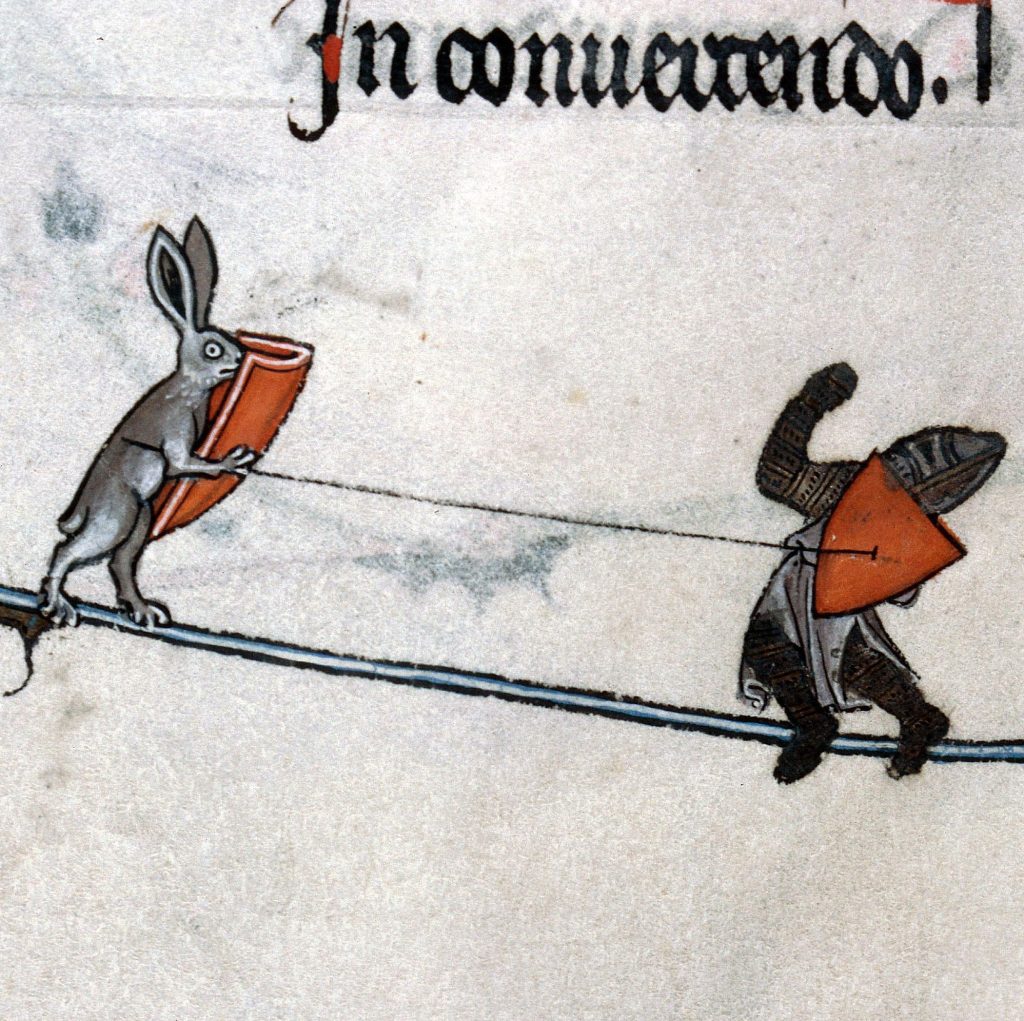
Rabbit strikes a knight with a lance in the Breviary of Renaud, c. 1302-05, France, Bibliothรจque municipale, MS 107, f. 141v.

Rabbits spar with knights, wield axes at kings, and lay siege to castles. They ride snails with human faces and carry hounds on their shoulders into battle. They beat, they behead, they hang, they flay. Ranging from delightfully strange to strangely sadistic, the images of rabbits enacting violence reveal a world turned topsy-turvy through their reversal of expectations.
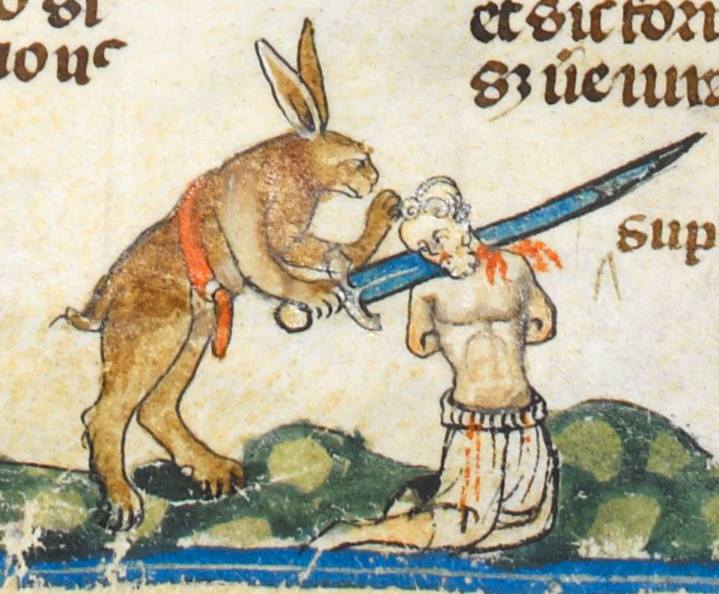
Rabbit beheads a man with a swordโ€”the final image in a series of five that features rabbits hunting, capturing, and killing a manโ€”in the Smithfield Decretals, c. 1340s, London, England, British Library, MS 10 E IV, f. 61v.

But medieval bunnies are not all bad. In bestiaries, they pose timidly in their portraits or express fear as they flee from hunting dogs. They frequently adorn decorative borders sans weapons and sometimes appear surprisingly realistic, as in the stunning illumination from the Cocharelli Codex below.
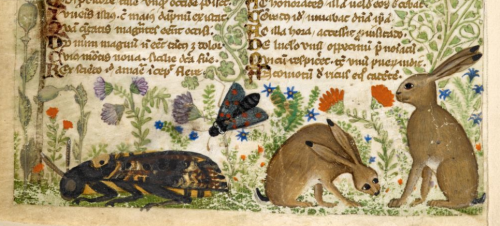
Pair of hares in the Cocharelli Codex, c. 1330-40, Genoa, Italy, British Library, Add MS 28841, f. 6v.

Although the killer coney and the cowardly knight have become a familiar motif, it is not a reflection of the rabbit population ransacking the English countryside, as some might be inclined to suspect. After all, wild rabbits did not become abundant until centuries later. But whether turning the world upside down or nestled benignly within a manuscript border, rabbits in medieval marginalia showcase their multifacetednous as an enduring and aptly inexhaustible cultural symbol.

Emily McLemore, Ph.D.
Alumni Contributor, Department of English


[1] Claude K. Abraham, โ€œMyth and Symbol: The Rabbit in Medieval France,โ€ Studies in Philology, vol. 60, no. 4 (1963), pp. 589-597, at 589.

[2] Pliny the Elder, Natural History, Loeb Classical Library, at 153.

[3] Mark Bailey, โ€œThe Rabbit and the Medieval East Anglian Economy,โ€ The Agricultural History Review, vol. 36, no. 1 (1988), pp. 1-20, at 1.

[4] Kathleen Walker-Meikle, Medieval Pets, Boydell Press (2012), pp. 14.

[5] Bailey, 2.

[6] Geoffrey Chaucer, Parliament of Fowls, http://www.librarius.com/parliamentfs.htm.

[7] Beryl Rowland, Animals with Human Faces: A Guide to Animal Symbolism, University of Tennessee Press (1973), pp. 135.

[8] cunny, n. Oxford English Dictionary.

[9] David Stocker and Margarita Stocker, โ€œSacred Profanity: The Theology of Rabbit Breeding and the Symbolic Landscape of the Warren,โ€ World Archaeology, vol. 28, no. 2, pp. 265-72, at 270.

[10] Stocker and Stocker, 271.

[11] Rowland, 135.

What the Wife of Bath Still Has to Teach Us

As a medievalist who is both interested and personally invested in the representation of womenโ€™s bodies, I am acutely aware of how our gendered ideology hearkens back to the Middle Ages. The ways in which the Canterbury Tales mirror contemporary discourse and practices around sexual violence are abundant, and though I know them well through my work with Chaucer, they remain alarming.

A sign outside a strip club near Denver, Colorado, an image that accompanied an article in The Guardian, dated December 3, 2017

Needless to say, I was hardly surprised when, in October of 2016, Sonja Drimmer and Damian Fleming described in a blog post to In the Middle the remarkable relevance of the Millerโ€™s Tale, in which Nicholas corners an unsuspecting Alisoun and grabs her by her genitals[i]:

โ€œAnd prively he caughte hire by the queynte,
And syde, โ€˜Ywis, but if ich have my wille,
For deerne love of thee, lemman, I spille.โ€™โ€[ii]

Used to describe Alisounโ€™s genitalia as โ€œa clever or curious device or ornament,โ€ the word โ€œqueynteโ€ employs both of its Middle English definitions, as it is simultaneously a โ€œpunningโ€ on a more modern derogatory term for the vaginal organs.[iii] That Alisoun โ€œsproong as a colt dooth in the traveโ€[iv] to escape Nicholasโ€™s hands on her vulva demonstrates that his fondling of her body is not only unexpected but also unwanted.[v] What Chaucerโ€™s narrative describes is sexual assault.

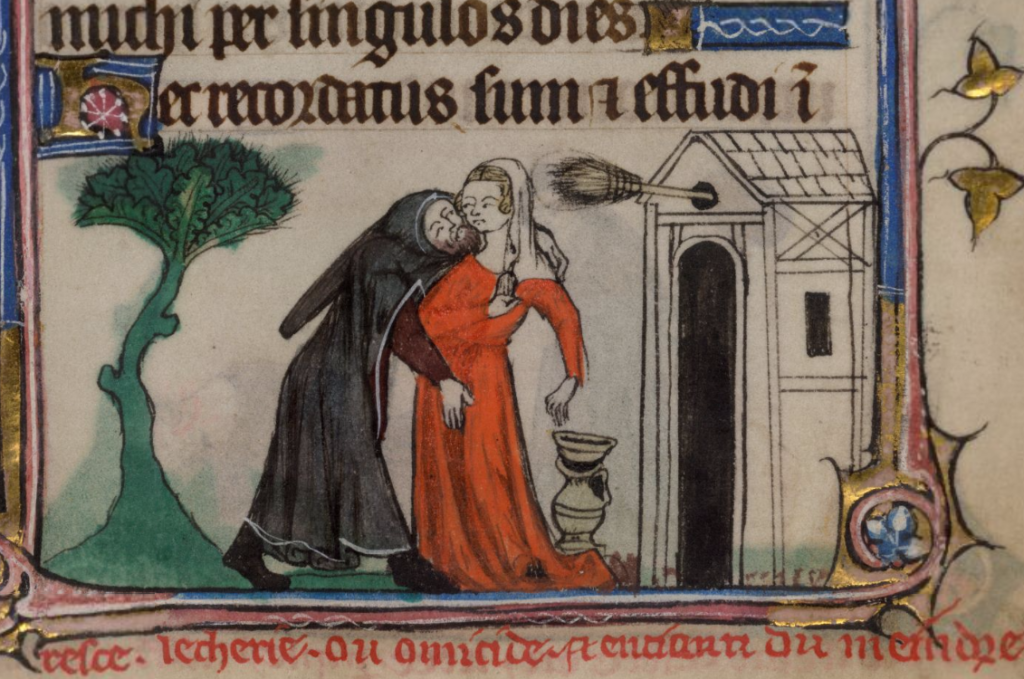
A friar grabs a woman by her genitals in an image from a fourteenth-century manuscript, The Taymouth Hours, London, British Library MS Yates Thompson 13, fol. 177. Specifically citing the manโ€™s actions as lechery (โ€œlecherieโ€), the French caption condemns his behavior and serves as a warning for young women, who would have been the textโ€™s primary audience. The Wife of Bath begins her tale with an allusion to the prevalence of friars in woods like those where the maiden is raped by the knight.[vi] 
The Millerโ€™s Tale is, of course, a fabliau, characterized by bawdy humor intended to make the audience laugh. The genre, however, should not negate the inappropriateness of Nicholasโ€™s actions, and if it renders them humorous, it does so at womenโ€™s expense. If further evidence is needed for the genreโ€™s proclivity for misogyny, one needs only to consider the Reeveโ€™s Tale, which follows the Millerโ€™s and appropriates rape as its punchline. While critics have traditionally navigated the fabliau genre with the argument that the โ€œenthusiastically unchaste wivesโ€[vii] escape ridicule at the narrativeโ€™s end, the portion of this approach that requires the casual dismissal of sexual assault merits reconsideration, especially because consent cannot be given retroactively. That being said, Alisoun does consent to a sexual relationship with Nicholas, but only after he has violated her. Sexual contact without consent is assault โ€“ period.

Our own cultural conversation around sexual assault hasnโ€™t ebbed since last fall. On the contrary, its media current seems to be only gaining momentum. On Tuesday, December 6, Time magazine revealed their 2017 Person of the Year: โ€œThe Silence Breakers,โ€ the many women, as well as some men, who have recently been compelled to share their experiences as victims of sexual harassment and assault. Primarily composed of womenโ€™s voices, the massive movement demands that the men perpetuating this violence be held accountable for their actions. Meanwhile, Brock Turner, the former Stanford University student found guilty of three counts of felony sexual assault early last year, served only three months of a grossly lenient, six-month sentence in a county jail and began the process of appealing his conviction the same week as Timeโ€™s cover release.[viii] According to the New York Times, approximately 60 pages of the 172-page appeal document emphasize the intoxication of Turnerโ€™s victim on the night he raped her.[ix] As far as Turner is concerned, the violence he committed is still not his fault, suggesting that accountability can only take us so far, and, frankly, itโ€™s not nearly far enough.

Time cover announcing the “Silence Breakers” as Person of the Year, released online December 6, 2017

Current events have inspired me to return to the Canterbury Tales, this time to the Wife of Bath. In what is an often cited conundrum of the Wifeโ€™s tale, the knight who rapes the maiden at the storyโ€™s outset is rewarded at its end, while his female victim vanishes from the narrative entirely. While some critics see the maidenโ€™s disappearance as a problematic act of erasure, Iโ€™d like to consider what can be achieved through the Wifeโ€™s attention to the rapist, rather than his victim.

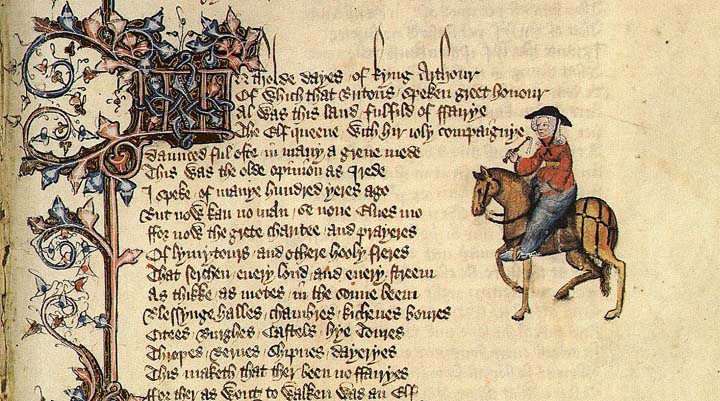
The first page of the Wife of Bath’s Tale from the Ellesmere Chaucer, a fifteenth-century manuscript housed at the Huntington Library, San Marino, MSS EL 26 C 9, fol. 72 r

In a tale that focuses more on remedy than reaction, the Wife conveys how the knight should not merely be punished but, rather, reformed. To weight the punishment Arthur initially proposes against the repercussions for contemporary sexual aggressors is a telling measure, as Arthur would have the knight executed for his actions. Guinevere, however, intervenes and โ€“ after her husband agrees that she should sentence the knight โ€œat hir willeโ€ โ€“ challenges him instead to discover what women desire most.[x] The quest upon which the knight embarks does not lead him to an explicit answer for her question, and his failure in this endeavor is, in my opinion, precisely the point: he must learn that women have wills of their own and understand that womenโ€™s wills should not be subsumed by menโ€™s.

At the taleโ€™s conclusion, it is only when the knight recognizes his wifeโ€™s will as equal to his own, a reflection of his reformed character, that he is rewarded. Admittedly, when the wife tells him he may choose to have her โ€œfoul and oldโ€ but โ€œa trewe, humble wyf,โ€ or โ€œyong and fairโ€ but unfaithful, neither option is ideal.[xi] But having just concluded her speech on โ€œgentillesse,โ€[xii] through which she conveys how nobility originates in oneโ€™s character and is defined through oneโ€™s actions,[xiii] it would appear that the knight accepts the meaning of her words:

โ€œMy lady and my love, and wyf so deere,
I put me in youre wise governance;
Cheseth youreself which may be moost pleasance
And moost honour to yow and me also.โ€[xiv]

Not only does the knight address his wife with kindness and respect, but he also conveys that he has internalized the lesson she has taught him by deferring to her โ€œwise governanceโ€ and imploring her to decide what kind of woman she wishes to be. Through his deliberate suspension of his own will to accommodate his wifeโ€™s, the knight demonstrates how his character has been reformed from the narrativeโ€™s beginning when he exerts his will over his female victimโ€™s in his sexual assault on her body. In effect, the Wife of Bathโ€™s Tale advocates for social reformation of masculinity as a proactive solution to sexual violence, situating punishment alone as a reactive and, thus, less productive response.

As a medieval scholar, I am dedicated to the idea that there is much we can learn from our past. As a literary scholar, I believe that studying literature can facilitate much of that learning. As a woman and a feminist, I wonder what can be gained by redirecting our collective gaze onto the perpetrators of sexual violence. Perhaps the Wife of Bath, a survivor of gendered violence herself, has a lesson she can teach us โ€“ and if thereโ€™s anything that can be learned, we must listen.

Emily McLemore
University of Notre Dame

[i] Drimmer, Sonja and Damian Fleming. โ€œNot Subtle; Not Quaint.โ€ In the Middle, 9 Oct. 2016.

[ii] Chaucer, Geoffrey. The Millerโ€™s Tale. The Riverside Chaucer, edited by Larry D. Benson, Houghton, 1987, pp. 68-78, lines 3276-78.

[iii] Queynte] Middle English Dictionary, def. 1a, 2a.

[iv] Trave] an enclosure or a frame for restraining horses while they are being shod (Middle English Dictionary, def. b)

[v] Chaucer. The Millerโ€™s Tale. The Riverside Chaucer, line 3282.

[vi] Chaucer. The Wife of Bathโ€™s Tale. The Riverside Chaucer, pp. 116-22, lines 865-81.

[vii] Benson, Larry D. โ€œThe Canterbury Tales.โ€ The Riverside Chaucer, pp. 8.

[viii] Stack, Liam. โ€œLight Sentence for Brock Turner in Stanford Rape Case Draws Outrage.โ€ New York Times, 6 Jun. 2016.

[ix] Salam, Maya. โ€œBrock Turner is Appealing his Sexual Assault Conviction.โ€ New York Times, 2 Dec. 2017.

[x] Chaucer. The Wife of Bathโ€™s Tale. The Riverside Chaucer, lines 894-97.

[xi] Chaucer. The Wife of Bathโ€™s Tale. The Riverside Chaucer, lines 1219-26.

[xii] Chaucer. The Wife of Bathโ€™s Tale. The Riverside Chaucer, line 1211.

[xiii] Gentillesse] nobility of birth or rank, or nobility of character or manners (Middle English Dictionary, def. 1a, 2a)

[xiv] Chaucer. The Wife of Bathโ€™s Tale. The Riverside Chaucer, lines 1230-33.


The Christ Knight

Most of us are familiar with the idea of Jesus as the Good Shepherd, but what about Jesus as a knight in shining armor, ready to do battle with a Black Knight called Satan or a fire-breathing dragon called Hell? ย In the literature of the Middle Ages, Christ was represented as such a knight, ready to save the day. ย Evidence of this can be found in Latin and Middle English sermons, religious lyrics, dramas, and hymns from the 13th to the 15th centuries. ย In one hymn, Christ’s crown of thorns actually transforms into a battle helmet!

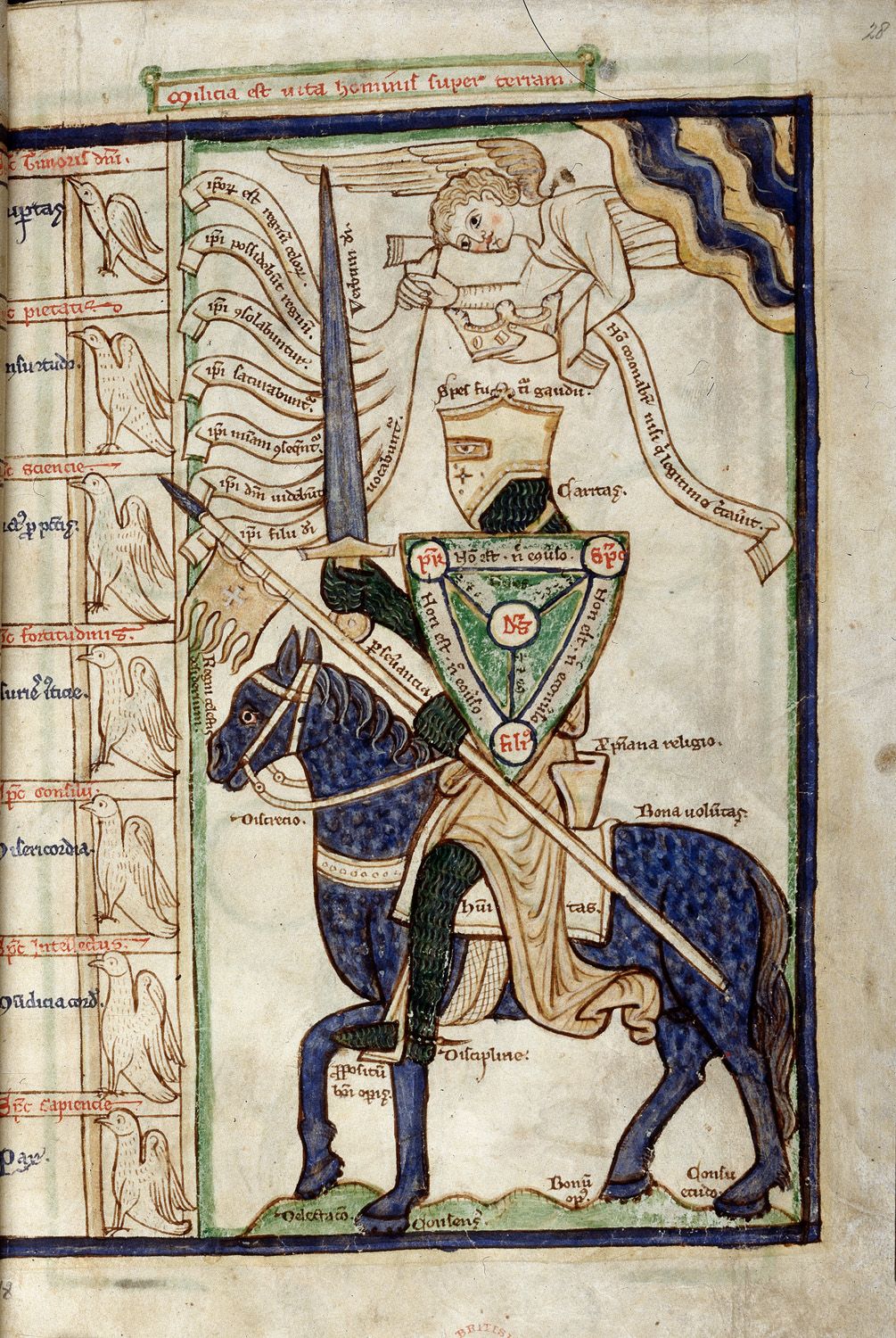
The knight on horseback as the Just Man armed with good virtues with his shield of faith; William Peraldus, Summa de vitiis, England, 2nd or 3rd quarter of the 13th century; BL Harley MS 3244, f. 28r.

Though the idea of the Christ Knight may seem strange, there is a biblical precedent. ย Ephesians 6:13-16 describes the armor of God’s soldier:

Wherefore take unto you the whole armor of God, that ye may be able to withstand in the evil day, and having done all, to stand. Stand therefore, having your loins girt about with truth, and having on the breastplate of righteousness; and your feet shod with the preparation of the gospel of peace; Above all, taking the shield of faith, wherewith ye shall be able to quench all the fiery darts of the wicked.ย ย  And take the helmet of salvation, and the sword of the Spirit, which is the word of Godโ€ฆ

The Christ Knight could be represented in two different ways. ย He could be the courtly lover wooing his beloved lady and sacrificing his life for her in battle (a story about Christ’s love of the human soul), or he could be the fearless warrior who duels with the forces of evil, is crucified, and rises from the grave to free the souls imprisoned in Hell.

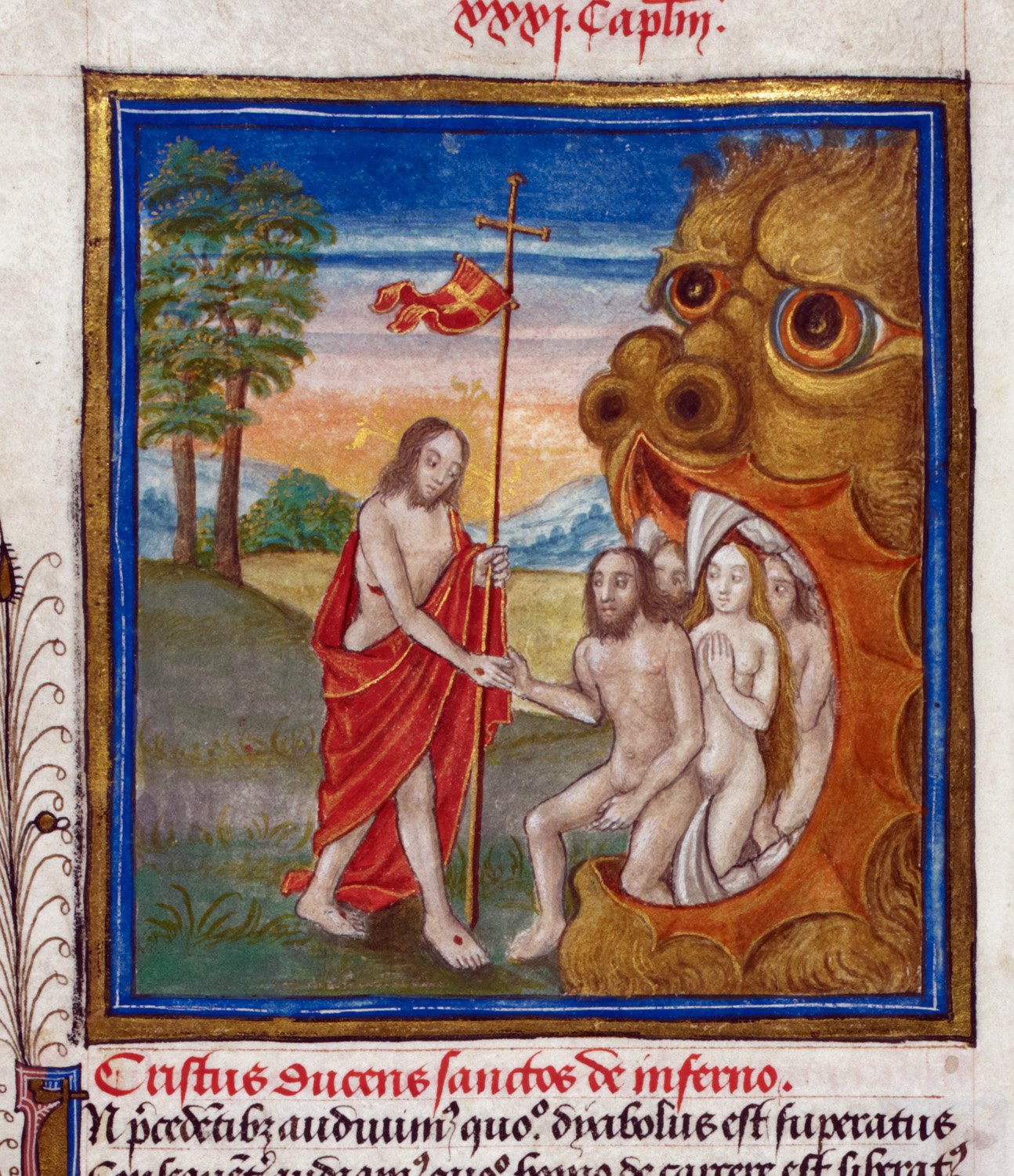
Christ harrowing Hell, detail of a miniature from the Speculum humanae salvationis, London, 1485-1509; BL Harley MS 2838, f. 33v.

One of the earliest examples of the Christ Knight as courtly lover comes from an English manuscript of 1215. ย An anonymous author wrote the manuscript, Ancrene Riwle, whose purpose was to instruct three young ladies on religious and intellectual matters. ย In it, he tells a story about a lady in a castle of clay, surrounded by enemies. ย She is cold and unresponsive to the brave knight trying to woo her, yet he rides out to joust for her and dies on the battlefield, his body his shield, stretched out on the Cross.

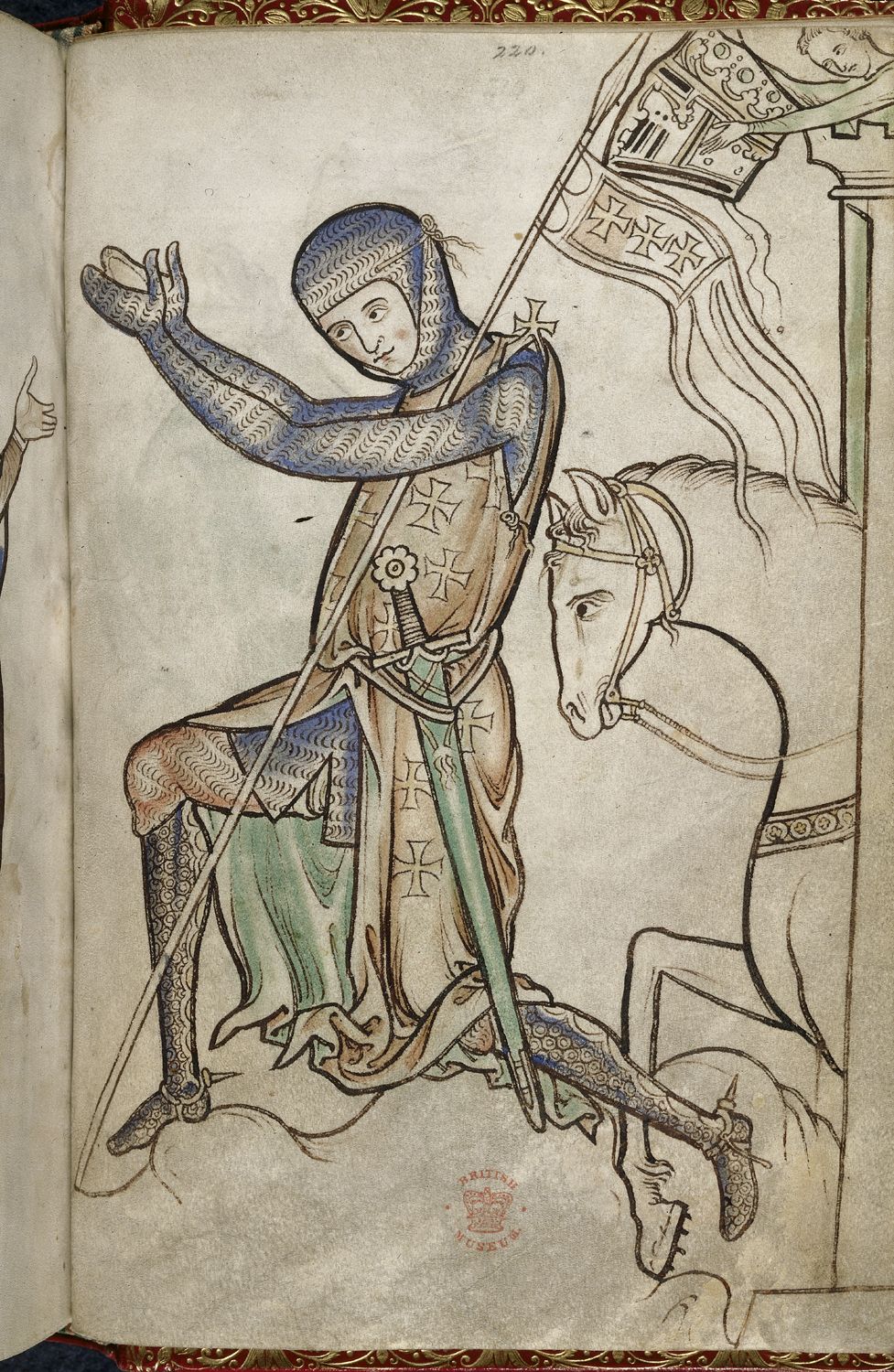
Knight illustration from the Westminster Psalter, Westminster, second quarter of the 13th century; BL Royal MS 2.A.xxii, f. 220r.

Christ as a warrior was also a popular motif. ย In a poem by William Herebert, written in 1333, Jesus is a young lord and valiant champion, not afraid of a good fight. ย In the Christian epic poem, Piers Plowman, Christ wears his “humana natura” as a helmet and armor to save all of mankind. ย Though he’s crucified on earth, he rises after death to storm the gates of Hell, described as a castle. ย The devils in Hell are unprepared for the attack, because Christ had come “disguised” as a simple human being rather than a great king. ย This disguise is payback to Satan for wearing the disguise of a snake to tempt Adam and Eve. ย “Jousting” with Satan in the “armor” of human flesh, Christ frees the souls of the good people (such as Moses and Adam) who lived on earth before his birth. ย Clearly, the Christ Knight was a powerful Medieval symbol.

James Cotton
PhD Candidate
Literature Program
University of Notre Dame