Ivory in the Rust: Reading the Old English “Ruin” in South Bend

As a medievalist studying at the University of Notre Dame, I am afforded many luxuries. The university’s resources for research in my field are exceptional, and I can honestly say that from my personal experience both the Medieval Institute and my home English Department have proven to be places where intellectual curiosity flourishes and where the spirit of generosity pervades. It has been a wonderful place to pursue my graduate studies, and of course the campus is absolutely beautiful, as the university’s collection of scenic images affirms. But when I decided to move off campus my second year, out of the gilded bubble surrounding the university and into the rust belt of South Bend, I met with some starkly different and rather unsettling imagery.
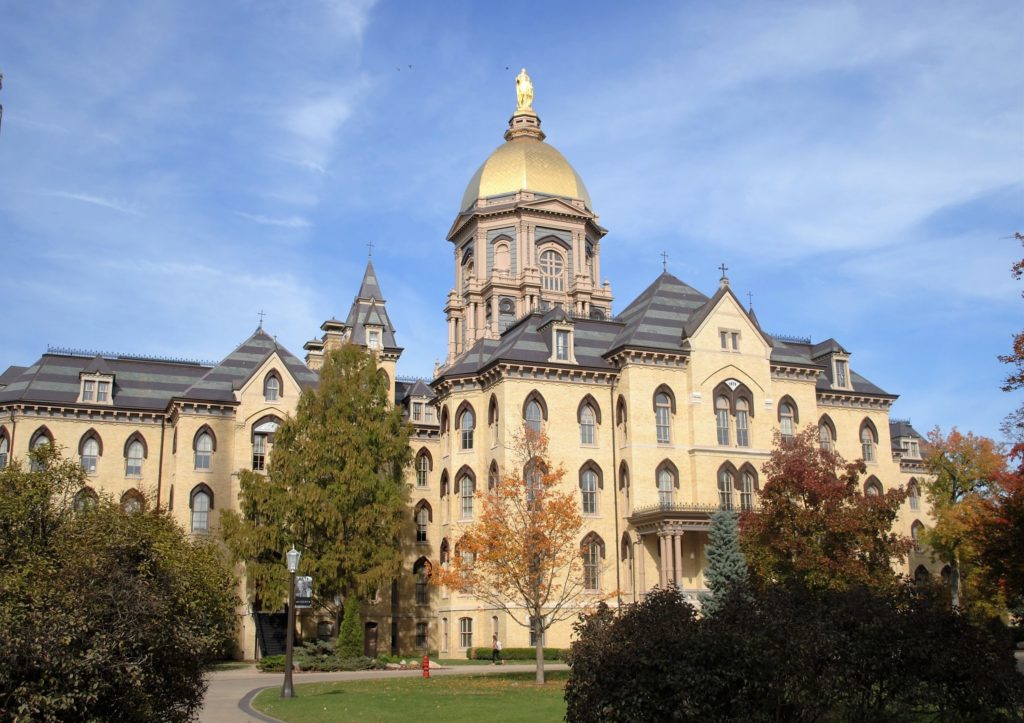
University of Notre Dame’s Golden Dome and Main Building

The juxtaposition between the two spheres which I came to inhabit—between the gorgeous Neo-Gothic architecture that adorns the picturesque campus and the industrial ruins scattered throughout the cityscape of South Bend—became repeatedly reinforced by my regular journey between these worlds on each morning commute and then again each night as I returned home. Every evening, I would leave the Golden Dome behind and drive by boarded up houses and businesses, like this one on Sample Street, which I routinely passed on my way home.

Ruined Building on Sample Street, photograph taken and edited by Rajuli (Khetarpal) Fahey

Below is a closer view from the front of the building. I pause on this particular structure, because it became engrained in my mind over time—the beautiful green decay and broken bricks—the state of disrepair. To me, this building came to represent the rust belt ruins of South Bend. My wife—artist and graduate of Massachusetts College of Art & Design, Rajuli (Khetarpal) Fahey—photographed the rotting building and describes experiencing an overwhelming stench of mildew and mold wafting from the broken windows upon approaching the structure.
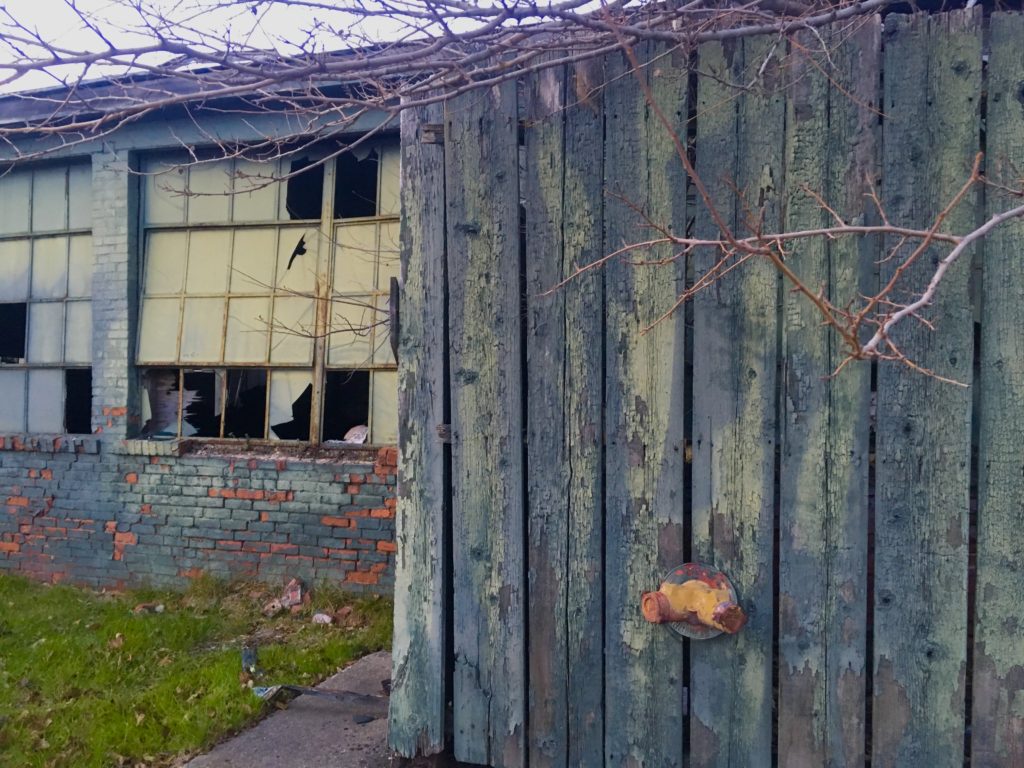
Sample Street Ruin, photograph taken and edited by Rajuli (Khetarpal) Fahey

In my opinion, there is a certain beauty in the haunting imagery of this broken down building, which recalls a time before the place fell into ruin while simultaneously emphasizing its current dilapidation. This theme is well known to Anglo-Saxonists, as the question of ubi sunt “where are (they now)?” pervades the so-called Old English elegies, which reflect on the transitory nature of human existence, noting the decay of great civilizations passed. As I read these medieval poems in the ivory tower of Hesburgh Library, I found myself thinking about South Bend and the many other rust belt cities across the country, weathered by similar economic decay. More than any other Old English elegy, the Exeter Book Ruin prompted me to meditate on the industrial remnants of a former time in South Bend.
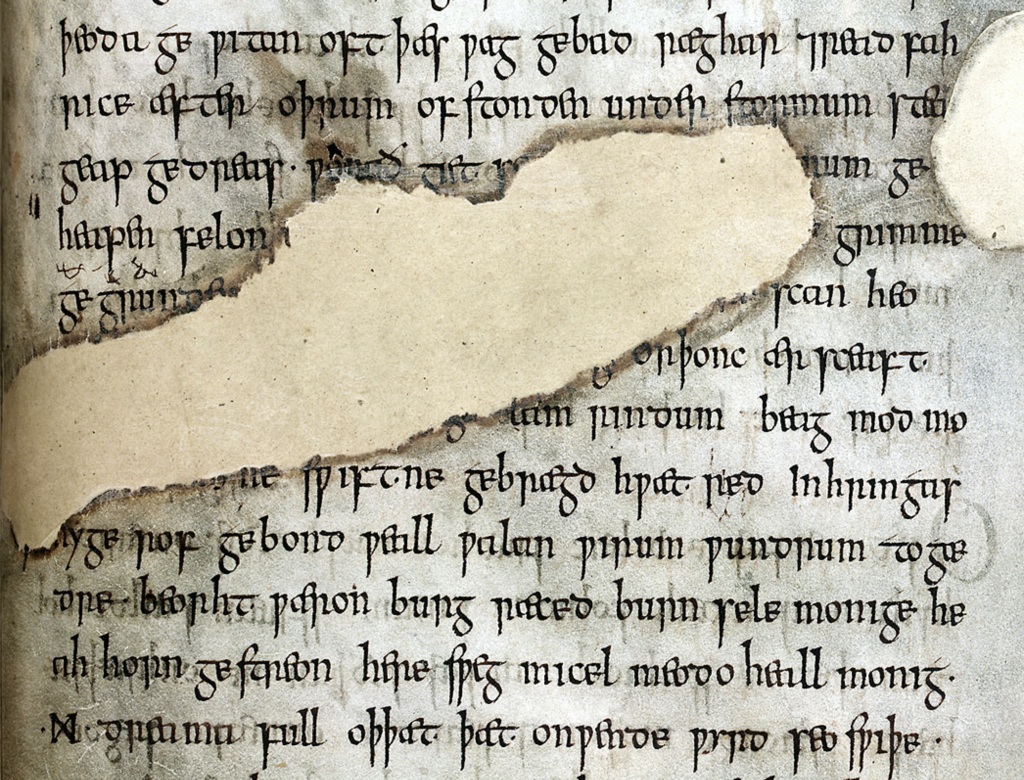
Exeter Cathedral Library MS 3501, f. 124r, all rights reserved Dean & Chapter Exeter Cathedral

The Old English Ruin is itself a ruin—appearing on fire-damaged folia in the Exeter Book (Exeter Cathedral Library MS 3501). Fittingly, the poem bears its own marks from the wear of time and circumstance, and at first sounds almost like a riddle—beginning with one of the lexical markers scholars have used identify riddles (wrætlic meaning “wondrous” or “marvelous”). Moreover, in its manuscript context, the Old English Ruin is embedded within the two major collections of riddles found in the Exeter Book, amongst some stray riddles and the more enigmatic “elegies” in the codex, including The Wife’s Lament and The Husband’s Message. The Exeter Book Ruin demonstrates an interest in contemplating the destructive and the inevitable—crushing—passage of time, particularly on monumental manmade structures.

As Rajuli and I were discussing the poem and pockets of dilapidation throughout the city, she suggested that we drive around the city and take a family tour to document some of the ruins of South Bend, which I use here to complement sections of my translation of the Old English Ruin.
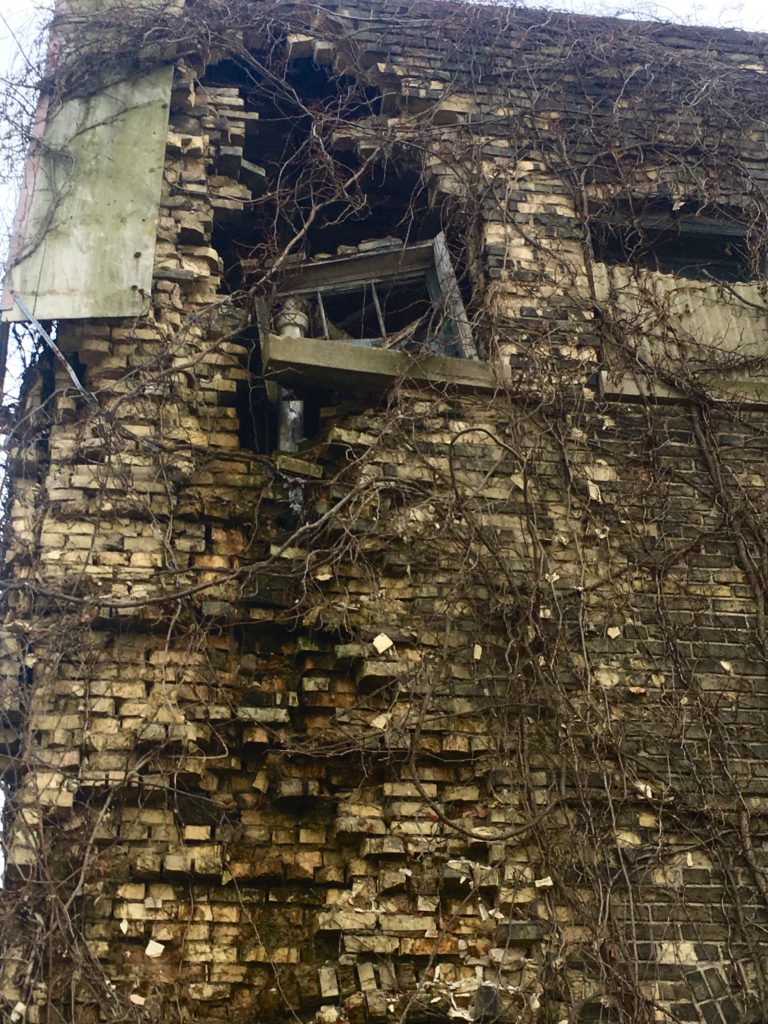
Ruined wall-stones in South Bend, photograph by Richard Fahey and edited by Rajuli (Khetarpal) Fahey

Wrætlic is þes wealstan wyrde gebræcon;
burgstede burston brosnað enta geweorc
Hrofas sind gehrorene hreorge torras,
hrungeat berofen (1-4).

“Wondrous are these wall-stones,
broken by fortune, the citadels crumbled,
the work of giants ruined.
The roofs are collapsed,
the towers tumbled, the pillars bereft.”
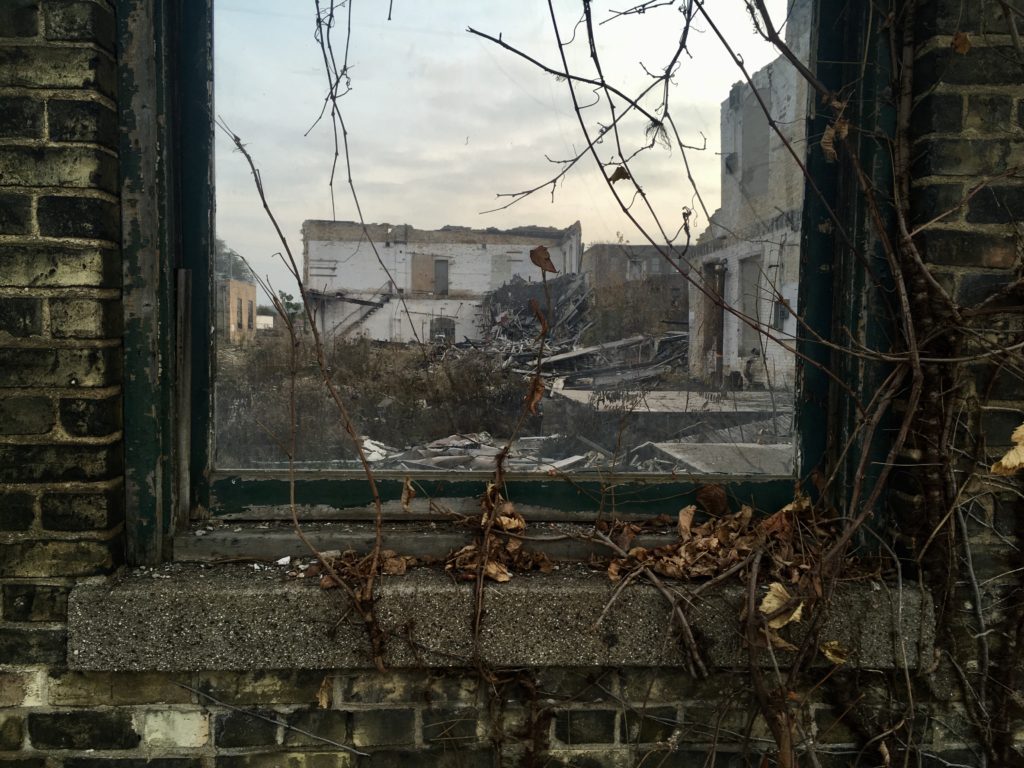
Ruined South Bend factories, photograph by Richard Fahey and edited by Rajuli (Khetarpal) Fahey

wurdon hyra wigsteal westen staþolas,
brosnade burgsteall (27-28).

  “their fortification became deserted places,
their strongholds crumbled.”
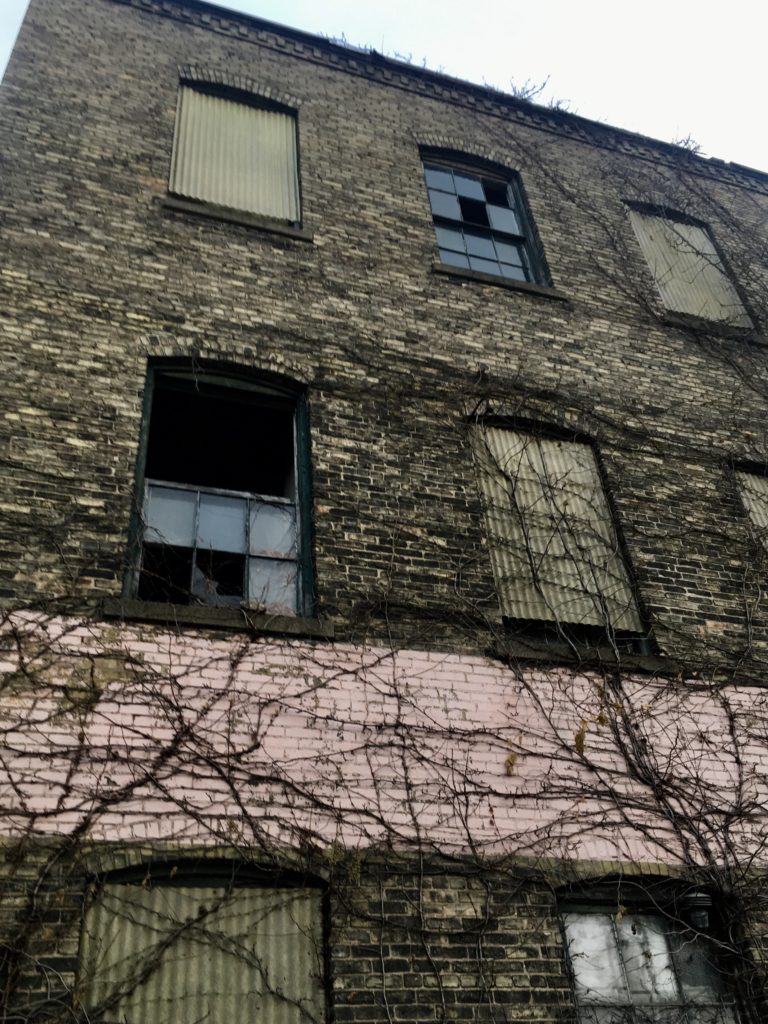
Ruined factory near Western Ave, South Bend, photograph by Richard Fahey and edited by Rajuli (Khetarpal) Fahey

Forþon þas hofu dreorgiað,
ond þæs teaforgeapa  tigelum sceadeð
hrostbeages hrof (29-31).

“Therefore these houses have decayed,
and this gabbled structure sheds its tiles,
the roof of ringed-wood.”
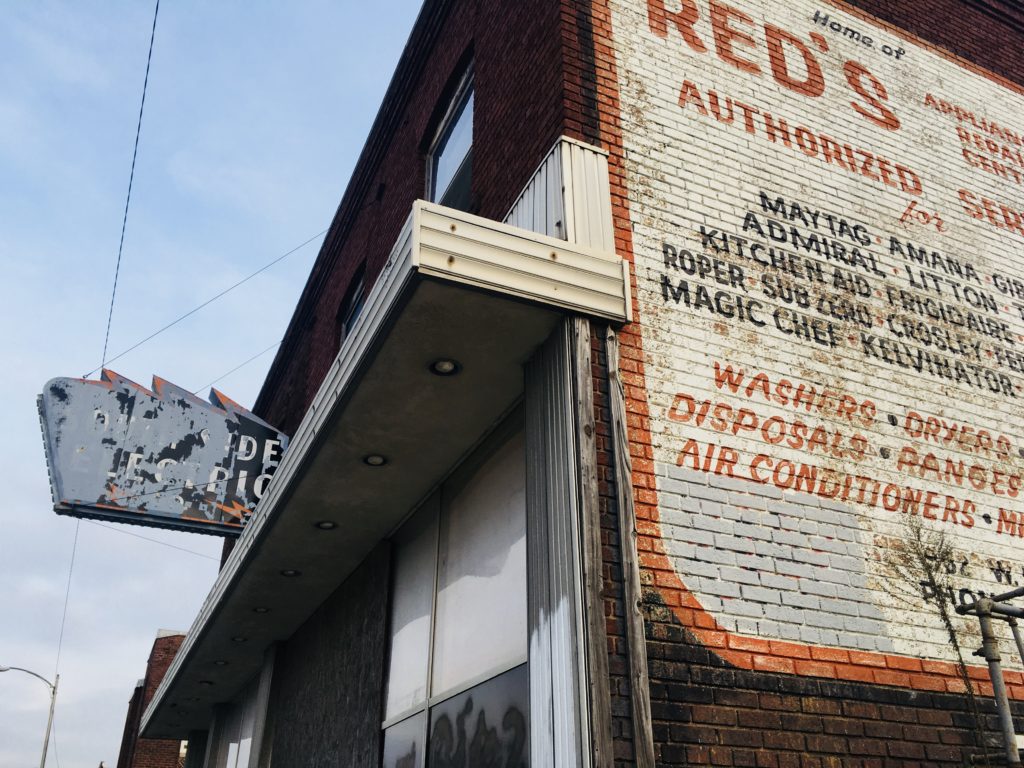
Red’s abandoned business on Indiana Ave, South Bend, photograph taken and edited by Rajuli (Khetarpal) Fahey

Sadly, the descriptions of desolation and structural decay in the poem reflects a bit too closely the current state of disrepair which still plagues certain parts of South Bend. This deserted business located on Indiana Avenue, once both Red’s Appliance Repair Center and Southside Electric, still bears obsolete information etched on the brick wall, whispering to us from the past. Reminding us that things were not always as they are today, and begging for renewal. Nevertheless, the enduring dilapidation that decorates the city stands as a reminder of how South Bend, and places like it, became collateral damage—destroyed by the tides of economic fluctuation.
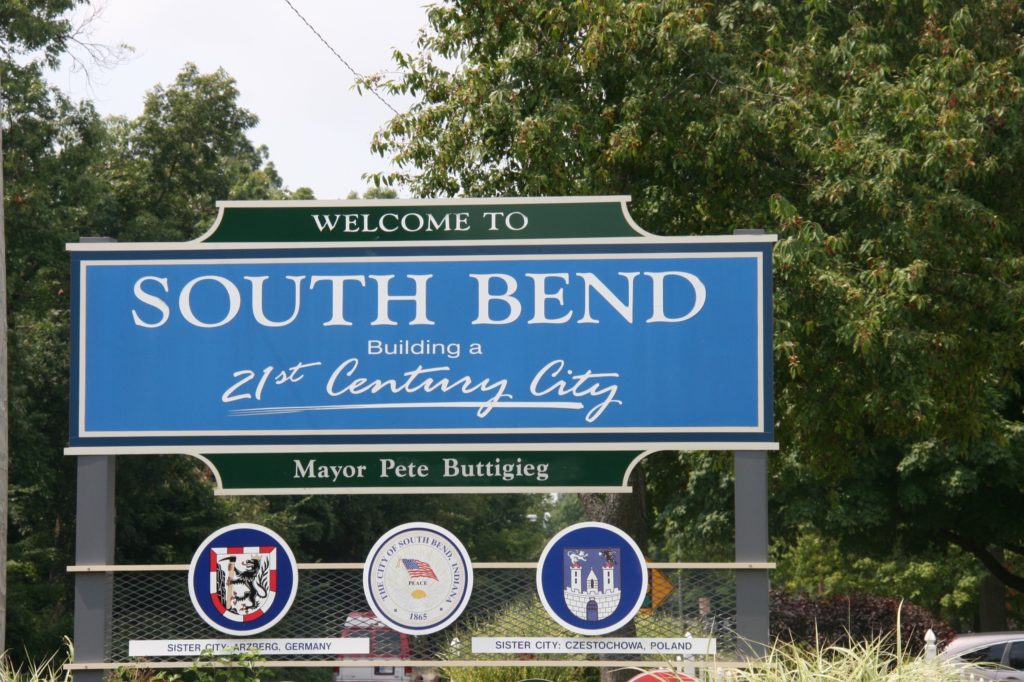
Greeting sign upon entering the city of South Bend

As the sign suggests, South Bend is a city on the rise, racing to catch up to 21st century, and doing quite well in this effort. During my tenure at the University of Notre Dame, I have seen the city of South Bend improve tenfold—drawing new and thriving businesses, expanding campus infrastructure, renovating depressed neighborhoods, and even beginning to cultivate and encourage artistic movements within the city. Many rust belt cities do not have the advantage of housing such a vibrant university community which generates innovation and economic growth, and those cities have far greater challenges to overcome. Both the campus and the city at large often seem as if they are one enormous construction site: demolishing, repairing and rebuilding. Still, amidst citywide growth and revitalization lies the skeletal ruins of the rust belt economy.

Richard Fahey
PhD Candidate
Department of English
University of Notre Dame

Text and translation of the Old English Ruin

Collection of images “Rust Belt Ruins of South Bend


Working in the Archives – The Rijksarchief te Gent

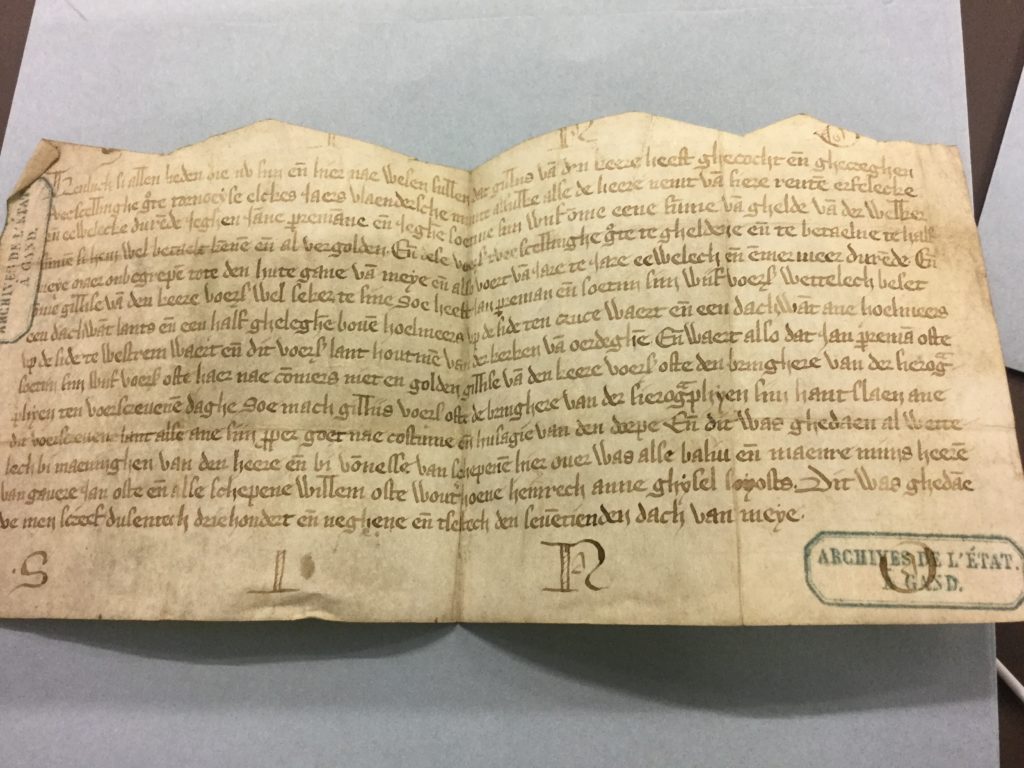
RA Gent, K56, Klooster de Filledieusen

This post contributes to our ongoing special series, “Working in the Archives.” Previously, our bloggers have explained the archival procedures in Morocco and in France. Today, I will discuss some strategies and tips to make a trip to the The Rijksarchief te Gent in Belgium a productive one.  

The State Archives in Gent is one of the major depositories of medieval manuscripts in Belgium. I resided and researched in Gent for nine months and hope this blog will help scholars who are traveling to Gent, to the Rijksarchief, to complete research in a short amount of time and with limited knowledge of the city.

Below, I will discuss the practical knowledge needed to make an archive visit productive: how to get to the Rijksarchief from the train station (Station Gent-Sint-Pieters), what is needed to access the archive, how to search for material, how to request that material, and how long the material takes to arrive. Additionally, I will mention some quality of life information- a good place for lunch, for coffee, and for dinner and a drink after a long day in the archive.

How to Get There- Bagattenstraat 43, 9000 Gent

The train to Gent from Brussels Airport (BRU) takes either an hour or an hour and a half, depending on the available trains at the airport when you land. One can take any train going to Brussels Central and switch trains there to arrive faster. Train travel in Brussels is quite easy, with train times and destinations presented in Flemish, French, and English (most of the time, but not always). Upon arriving in Gent-Sint-Pieter’s, there are three easy ways to get to the Rijksarchief- tram, taxi, or by foot.  Taking a taxi in Gent is a bit pricey, so if one is on a budget, taking the tram or walking is the better option.

There is a tram that runs regularly from the front of Sint-Pieter’s Station. It is on the Red Line (1) that goes straight into the city center. The stop on the Red Line next to the Rijksarchief is called Verlorenkost. The stop is one street before Bagattenstraat, the street on which the archive is located.

To walk from the train station, one will want to follow the same path as the tram: first, take Konigen Elisabethlaan away from the station; after about a quarter of a mile, bear to the left onto Kortrijkseestenweg; remain on this street through a major intersection. The street changes in name to Kortrijksepoortstraat; continue on this street until you reach Bagattenstraat on the right, and the archive is the third building on the left. It is a large white building.

What You Need to Access the Archive

To access the material in the archive, one needs a research card (Lezerskaart). One can spend 5 euros for a weeklong visitor’s research card, or one can spend 20 euros for a yearlong card. You must show your personal reader’s card at every visit. It can be purchased on-site: the annual card gives access to all the reading rooms of the State Archives of Belgium. If one has a student card from the University of Gent, the card is half price.

How to Search For Material

RA Gent K54, Grauwe Zusters bij Sint-Jans
RA Gent K52, Klooster van Arme Klaren

One can search the Rijksarchief online at arch.be/. However, many of the inventories of the collections held in the archive are not online, and can only be consulted in-person. The inventories are shelved on the second floor in the reading room.

To fully understand what the inventories and search tools say, one needs to have some grasp of Dutch. Most of the finding tools are only in Dutch, although one can ask the staff for clarifications and assistance. At minimum, bring a Dutch dictionary, as there is no Wi-Fi at the archive to look up words and phrases online.

How to Request Material and its Arrival Time

To request a manuscript, one can email the archive a day before to have the material ready in the morning. Otherwise, you must request them in person. The manuscripts are brought to the reading room on the top of every hour, so plan your time accordingly.

Quality of Life

In terms of walkability, Gent is a very manageable city. While it only takes about 15 minutes to walk to the city center from the Rijksarchief, there are nearby cafes and restaurants that are of excellent quality and affordable. My favorite spot near the archive is Vooruit- a restaurant at the other end of Bagattenstraat. It has good food at a good price, with a daily special every day. Vooruit also has excellent coffee. For an afterwork drink or game of pool, turn right out of the archive and go two buildings down to Kaptein Kravate.

Sean Sapp
University of Notre Dame

Working in the Archives – Navigating Archival Research in Central Europe

Chapter 58 of the Rule of St. Benedict describes a postulant requesting entrance into the religious life:

“Anyone on first coming to the religious life should not find the entrance made easy, but as the apostle says, “Test the spirits to see if they are of God.” If, however, the newcomer continues to knock at the door, and for four or five days shows a patient bearing,…He shall then be allowed to enter…”[1]

The process of archival research was once described to me in such terms by a seasoned medieval scholar, and I haven’t forgotten the analogy. Planning archival visits often involves persistence and patience, but the experience can be rewarding and the time spent in research worthwhile. Utilizing digital resources in conjunction with archival visits can help make the best use of precious time and research funding. Here are my tips for successfully navigating research in Central Europe:

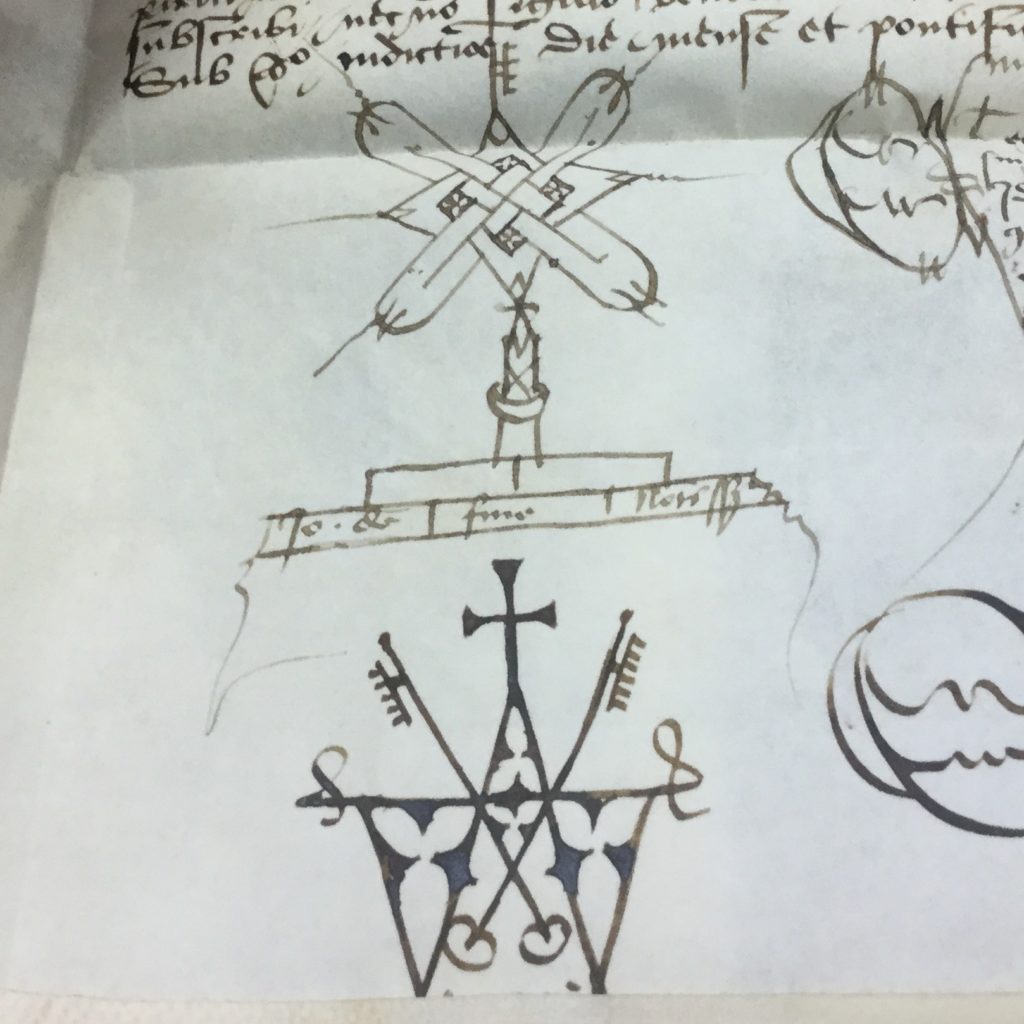
1. Be aware of digital resources that will make your research and archive visit easier. Monasterium.net  is a virtual archive of digitized monastic charter documents from archives throughout Central Europe. The “Find” option allows you to search by archival location, while the “Search” tool allows you to pull up documents by keywords like monastery name.  A second valuable digital resource is Prague-based manuscriptorium.com. Sign up for free as a user. Search through the database for manuscripts and organize your favorites in research folders of your creation. Manuscript entries vary from basic catalog description to full digital facsimiles. Check the site for participating libraries, as the database continues to expand to other areas in Europe.

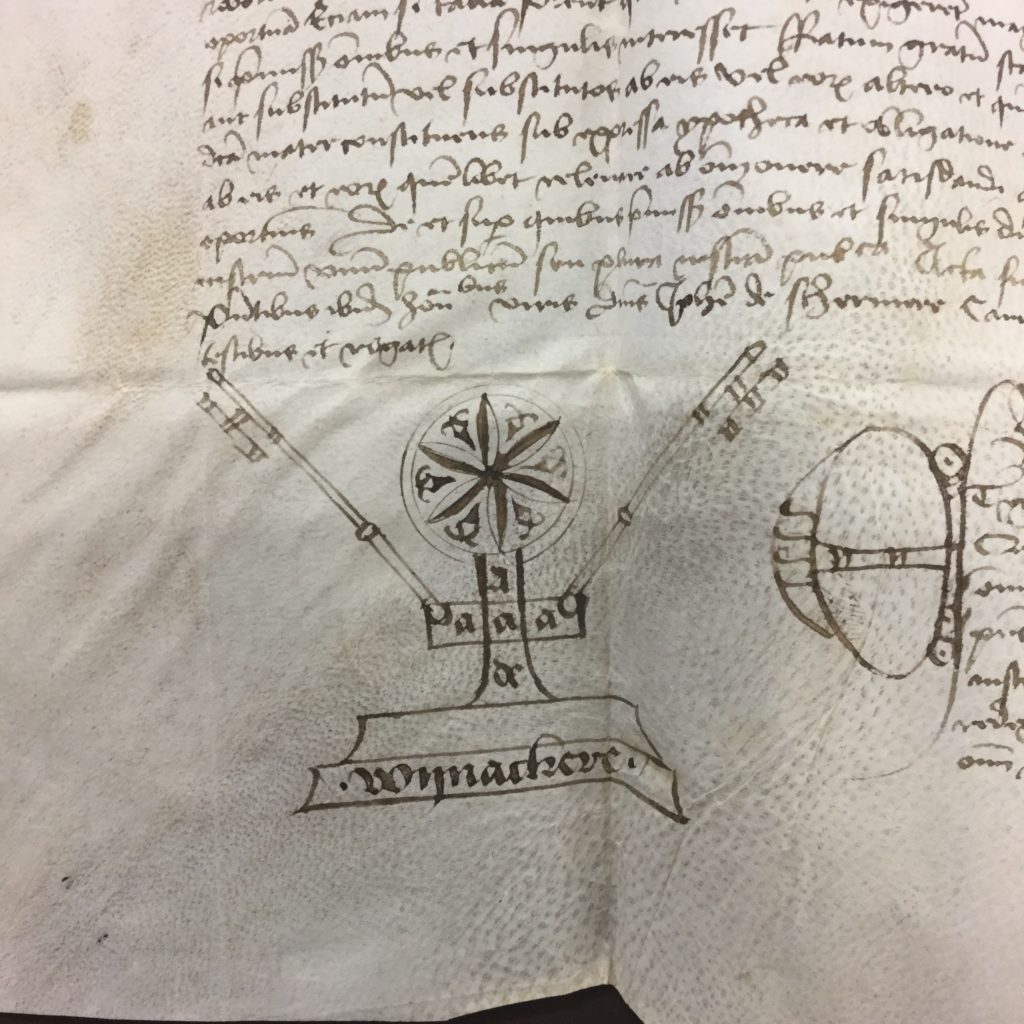
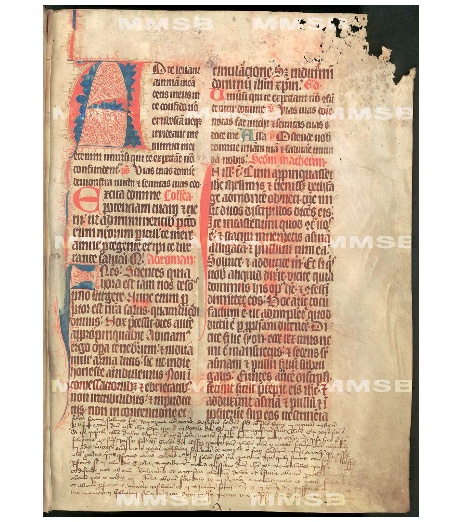
Missale monasterii Chotěšoviensis, XIV C.3 Národní knihovna České republiky, Prague, fol. 6r. This work is licensed under a Creative Commons Attribution-NonCommercial-ShareAlike 4.0 International License.

2. Be prepared to communicate in languages other than English. Regardless of whether or not you used it to arrange your visit, security personnel and archivists on site don’t always know English. Have a list of your requested documents handy and the correspondence granting you access printed off to streamline your processing time. And don’t forget your passport!

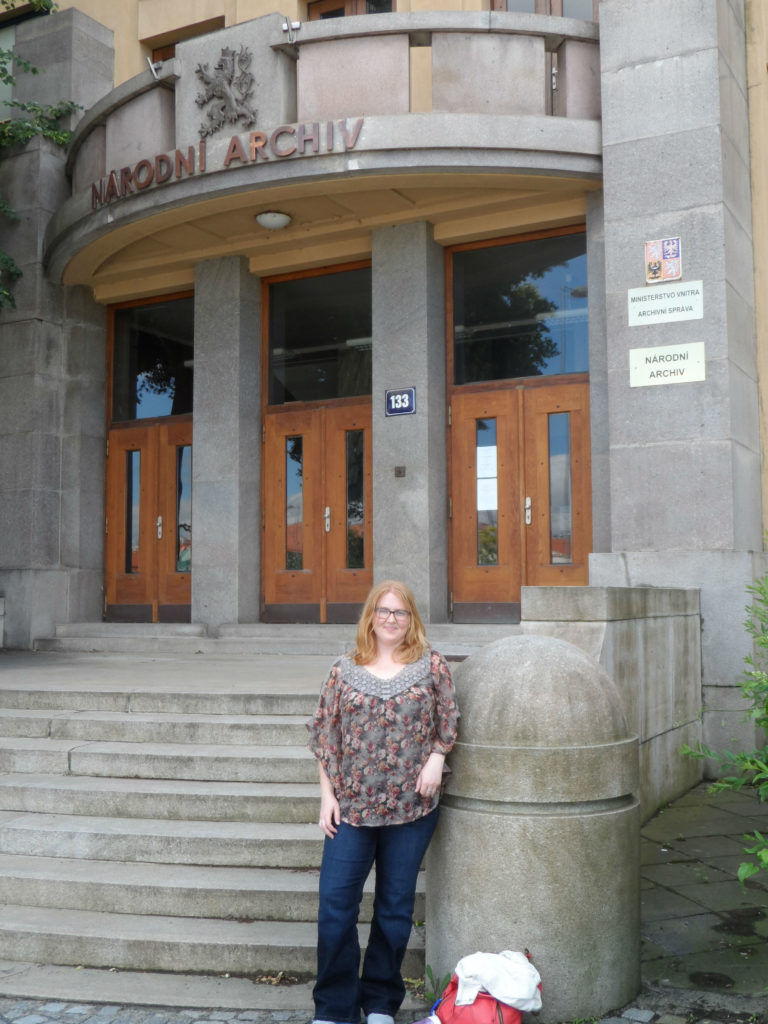
3. Do not count on the use of a camera or printer. If photos are not allowed, request that the archive provide images for you (you will likely pay a fee). Among the archives I found most photo-friendly were the Moravian Provincial Archives in Brno (Moravský Zemský Archiv) and the Czech National Archives in Prague (Národní Archiv)–I faced no photo restrictions at these sites. The Austrian National Library (Österreichische Nationalbibliothek) will allow printing of microfilm documents and some photography of sources depending on the items you are consulting.

Czech National Archives, Prague. Photo Credit: Lisa Scott

4. Getting around Central Europe is relatively easy with pre-planning. Trains and buses are inexpensive and will get you reliably from A to B. For busing between cities I recommend Student Agency, which travels all over Central and Eastern Europe.

5. I’ve had the privilege of visiting several outstanding archives and research libraries around Central Europe; I will recommend one in particular. The Moravian Provincial Archives in Brno is a modern and active location. The atmosphere is airy, well-lit, and professional, and the archivists on duty are extremely helpful. I had no problems arranging my visits in advance, and archivists communicate in German if you do not have sufficient Czech. Local transport can be a bit daunting as the archive is out of the city center, but it is doable. Acquire a city bus ticket at any of the yellow kiosks (Select one 60-minute ticket for 2 “Zones”. This includes a free transfer. Don’t forget to validate your ticket once you enter the bus.). From the main train station, you’ll get to the archives in about 30 minutes. Google Maps is equipped with adequate route planning capabilities; there are several bus lines available.

6. Be aware of your resources back home. Despite making multiple attempts to do so, I was unable to see a few manuscripts pertaining to my dissertation housed in a rural Austrian monastery. Upon returning to the U.S., however, I was able to access microfilm copies of the manuscripts in question at the Hill Museum and Manuscript Library in St. Joseph, MN. The large-scale effort to photograph manuscripts housed in European libraries began in Austria in 1965 and continues to this day. The newly-renovated Austria/Germany Study Center is a lovely facility, and the staff is eager to work with scholars pursuing research on manuscripts in the collection.

Amy Nelson
Ph.D. Candidate
University of Notre Dame

[1] Benedict of Nursia, The Rule: from The Rule of Saint Benedict, trans. Cardinal Gasquet (London, 1909), Ch. 58.