The Riddle of Grendel’s Monstrous Mother: Echoes of Scylla in Beowulf?

Grendel’s mother has long been regarded by scholars as the least monstrous of the three—not being an obvious vampire-cannibal like Grendel nor a fire-breathing dragon. Her vengeful response to the death of her son, and her decision to continue the feud between the Grendelkin has been regarded as ethical (within the broader context of warrior ethos), legal (within the context of early medieval Norse and English laws), and even heroic (aligned with the heroism as depicted in the poem).
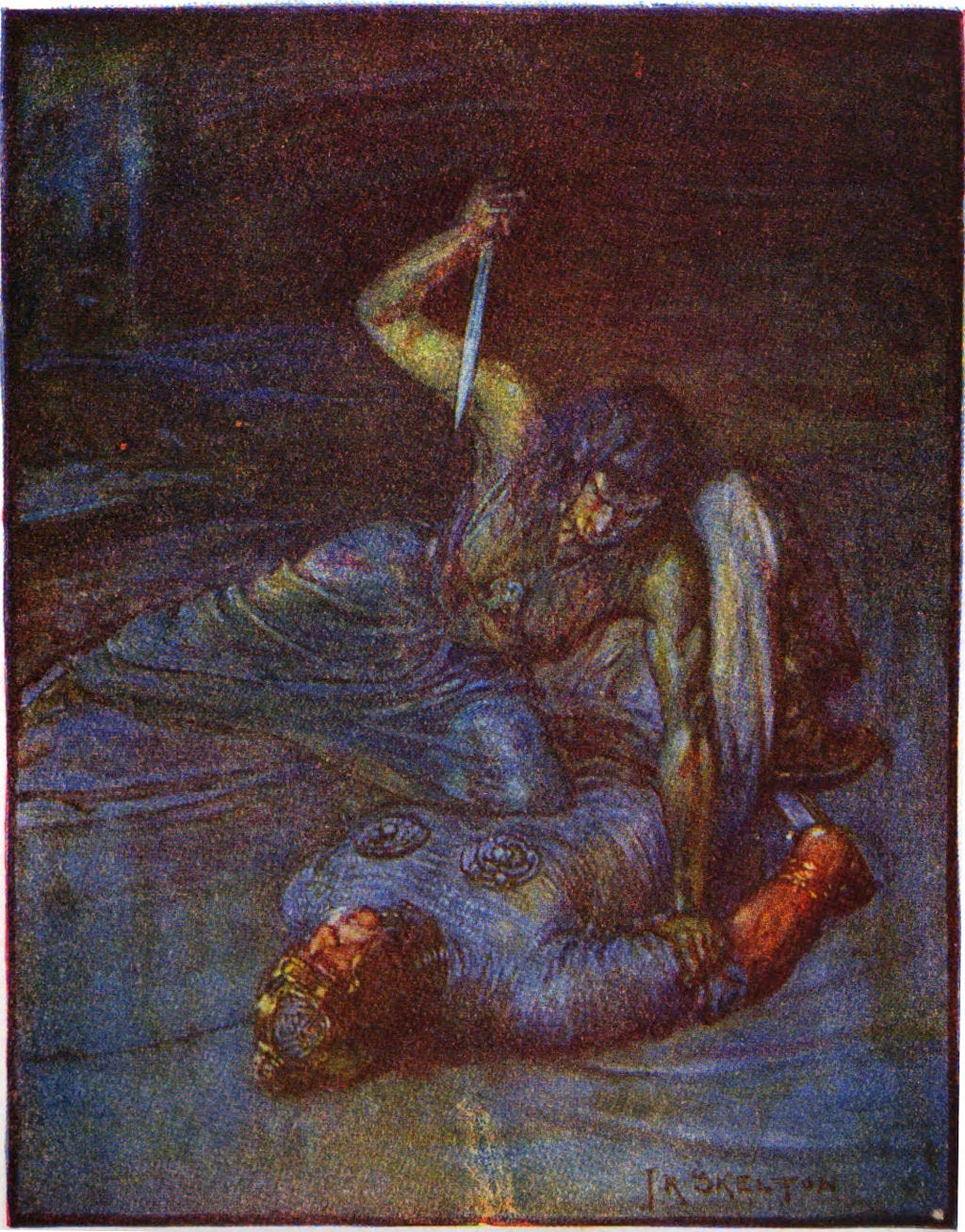
Grendel’s mother tries to stab Beowulf. Illustration by J.R. Skelton, 1908.

While I would generally agree with this broad characterization of Grendel’s mother, and there is no doubt that her actions mirror those of any avenging warrior in Beowulf, to erase her monstrosity seems to ignore at least some of the evidence. While I do not find her maternity at all indicative of abject horror (indeed quite the opposite as it is her identity as “mother” that humanizes her in my view), certain terms used to describe her and indeed everything from her association as Caines cynn “Cain’s kin” (107; 1261-65) and the hellish descriptions of her lair suggest some measure of monstrosity embedded in her character. And for this Halloween, we will spend some time unpacking the nature of her monstrosity.

I would contend that the main reason scholars argue about Grendel’s mother’s monstrosity and characterization is because of her enigmatic design. As I point out in my dissertation, riddles encode Beowulf, and, in my opinion, employ riddling rhetorical strategies, especially imitation, equivocation, esotericism and paradox. These obfuscations help account for the many irregularities observed in the poem the scholars have scratched their heads over for more than a century and help explain why often the heroes looks like the monsters—and the monsters like the heroes.  

Grendel’s mother battles Beowulf. Illustration by John Howe, 2006. All rights reserved.

Because of the influence of riddling rhetorical strategies on Beowulf, turning to the Anglo-Latin enigmata tradition is an especially fruitful practice, especially in explorations of monstrosity in the poem. Indeed, monsterized riddles have long been a feature starting with the late classical enigmatist, Symphosius, who establishes the Anglo-Latin tradition, includes numerous riddles on wondrous creatures, such as the phoenix (Enigma 31). Similarly, Aldhelm’s enigmata also feature numerous monsterized riddles, in some cases the solution is a wondrous creature (as with Symphosius’ paradoxical phoenix-riddle), in other cases the mundane is made monstrous through imitation, and the monsterization is another mechanism of obfuscation (as in Aldhelm’s Enigma 97 solved nox). Even Boniface, whose riddles center on vices and virtues, monsterizes his vice-riddles in the mode of Prudentius’ Psychomachia, a popular classroom text in early medieval English which depicts vices as monsters in an allegorical epic.

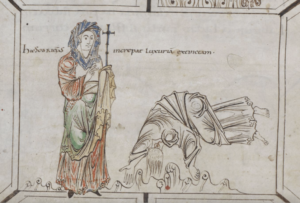
Ira’s sword shatters on Patientia’s helmet, then the enraged Ira dies by her own blade (c.900, Bern, Burgerbibliothek, Codex 264, p.79).

But what does this have to do with Grendel’s monstrous mother? Let’s start with her introduction and the complex portrait it paints:

Þæt gesyne wearþ,
widcuþ werum,   þætte wrecend þa gyt

lifde æfter laþum,   lange þrage,
æfter guðceare:   Grendles modor.
Ides aglæcwif   yrmþe gemunde,
se þe wæteregesan   wunian scolde,
cealde streamas,   siþðan Cain wearð
to ecgbanan   angan breþer,
fæderenmæge.   He þa fag gewat,
morþre gemearcod,   mandream fleon,
westen warode. 

“That became manifest, widely known to men, that an avenger still lived after the hostile one, for a long time, after war-grief: Grendel’s mother. A lady, a fearsome woman remembered misery, he who must inhabit the terrible-waters, the cold streams because Cain became the edge-slayer to his only brother, kin of the same father. He then went hostile, marked by murder, fled the joys of men, inhabiting the wilderness.”

Beowulf, 1255-65.

The first term used to describe Grendel’s mother emphasizes her desire for vengeance. The narrator names her a wrecend “avenger” (1256) —an appropriate title considering her entire characterization is framed by revenge and feuding—and her motive is thrice repeated almost verbatim and with language that could apply equally to avenging heroes in the poem (1276-78, 1339-1340, 1546). Moreover, Grendel’s mother’s is thrice described as wif “woman” (1259, 1519, 2120,) and even twice as an ides “lady” (1259, 1351) establishing gender as one of the pillars of her characterization, alongside her roles as avenger and mother. Kinship ties are further emphasized when Grendel’s mother is described as Grendles maga “Grendel’s female relative” (1391) and twice as Grendles mæg “Grendel’s kinsman” (2006, 2353), which account for her desire for revenge in upholding the warrior ethics and continuing the feud between the Danes and the Grendelkin.
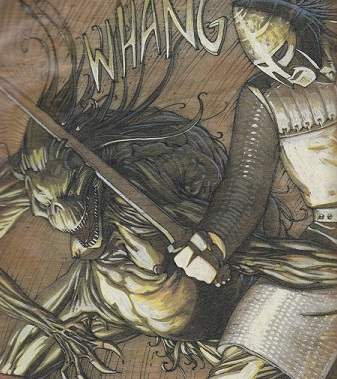
Beowulf fights Grendels mother Gareth Hinds
Beowulf fights Grendel’s mother. Illustration fromm Gareth Hinds graphic novel, Beowulf (2007). All rights reserved.

Moreover, like the monstrous vices in Prudentius’ Psychomachia and Boniface’s Enigmata, the avenger—Grendel’s mother—is clearly wondrous and monstrous in certain descriptions of her. She and her lake monsters are wæteregesa “water-terrors” (1260). Grendel’s mother is called se broga “the terror” (1260), and together with her son, she is described as mihitig manscaða “man-slayer” (1339), micle mearcstapa “great marked-wanderer” (1348), dyrna gast “secret spirit” (1357), ælwiht “alien thing” (1518), thrice as ellorgæst “foreign spirit” (1349, 1617, 1621) and even deofol “devil” (1680). She is even described as a merewif mihtig “mighty mermaid” (1519), aglæcwif “fearsome warrior woman” (1259) or wif unhyre “untamed woman” (2120), grundwyrgenne “ground wolf” (1518) and twice is characterized with the compound a brimwulf “sea-wolf” (1506, 1599).

It is my contention that descriptions of Scylla—a classical monster, famously featured in the Odyssey and popular in Anglo-Latin literature contemporary with Beowulf—likely influence the characterization of Grendel’s mother, a riddle embedded in the poetic compounds used to describe her and in the depiction of her monstrous lair.

Scylla as a maiden with a kētos tail and dog heads sprouting from her body. Detail from a red-figure bell-crater in the Louvre, 450–425 BC. This form of Scylla was prevalent in ancient depictions.

Scylla is a monstrous sea creature from Greek mythology, known for inhabiting a narrow strait opposite the whirlpool Charybdis. She often has multiple heads with each head bearing a set of sharp, ravenous teeth. Scylla’s body is a woman’s often combining serpentine, aquatic and canine features. She emerges from a rocky cliffside and narrow passage where she lives. She preys on passing sailors, snatching them from ships with her many heads and her “sea dogs” which accompany her. Once a beautiful nymph, she becomes cursed and exiled.

Scylla is the riddle-subject of Aldhelm’s Enigma 95 (solved Scilla) and is featured in his prose De uirginitate (X). Aldhelm’s Enigma 95 describes Scylla as follows:

Ecce, molosorum nomen mihi fata dederunt
(Argolicae gentis sic promit lingua loquelis),
Ex quo me dirae fallebant carmina Circae,
Quae fontis liquidi maculabat flumina uerbis;
Femora cum cruribus, suras cum poplite bino
Abstulit immiscens crudelis uerba uirago.
Pignora nunc pauidi refereunt ululantia nautae,
Tonsis dum trudunt classes et caerula findunt.
Uastos uerrentes fluctus grassante procella,
Palmula qua remis succurrit panda per undas,
Auscultare procul quae latrant inguina circum.
Sic me pellexit dudum Titania proles,
Ut merito vivam salsis in fluctibus exul.

“Look, the Fates gave me the name of dogs—thus does the language of the Greeks render it in words—ever since the incantations of dread Circe, who stained the waters of the flowing mountains with her words, deceived me. Weaving words, the cruel witch deprived me of thighs together with shins, and calves, together with knees. Terrified mariners relate that, as they impel their ships with oars and cleave the sea, sweeping along the mighty wave while the tempest rages, where the broad blade of howling offspring that bark about my loins. Thus the daughter Titan [scil. Circe] once tricked me, so that I should live as an exile—deservedly—in the salty waves.”

Lapidge and Rossier, Aldhelm: The Poetic Works, 91.

In this riddle, solved Scylla (Scilla), Aldhelm emphasizes her canine connection, and gives a reference to her origin in Greek mythology and her transformation at the hands of the witch, Circe. There is also mention of the danger she poses to any who sail by her watery abode, alongside her “howling offspring that bark” about her an further threaten wayward travelers.
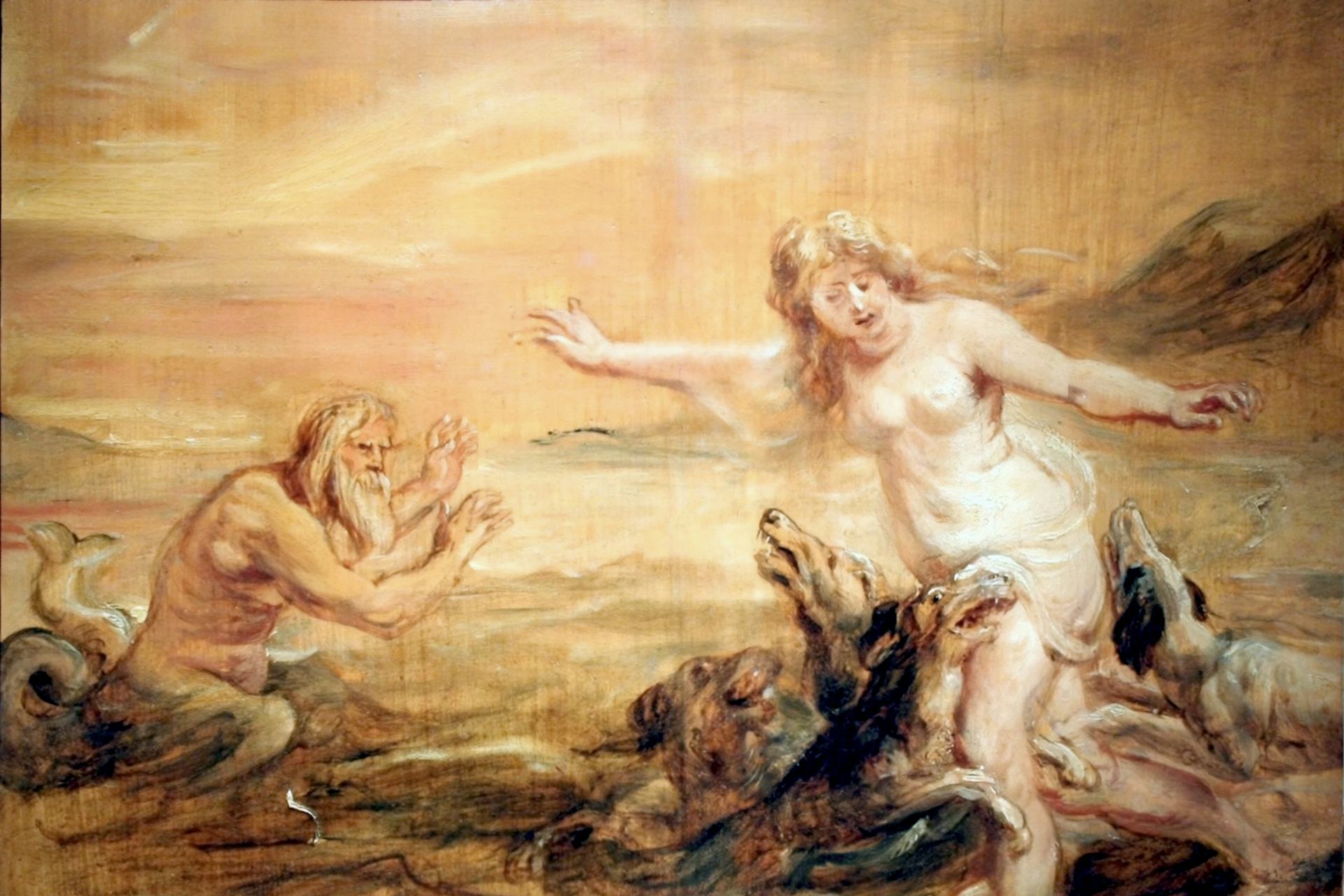
Scylla and Glaucus by Peter Paul Rubens (ca. 1636)
Scylla and Glaucus by Peter Paul Rubens (ca. 1636). Musée Bonnat-Helleu.

Scylla also appears twice in the Liber monstrorum (I.14, II.19), where she is described in detail. This first mention from Liber monstrorum I.14 in the section on humaniod monsters is as follows:

Scylla monstrum nautis inimicissimum in eo freto quod Italiam et Siciliam interluit fuisse perhibetur capite quidem et pectore uirginali sicut sirenae, sed luporum uterum et caudas delfinorum habuit. Et hoc sirenarum et Scyllae distinguit naturam quod ipsae morifero carmine mauigantes decipiunt et illa per uim fortitudinis marinis succinta canibus miserorum fertur lacerasse naufragia.

“It is reckoned that Scylla has been the monster most hostile to sailors in that channel which washes between Italy and Sicily, having indeed the head and chest of a maiden (like the sirens), but the belly of a wolf and the tail of dolphins. And what distinguishes the nature of the sirens from Scylla is that they deceive seamen by their deadly song, whilst she with the strength of her force, girt about with sea-dogs, is said to have mangled the wrecks of the unfortunate .”

Orchard, Pride and Prodigies, 266-67.

This description emphasizes her superlative hostility [inimicissimum]—similar to Grendel’s mother’s characterization as an aglæcwif “fearsome warrior woman” (1259) or wif unhyre “untamed woman” (2120). Emphasis on the narrow channel where Scylla resides shifts to her hybrid representation with “the head and chest of a maiden (like sirens) but the belly of a wolf and the tail of a dolphins” (fuisse perhibetur capite quidem et pectore uirginali sicut sirenae, sed luporum uterum et caudas delfinorum habuit). This establishes Scylla as a woman-canine-marine creature, combining “maiden” (virgo), “wolf” (lupus), and “dolphin” (delphinus) parts. Moreover, she is twice compared to the treacherous sirens, while explaining that unlike the sirens, who use song to ensnare their victims, Scylla uses force, violence and her mighty strength, with her “sea-dogs” (marinis canibus) to take down unfortunate sailors who enter her domain.

Scylla, relief sculpture on a pair of terracotta plaques with glass inlays, late 4th century BCE; in the Metropolitan Museum of Art, New York City. The Metropolitan Museum of Art, New York City, Sandra Brue Gift, 1998 (accession no. 1998.210.1, .2); www.metmuseum.org.

In the second section, centered on bestial monsters, there is an entry on the sea-beasts of Scylla. Liber monstrorum II.19 reads as follows:

fingunt quoque poetae inmari Tyrrheno ceruleos esse canes, qui posteriorem corporis partem cum piscibus habent commune. Ipsis quoque Scyllam ratem Ulixis lacerans marinis succincta canibus describitur.

“the poets also image that there are azure dogs in the Mediterranean, the hind parts of whose bodies they share with fish; also girt round with these same sea-dogs Scylla is described tearing apart the ship of Ulysses”

Orchard, Pride and Prodigies, 266-67.

This entry focuses on the “azure dog” (ceruleos canes) or “sea dogs” (marinis canibus) of Scylla, which are described as featuring canine heads and legs, but “the hind parts of whose bodies they share with fish” (qui posteriorem corporis partem cum piscibus habent commune) making them a canine-marine hybrid creature. Scylla is directly mentioned in connection with her accompanying sea-monsters, and the passage directly references the struggles of Odysseus [i.e. Ulysses] when he encounters Scylla on his epic journey home.
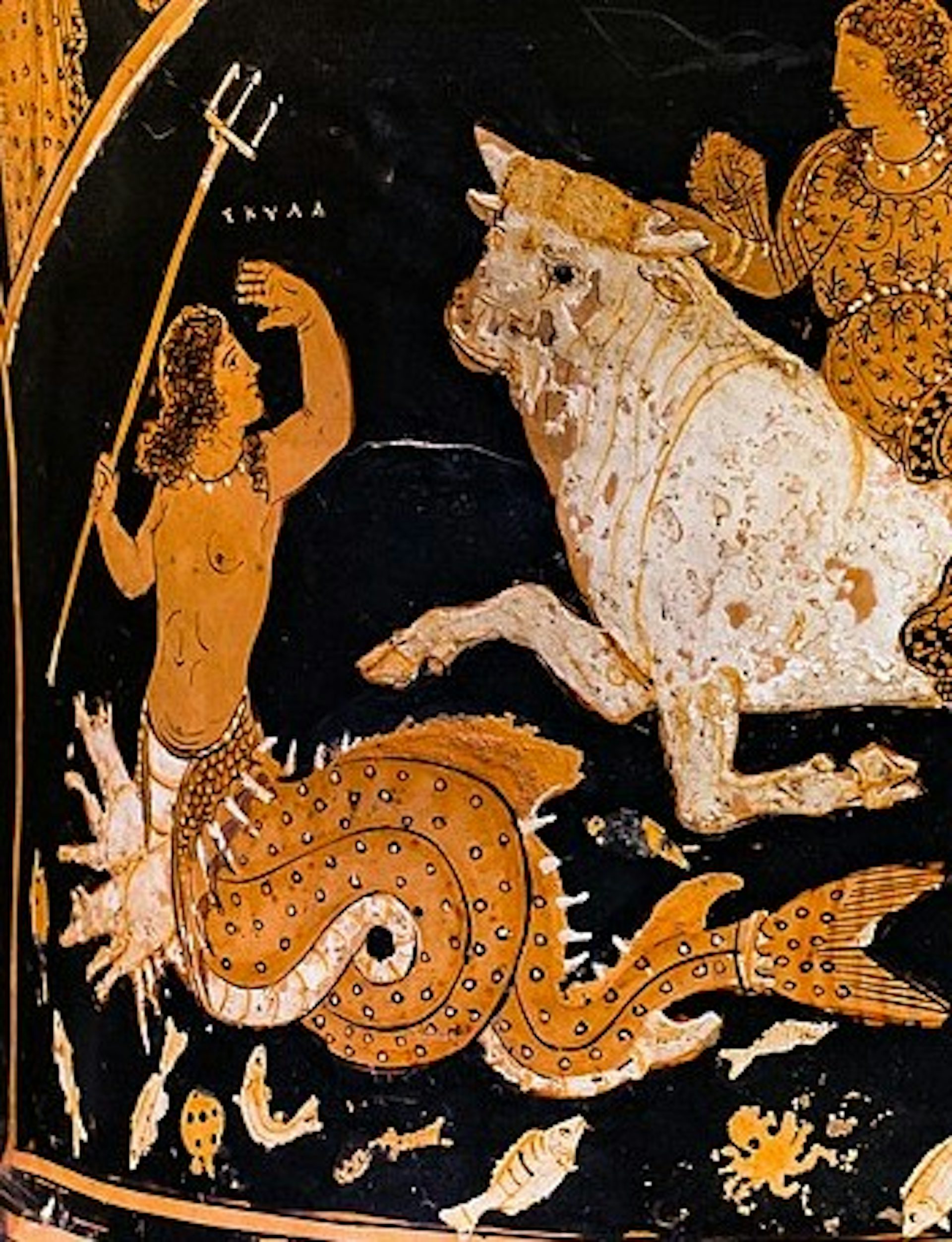
Asteas - Europa on the bull - Dionysos with satyrs and maenads and Pan - Montesarchio
Paestan red figure calyx-crater showing Scylla wielding a trident (ca. 350 BCE). Museo Archeologico Nazionale del Sannio Caudino, Montesarchio. 

The key features of Scylla’s narrow channel are present also in the monster-mere found in Beowulf which is the home and hall of the Grendelkin. Grendel’s Mother’s lair is described in the poem as follows:

Hie dygel lond
warigeað, wulfhleoþu,   windige næssas,
frecne fengelad,   ðær fyrgenstream
under næssa genipu   niþer gewiteð,
flod under foldan
.

“They [Grendelkin] inhabit the secret land, the wolf-slopes, the windy narrows, the dangerous fen-path, where the mountain stream cascades downward under the cover of cliffs, the flood under the land.”

Beowulf, 1357-61.

This description emphasizes the dangerous narrows and the crafty cliffs surrounding the monstrous abode and in this way echoes Scylla’s watery domain. In this passage are numerous references to the steep and narrow geography, especially in descriptions of the wulfhleoþu windige næssas “wolf-slopes (and) windy narrows” (1358), and fyrgenstream under næssa genipu, “a mountain river under the cover of cliffs” (1359-60). As Beowulf enters the waves, he finds himself, like those caught by Scylla in the Odyssey, in a violent struggle for his life at the hands of a ferocious woman who pulls him to the depths of her haunted lake. The narrator explains how:

Bær þa seo brimwylf,   þa heo to botme com,
hringa þengel         to hofe sinum,
swa he ne mihte,         no he þæs modig wæs,
wæpna gewealdan,   ac hine wundra þæs fela
swencte on sunde,         sædeor monig
hildetuxum         heresyrcan bræc,
ehton aglæcan.         ða se eorl ongeat
þæt he in niðsele         nathwylcum wæs,
þær him nænig wæter         wihte ne sceþede,
ne him for hrofsele         hrinan ne mehte
færgripe flodes;         fyrleoht geseah,
blacne leoman,         beorhte scinan.
Ongeat þa se goda         grundwyrgenne,
merewif mihtig .

“When she came to the bottom, the sea-wolf bore the prince of rings to her hall, so he could not, no matter how brave he was, wield weapons, but so many wonders afflicted him while swimming, many a sea-beast poked the battle-armor with battle-tusks, harassed the fearsome assailant (Beowulf). Then the man perceived that he was in some kind of hostile-hall, where no water could harm them at all, nor could the sudden grasps of the flood touch them because of the roofed-hall.  He saw firelight, pale illumination brightly shining. Then the good one (Beowulf) perceived the bottom-wolf, the mighty sea-woman.”

Beowulf, 1506-1519.

Henry Justice Ford “Beowulf battles with Grendels Mother” (1899).

In reading this passage from the poem, we can observe numerous parallels between Grendel’s mother and Scylla, which I believe suggests that the classical monster, frequently featured in Anglo-Latin texts, may have influenced the depiction and characterization of Grendl’s mother. Just like with Scylla’s channel, the monster-mere in Beowulf includes sea-creatures that attack anyone who enters their watery lair. Both Scylla and Grendel’s mother are ancient, cursed and exiled monsters, the former as a result of a witch’s curse, the latter is prediluvian, cursed and marked as kin of Cain. Grendel’s mother seems to travel with sea-beasts (nicoras) which resemble Scylla’s sea-dogs. Both Scylla and Grendel’s mother are hybrid women monsters—featuring both canine or lupine characteristics (as indicated by her description as brimwulf “sea-wolf” and grundwyrgenne “bottom-wolf”) characteristics and piscine or serpentine characteristics (as indicated by her description as merewif “mermaid”). And, both Scylla and Grendel’s mom occupy a craggy narrow passage that is terrifying and dangerous for sailors or sea-men.

While I would not push so far as to contend that Grendel’s mother is intended as a literal representation of Scylla, and while I agree with others who have observed her ethically complex characterization, it seems plausible—even probable—that the famous Scylla could have influenced her enigmatic monsterization. At the very least, many counted among the learned audiences of Beowulf in early medieval England would likely have discerned the numerous and noteworthy parallels between these two monstrous women.

Richard Fahey, PhD
Medieval Institute
University of Notre Damme

Selected Bibliography

Acker, Paul. “Horror and the Maternal in Beowulf.Publication of the Modern Language Association 121.3 (2006): 702-16.

Aldhelm. Aldhelm: The Poetic Works. Translated by Michael Lapidge and James L. Rosier. Dover, NH: D. S. Brewer, 1985.

—. Aldhelm: The Prose Works. Translated by Michael Lapidge and Michael Herren. Cambridge, UK: D. S. Brewer, 1979.

Fahey, Richard. “Enigmatic Design and Psychomachic Monstrosity in Beowulf.” Dissertation: University of Notre Dame, 2020.

Hennequin, M. Wendy. “We’ve Created a Monster: The Strange Case of Grendel’s Mother.” English Studies 89.5 (2008): 503-23.

Klaeber’s Beowulf, 4th Edition. Edited by Robert D. Fulk, Robert E. Bjork and John D. Niles. Toronto, ON: University of Toronto Press, [reprint] 2009.

Kiernan, Kevin S. “Grendel’s Heroic Mother.” In Geardagum 6 (1984): 13-33.

Lockett, Leslie. “The Role of Grendel’s Arm in Feud, Law, and the Narrative Strategy of Beowulf.” In Latin Learning and English Lore: Studies in Anglo-Saxon Literature for Michael Lapidge (I), edited by Katherine O’Brien O’Keeffe and Andy Orchard, 368-88. Toronto, ON: University of Toronto Press, 2005.

Orchard, Andy. A Critical Companion to Beowulf. Cambridge, UK: D.S. Brewer, 2003.

—. Pride and Prodigies: Studies in the Monsters of the Beowulf-Manuscript. Toronto, ON: University of Toronto Press, 1995.

Sayers, William. “Grendel’s Mother, Icelandic Gryla, and Irish Nechta Scene: Eviscerating Fear.” Proceedings of the Harvard Celtic Colloquium 16 (1996): 256-68.
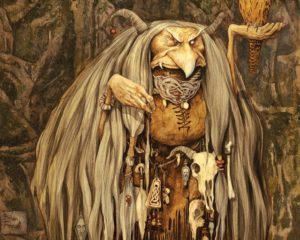
Internet Trolls: Monsters Haunting the World Wide Web

Wendy and Brian Froud, book cover of ‘Trolls’ (2012).

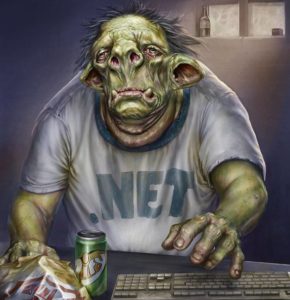
In continuing our previous conversation surrounding the semantics of trǫll in Old Norse-Icelandic literature, and the evolution of the term in modern English, we turn our attention to contemporary applications of the term, particularly in the context of internet trolls and trolling. The concept of  internet trolls builds on the image of a goblin or a giant stalking and skulking about in the dark and the implication that these people are perhaps ugly. This produces a harmful stereotype of “somebody sitting on their bed that weighs 400 pounds,” as Donald Trump remarked in a 2016 debate, in a diversionary (and rather ironic) attempt to draw attention away from evidence of Russian meddling in his favor during the most recent U.S. presidential election.

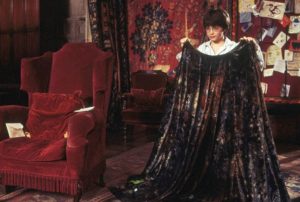
Harry Potter (Daniel Jacob Radcliffe) holding his invisibility cloak in Chris Columbus’s ‘Harry Potter and the Sorcerer’s Stone’ (2001).

However, the reality is that the online shield of anonymity operates as a cloak of invisibility, not unlike the invisibility cloak worn by Harry Potter as he explores Hogwarts castle at night or the tarnkappe “cloak of concealment” that Sîfrit [Siegfried] receives from a dwarf named Alberich in the Middle High German Nibelungenlied. Online anonymity often renders one’s physical fitness either irrelevant or artificial anyway, while at the same time it protects the identities of nefarious actors, thereby allowing them to troll the internet unseen or in disguise. Indeed, the ugliness of internet trolls has everything to do with their emotionally pathetic behavior characterized by cowardly hatred and blind rage.

BrittMartin, ‘Internet Troll’ (2014 – 2020).

Considering this semantic range, a trǫll is not much more specific than the general concept of a “monster” that encompasses everything from sorcerers to goblins and giants to dragons. As we have seen, the medieval tradition bears out the vagueness of this term as a category of being. While the giant-trǫll may be one of the most common applications of the term in saga literature, modern representations of trolls suggest far more uniformity than evidence from medieval literature demonstrates.

However, even the modern sense of troll retains some flexibility, for in addition to the giant-trǫll, much smaller goblin-like representations of trolls (manifesting in the modern troll doll phenomenon) also features prominently in modern medievalism from early modern fairy tales, like those in the Grimm brothers‘ and Hans Christian Andersen‘s collections, to contemporary fantasy literature and film.

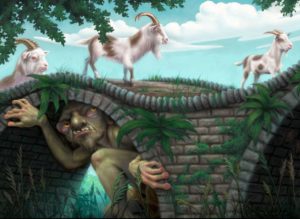
Allen Douglas, ‘The Brothers Gruff’ (2020).

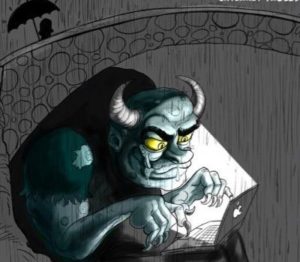
If a troll is principally a monster lurking in the shadows, then the contemporary use of the term to describe a form of cyber-bullying is especially apt. Not everyone agrees on the precise definition of a modern internet troll, and it seems that—in this sense—the semantic ambiguity of the word endures. For some a troll is specifically someone interested in online agitation for the purposes of entertainment, for others a troll is essentially comparable to a cyber-bully and internet stalker. As with some of their medieval counterparts, internet trolls may hunt in packs or prowl alone, though they no longer hide under bridges and caves but instead lurk in the recesses of the world wide web.

The monstrous vitriol, stalking and harassment in which internet trolls engage is notorious, especially on social media platforms such as Twitter, and has furthered cultural trends in discourse toward antagonism rather than cooperation, leading Melania Trump to launch a campaign as first lady against cyber-bullying and online harassment, in other words against the internet trolls.

Alexander Pavlov, ‘Internet Troll Sitting at the Computer’ Vector Illustrations (2003-2020).

Internet trolls have developed a terrible reputation as being a cowardly group of angry individuals. Bernie Sanders, despite unequivocally disavowing any internet trolls among the ranks of his supporters and calling for a government of compassion and justice, suffered from a lasting stereotype of the “Bernie-bro” during both his presidential campaigns, which characterized his grassroots movement as an army of internet trolls, primarily comprised of angry white men terrorizing Twitter. Although a recent Harvard study revealed that the “Bernie-bro” narrative was a myth and suggested that political trolling occurred by supporters of every Democratic candidate at similar rates, this caricature proved impossible for Sanders to shake as a result of the public disdain for internet trolls.

Steve Sack, ‘Troll Trouble’ Star Tribune (2020).

This Harvard study, however, highlighted a different but related issue—namely how ubiquitous trolling has become and the damage it has wrought upon ethical discussion and political conversations in this country regardless of which candidate one supports or with which party one affiliates.

Although Joe Biden does not have the same online presence as Sanders, and has promised to restore decency, he nevertheless embodied the trollish spirit of combativeness, which permeates social media discourse, in his everyday interactions with voters on the campaign trail. Biden repeatedly told those who disagree with him that they should vote for someone else, and at times getting into near physical altercations with Americans who challenged him on his record and policies. Despite both Democratic candidates’ feisty reputations (or in Sanders’ case the reputation of his supporters), both Bernie and Biden were notably amicable and referred to each other frequently and intentionally as friends during the primary. Sanders‘ recent endorsement of Joe Biden for president as the Democratic nominee then comes as no surprise and underscores a shared sense of party unity with the goal of winning back the White House.

US Senator Bernie Sanders (I-VT) and former Vice President Joe Biden hug at February’s debate, Getty Images (2020).

When responding to charges of a “Bernie-bro” culture among his supporters, Sanders has wondered if again, as in 2016, Russian media (especially bots and trolls) might be targeting his campaign, though this claim has been contested. Sanders also noted that in fact some of the most vicious trolling has been aimed at his surrogates and supporters of his campaign and progressive agenda, especially women of color, including his campaign co-chair Nina Turner, and the freshmen congresswomen known as “the squad” three of whom have endorsed Sanders, namely Alexandria Ocasio-Cortez, Ilhan Omar, and Rashida Tlaib. In making this point, Sanders shifted the spotlight onto some of the most marginalized voices in our government who face some of the most vile and threatening trolls haunting the internet.

US Representatives Ilhan Abdullahi Omar (D-MN), Alexandria Ocasio-Cortez (D-NY) and Rashida Tlaib (D-MI) hold a press conference on July 15, 2019 to address remarks President Donald Trump Twitter attacks on them. Photo by Brendan Smialowski/Getty Images (2019).

In our own field of medieval studies, we have observed a similar phenomenon. Medievalists of color, including junior scholars such as Dorothy Kim, Mary Rambaran-Olm, Adam Miyashiro, Sierra Lomuto, Seeta Chaganti and others, have become the target of alt-right trolls as a result of their speaking up against white nationalist appropriations of medieval history, literature and culture and raising the issue of racism within the field itself (and not without resistance). Professional internet trolls, like Milo Yiannopoulos, have pursued ad hominem attacks on some of these scholars in the guise of pseudo-academic arguments, and the internet troll forces involved with the alt-right movement have taken up his call to arms against our colleagues of color in the name of white supremacy, masquerading as nationalism (but centered on issues of ethnocentrism and notions of cultural homogeneity). The threat from modern trolls is indeed as serious as encountering a monstrous trǫll in an Old Norse-Icelandic saga.

Ashva, ‘Ugly Internet Troll’ Vector Illustrations (2003-2020).

Many have argued that Donald Trump is a cyber-bullying wizard, and his supporters notoriously seem to follow his lead. This characterization marks the president as essentially the mesta trǫllgreatest troll” capable of dragon-scale destruction via the internet, which renders his wife’s campaign against online harassment profoundly paradoxical. Moreover, whether it’s demonizing undocumented immigrants, insulting the squad, or attempting to rebrand covid-19 as the “Chinese virus” rather than simply calling it the novel coronavirus, the president is infamous for his straightforwardly offensive, racially loaded and politically incorrect tweets, which inflame racial tensions and partisanship. Trump’s relentless trolling of Climate Change activist Greta Thunberg is perhaps his most opprobrious internet feud, surpassing even his decade-long spat with Rosie O’Donnell

Steve Sack, ‘Feeding the Trolls’ (2019).

While it only takes one brief glance at Trump’s Twitter account to recognize his ferocity, dedication and skill in trolling his political opponents, it is important to recognize that he also receives his fair share of troll-attacks. Perhaps as a result of observing Trump’s effective trolling, Democrats and those criticizing the president have resorted to similar tactics, and have been praised for it, especially when Trump’s statements are trafficking in bigotry or misinformation. Indeed, if the Democratic nominee means to best Trump in the general election, and thereby defeat the greatest troll, as it were, it will certainly require strength of character and no small amount of courage.

Photo by Sofya Levina. Images by Drew Angerer/Getty Images (2016).

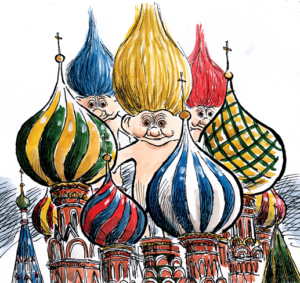
Perhaps the most infamous subcategory of internet troll, which has come under intense scrutiny as a result of their involvement in the 2016 presidential election in the United States, is the Russian troll. The involvement of Russian trolls (and bots) has received a share of credit for Donald Trump’s surprising victory over Hilary Clinton, and the president’s critics have alleged collusion between the Trump campaign and the Russian government, which resulted in a special investigation by Robert Mueller centered on whether there was a conspiracy (with Russia) or obstruction of justice on the part of the administration. This produced the famous Mueller Report that indicted 13 Russian nationals linked to tampering with the U.S. election. This Russian strategic operation was organized by the Internet Research Agency, which CNN describes as “a Kremlin-linked Russian troll group, [which] set up a vast network of fake American activist groups and used the stolen identities of real Americans in an attempt to wreak havoc on the U.S. political system.”

Jeffrey Koterba, Omaha World-Herald ‘Russian Trolls’ (2018).

Now in 2020, the U.S. again finds itself in yet another battle against Russian trolls and the spread of misinformation and disinformation. Russian trolls seem to be focused on antagonizing and disaffecting groups and individuals thereby turning Americans on Americans, as the Mueller Report outlines a “strategic goal to sow discord in the US political system.” Although Russian virtual propaganda and social media trolling certainly may have fanned the flames, the sad truth is the the fire was already burning. What’s worse, anyone and everyone arguing online becomes a potential Russian troll, providing scapegoats and discrediting of the hard work and dedication of many Americans calling for social, racial, environmental and economic justice, and necessary reform to meet these needs.

As the loudest and most provocative views often receive the most traction and attention, especially on social media, internet trolls—whether an operative from the Internet Research Agency or simply troubled person lashing out online—cast long shadows, effectively silencing all those softer voices and further destabilizing civil discourse.

Bryant Arnold, ‘Internet Troll Under a Bridge’ (2013).

In both medieval literature and modern times, we must fight the trolls and the horrors they bestow upon human society. While I am suggesting a sort of call to action against internet trolls and trolling, it is expressly not a call for tone-policing. Critique, even the sharpest criticism—especially of public officials and elected representatives—must be uncensored so the people may speak freely and in whatever (and whichever) language they choose, whether vulgar or polite in tone. However, I am suggesting that we consider changing our rhetorical strategy as a nation and a world.

Legendary heroes often fight trolls by matching their strength and ferocity, by fighting fire with fire, but I believe a different path might be more efficient. Perhaps it is cliché for a medievalist to suggest a hagiographical approach, but I would contend that we could learn a lesson from St. Juliana’s contest with a demon (267-558) in the Old English Juliana by Cynewulf recorded in the Exeter Book (Exeter Cathedral Library MS3051). As a medieval saint might when facing a devil, I believe that it is often best (and more rhetorically effective) to match vice with virtue, anger with empathy, belligerence with amicability and hate with love in order to transform political conversations in America toward more ethical practices.

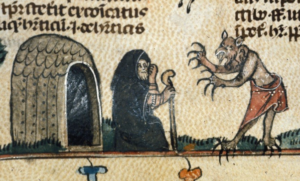
Demon attacks hermit in Smithfield Decretals, British Library, Royal MS 10 E IV, f. 113v.

This rhetorical strategy, meeting vice with virtue, is the centerpiece of the late classical Christian epic, Prudentius’s Psychomachia, often regarded as the first medieval allegory which establishes the robust tradition which follows. In the Psychomachia, demonic vices fight against saintly virtues in what amounts to a battle for the soul of humanity, a phrase which is repeatedly invoked regarding our current political moment. Although the Psychomachia frames its narrative in reductive notions of good and evil, it nevertheless argues that the strongest way to combat monstrous vices ira “wrath,” superbia “pride,” luxuria “luxury” and avaritia “greed” is with inverse behavior, in other words, the heroic virtues of patientia “patience,” humilitas “humility,” sobrietas “sobriety,” and operatio “service.”

Sobrietas defeats Luxuria, the vice is ultimately caught in the wheels of her own war-chariot and destroyed, British Library, Add MS 24199 f.20v.

Of course, we must continue the constant battle against what can seem like an endless horde of internet trolls, and it is all too tempting, and necessary at times, to get into the proverbial mud and valiantly take the fight to them in their digital lairs (usually located somewhere in the comment section) as heroes often do in saga literature and fantasy novels.

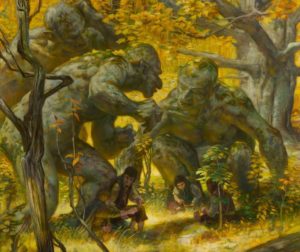
We might also note that in the Hobbit, the grey wizard Gandalf initiates and perpetuates an argument between three stone-trolls in an effort to stall and prevent the monsters from devouring Thorin’s company (ch 2: “Roast Mutton“). Gandalf’s ventriloquism mirrors the trolls‘ level of discourse, and eventually not only does their bickering delay their eating the dwarves, it causes the trolls to forget about the approaching dawn, which turns them to stone. Perhaps there is something of a serendipitous metaphor in the argument between the wizard and the trolls in the Hobbit, which suggests that in order to overcome trolls, one must beat them at their own game and hope they self-destruct.

DonatoArts, ‘Lunch with William, Tom and Bert’ (2018-2020).

Indeed, like Grettir wreaking vengeance upon the trǫllkona mikil “great troll-woman” in Grettis saga (ch. 65), it may be that sometimes the only way to respond to a troll is to retaliate in some form. But there is also another kind of strength, kinder but no less powerful. While it is often impossible to starve trolls by ignoring them, and acknowledging that no single strategy will always prove effective, it may nevertheless be that the most productive way to defeat internet trolls is through sustained civil discourse in the spirit of generosity. In other words, kill them with kindness.

Richard Fahey
PhD in English (2020)
University of Notre Dame

Texts and Translations

Andersen, Hans Christian. Fairy Tales and Stories, translation by H. P. Paull (1872).

Byock, Jesse. Grettir’s Saga. Oxford University Press (2009).

Grimm, Jakob, and Wilhelm Grimm. Grimm’s Household Tales, translation by Margaret Hunt (1884).

Cynewulf. Juliana. In Anglo-Saxon Narrative Poetry Project, translation by Aaron K. Hostetter. Rutgers University (2007).

Margaret Armour. The Nibelungenlied. In Parentheses Publications (1999).

Mueller, Robert. Report On The Investigation Into Russian Interference In The 2016 Presidential Election. Special Counsel Office (2019).

Prudentius. Psychomachia. In Prudentius, with an English translation by H.J. Thomson (1949).

Rowling, J. K. Harry Potter and the Philosopher’s Stone. Bloomsbury (1997).

Tolkien, J. R. R. The Hobbit, or There and Back Again. Allen & Unwin (1937).

Further Reading

Ashkenas, Jeremy. “Was It a 400-Pound, 14-Year-Old Hacker, or Russia? Here’s Some of the Evidence.” The New York Times (2017).

Chaganti, Seeta. “Statement Regarding ICMS Kalamazoo.” Medievalists of Color (2018).

Fahey, Richard. “Medieval Trolls: Monsters from Scandinavian Myth and Legend.” Medieval Studies Research Blog. University of Notre Dame (2020).

Grendell, Alexis. “Should We Have a Right to Troll Politicians on Twitter?The Nation (2019).

Hanson, James. “Trolls and Their Impact on Social Media.” University of Nebraska-Lincoln (2018).

Jones, Brandon G. “Harvard Scientist Analyzes 6.8 Million Tweets, Finds Bernie Sanders Supporters Are NOT More Abusive.” ABC 14 News (2020).

Kim, Dorothy. “White Supremacists Have Weaponized an Imaginary Viking Past. It’s Time to Reclaim the Real History.” Time (2019).

—. “Teaching Medieval Studies in a Time of White Supremacy.” In the Middle (2017).

Klempka, Allison and Arielle Stimson. Anonymous Communication on the Internet and Trolling. Concordia University (2017).

Kosoff, Maya. “Why the Right’s Dark-Web Trolls Are Taking Over Youtube.” Vanity Fair (2018).

Lahut, Jake. “Joe Biden Gets Away with Yelling at Voters, and May Even Benefit from It.” Business Insider (2020).

Leigh, Kira. “Fantastic Internet Trolls and How to Fight Them.” Medium (2017).

Lewis, Simon. “Bernie Sanders to Online Trolls: Stop ‘Ugly Personal Attacks.” Reuters (2020).

Lindgren, Émelie Vangen. “Trolls in Your Comment Section and How to Fight Them.” Medium (2017).

Lomuto, Sierra. “White Nationalism and the Ethics of Medieval Studies.” In the Middle (2016).

Martin, Tess. “Racism 101: Tone Policing.” Medium (2018).

McQuade, Barbara and Joyce White Vance. “These 11 Mueller Report Myth Just Won’t Die. Here’s Why They’re Wrong.” Time (2019).

Miyashiro, Adam. “Decolonizing Anglo-Saxon Studies: A Response to ISAS in Honolulu.” In the Middle (2017).

Noor, Poopy. “Trump’s Troll-in-Chief? Once Again, Nancy Pelosi Bites Back.” The Guardian (2019).

Perry, David. “How to Fight 8Chan Medievalism—and Why We Must.” Pacific Standard (2019).

 Mary. “Misnaming the Medieval: Rejecting ‘Anglo-Saxon’ Studies.” History Workshop (2019).

Ray, Alison. “The Psychomachia: An Early Medieval Comic Book.British Library (2015).

Read, Bridget. “I’m Sorry, What Did Biden Say to This Voter?The Cut (2019).

Roll, Nick, “A Schism in Medieval Studies, for All to See.” Inside Higher Ed (2017).

Sarsour, Linda. “Yes, Women of Color Support Bernie Sanders. It’s Time to Stop Erasing Our Voices.” Teen Vogue (2019).

Silver, Nate. “Donald Trump is the World’s Greatest Troll.” FiveThirtyEight (2015).

Spencer, Kieth A. “There Is Hard Data That Shows ‘Bernie Bros’ Are a Myth.” Salon (2020).

Sax, David. “‘If You Fight Fire with Fire, Everyone Burns’: How to Catch a Troll Like Trump.” The Guardian (2016).

Sebenius, Alyza. “Russian Trolls Shift Strategy to Disrupt U. S. Election in 2020.” Bloomberg (2020).

Stratton, Erica. “6 Ways to Fight Trolls Instead of Starving Them.” The Airship (2014).

Vinsonhaler, Christine. “The HearmscaÞa and the Handshake: Desire and Disruption in the Grendel Episode.” Comitatus 47 (2016): 1-36.

Waters, Lowenna. “AOC Destroys ‘Misogynist’ Twitter Troll with One Simple Comment: ‘I Don’t Give a Damn.” Indy100 & Independent (2019).