Crafting a New Kind of Renaissance Faire: Theatrical Medievalism and the Aesthetic of Wonder

I am always looking for my next adventure, and so this past year I took a risk and wandered into new territory. Through creative partnership with my wife, Rajuli Fahey, and the many folks involved in what became FaeGuild Wonders, we together built not one but two inaugural Renaissances Faires in Massachusetts. Rajuli served as Art & Entertainment Director, and Stage Manager (and one of the Vending Coordinators at the latter faire), I served as Creative & Theatrical Director, Playwright and Academic Consultant for both Wyndonshire Renaissance Faire at the Community Park in our resident town of Winchendon, MA and Enchanted Orchard Renaissance Faire at Red Apple Farm just down the road in nearby Phillipston, MA.
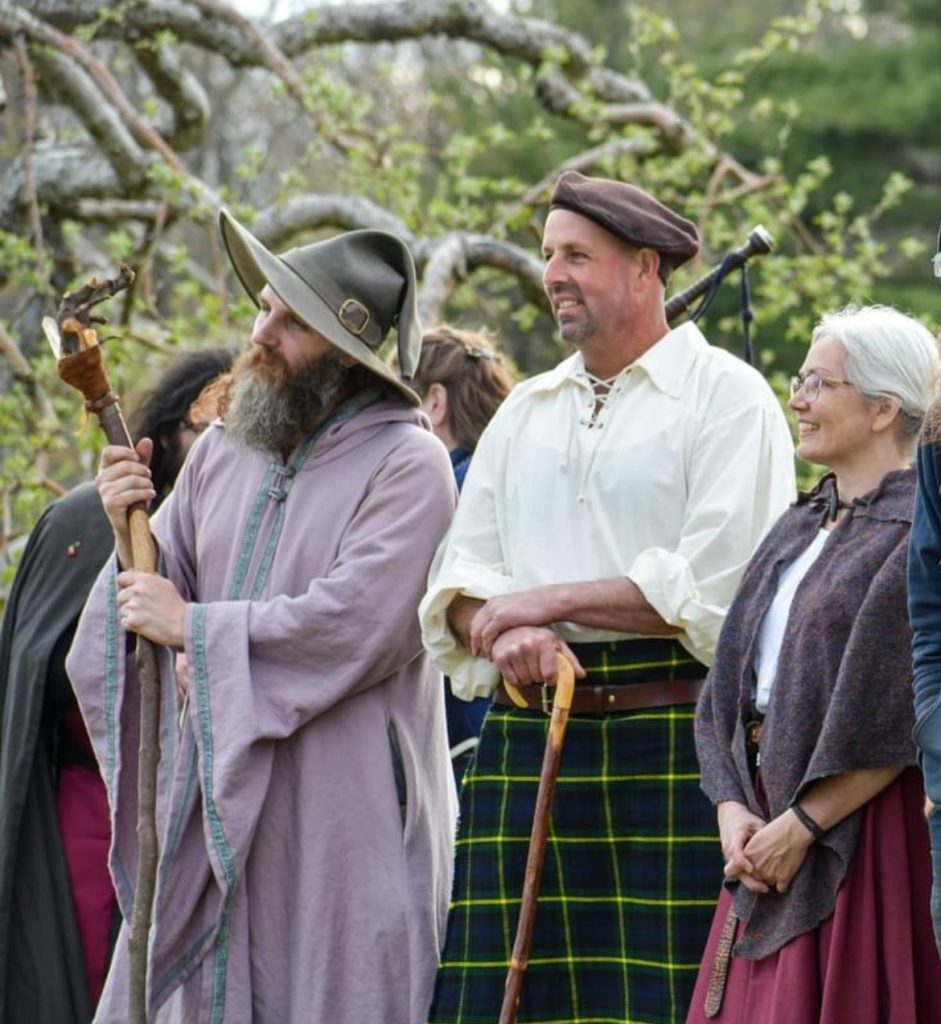
Witnessing the Maypole Dance at Enchanted Orchard: Orchard Wizard (Creative & Theatrical Director, Richard Fahey), Orchard Steward (Red Apple Farm Owner, Al Rose), Orchard Stewardess (Red Apple Farm Owner, Nancy Rose); Image by Richard Carter (May 4th, 2025).

Public medievalism has long been a professional interest and personal passion of mine, and although I enjoy scholarship and traditional ways of academically engaging with medieval history, literature and culture, I am also drawn to the fantastic and wondrous, to the creative and adaptive, and it has long been a personal dream to produce full-scale Renaissance Faire that takes medieval literature and the aesthetic of wonder as its creative direction. Indeed, during my PhD studies at the University of Notre Dame, I organized a small-scale theatrical production called Grendelkin, which featured innovative and avant-garde performances related to Beowulf, which brought together musical artists, professional dancers and early medieval English scholars.
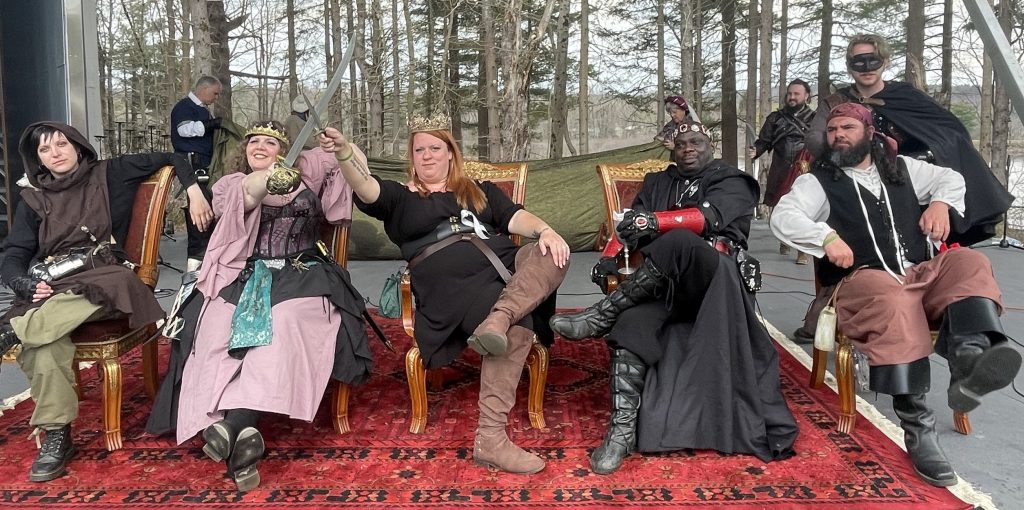
The Rogue Council of Wyndonshire: Hooded Rogue (Mandalina Blake), Pirate Queen (Katharine Taylor), Robber Baroness (Micayla Sullivan), Master of Arms (Keith Fisher), Pirate Quartermaster (Jarod Tavares), Masked Bandit (Mitch Lang); In back: Captain of the Kingsguard (Richard Carter), Blue Duchess (Lori Evans), Baronsguard (Ben Becker); Image by Adam Blake (April 27th, 2024).

The project’s scope expanded well beyond anything I might have anticipated when I signed on to be a Member of a Planning Group in our small Town of Winchendon, agreeing to create characters and produce a script, storyline and lore for Park & Recreation Member Dawn Higgins’ RenFaire initiative. Of course, there were many challenges to overcome along the way, some from the nature of startup projects and some from the circumstances surrounding organizing two distinct faires with very different models and storylines, which debuted back-to-back weekends this spring. While my blog today is in part a celebration of both events, it will center primarily on the creative inspiration and direction that shape both Renfaires and the world-building aspects that allowed me to leverage my expertise and love of medieval literature, especially that which contains monstrous and wondrous elements, in my creative process.
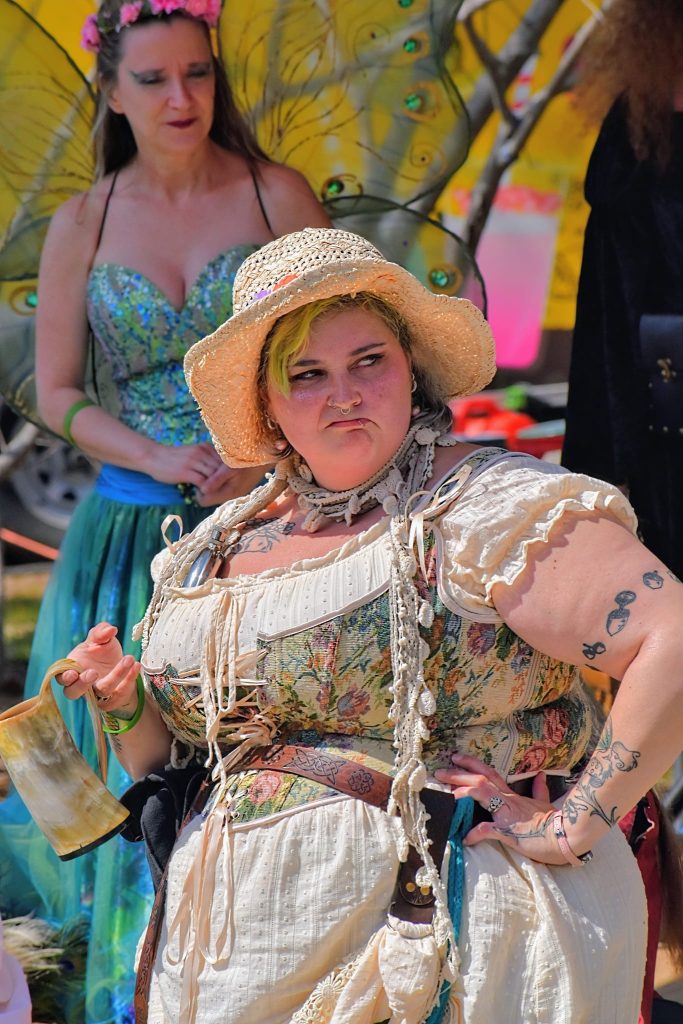
Wyndonshire Fairy (Jodi Schoolcraft) & Wyndonshire Town Crier (Leanne Blake), Image by Kit Catlett (April 27th, 2024).

However, before we dive too deep into the creative process, a brief description of both faires is in order:

Wyndonshire Renaissance Faire

For this faire, Rajuli and I both volunteered our professional services in order to support our town, local community and the beautiful amphitheater at the Winchendon Community Park. As the project grew so did our roles in the production of Wyndonshire. What began as a modest endeavor bloomed into a full-blown production that welcomed and engaged the local art community. Although all of the characters are fictitious (some cocreated with the character actors themselves), I based the House names around prominent families from Winchendon (the Murdocks and Whitneys in particular), though there is no intended relationship (allegorical or otherwise) between the Wyndonshire nobles and said historical families. This year’s plotline centered around “The Wyndonshire Wedding” between the Blue Princess (played by Melony “Melegie” Lemony) and Green Prince (played by Drew Dias). The wedding is coupled with political intrigue and subterfuge, resulting in a contest for power between the Blue King (played by James Higgins), Green Queen (played by Tammy Dykstra) and Red Baron (played by Dave Fournier) and culminating in a peasant revolt featuring rogues, pirates and marauders led by the Robber Baroness (played by Micayla Sullivan), the Pirate Queen (played by Katharine Taylor) and the Viking Jarl (played by Jason Sumrall).
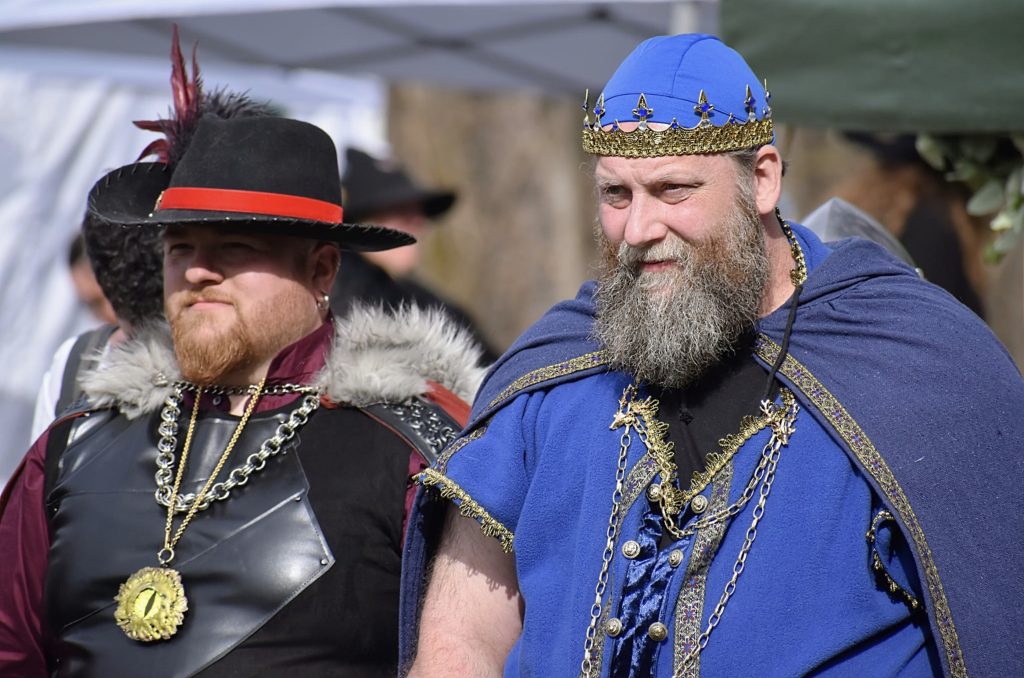
The Red Baron (Dave Fournier) and Blue King (James Higgins) of Wyndonshire; Image by Kit Catlett (April 27, 2024).

Enchanted Orchard Renaissance Faire

After Wyndonshire was underway, this faire was conceived in collaboration with a local farm and festival venue, Red Apple Farm, owned by Al and Nancy Rose, who were excited to cocreate an event such as this in order to advertise their growing business, provide interactive and experience-based agricultural awareness, bring tourism to the surrounding area and support both the regional economy and artist community. Enchanted Orchard Renaissance Faire features fictitious characters and storylines that are centered on sustainable farming practices and agrarian life which was the bedrock for the medieval world. The main conflict concerns a disagreement between the nobles as to whether or not to expand the orchard or preserve the forest, with the Orchard King (played by Paul Taft) and Blossom Baroness (played by Jen Knight) advocating for conservation and the May Queen (played by Tammy Dykstra) and Duke of Thorns (played by Dave Fournier) opposing and advocating for preservation, ending with an unexpected marriage proposal and announcement between the Prince of Leaves (Michael Barboza-McLean) and the Blueberry Princess (Melanie “Melegie” Lemony).
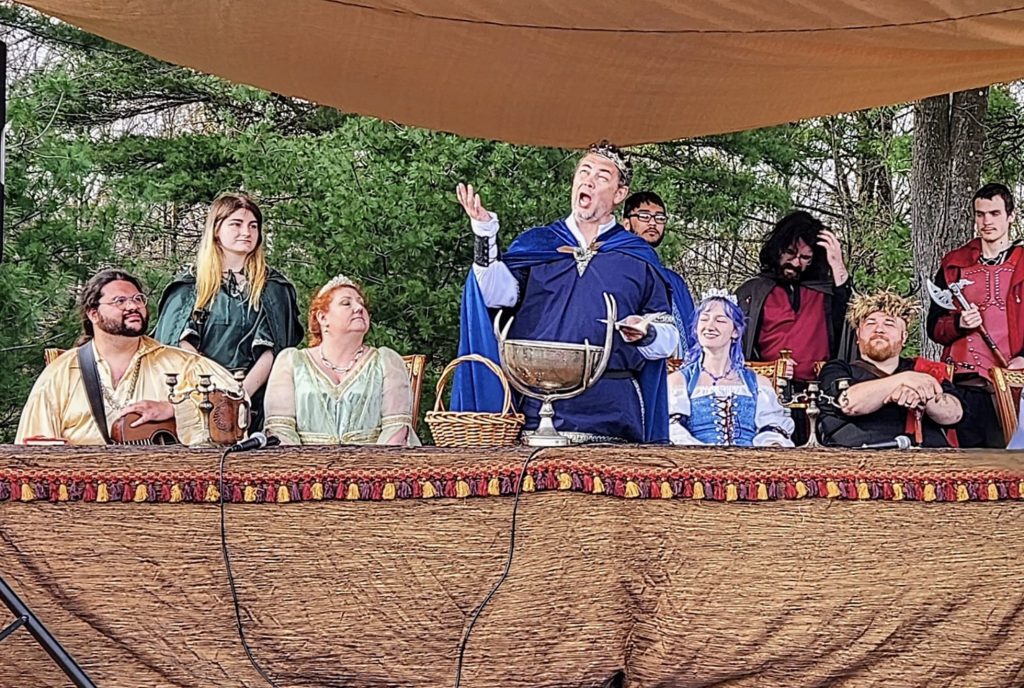
Enchanted Orchard Knights and Nobles: Prince of Leaves (Barboza-McLean), Green Knight (Quinne Richard), May Queen (Tammy Dykstra), Orchard King (Paul Taft), Blue Knight (Ayden Mel), Blueberry Princess (Melanie “Melegie” Lemony), Red Knight (Dan Towle), Duke of Thorns (Dave Fournier), Hand of the Duke (Devon Barker); Image by Kit Catlett (May 4th, 2024).

These events included performances by musical and theatrical groups such as The Knights of Lord Talbot, Meraki Caravan, The Phoenix Swords, The Shank Painters, The Harlot Queens, The Warlock Wondershow, The Misfits of Avalon, Diva Di, Dead Gods are the New Gods, The Green Sash, The Mt. Wichusett Witches, Skeleton Crew Theater, Massachusetts Historical Swordsmanship [HEMA], The Ditrani Brothers, Nagashri Dancers, PsyBEL, Our Dance Space and numerous solo performers.

Obviously, RenFaires are at their core fantasy. They do not reflect in any consistent or credible way the historical realities of the medieval or early modern period, and even those groups and projects that are purportedly more focused and committed to historical accuracy, such as the Society for Creative Anachronism [SCA] and Pennsic Wars, acknowledge the deep limitations of attempting to recreate a historical past in the present: it’s simply not possible.
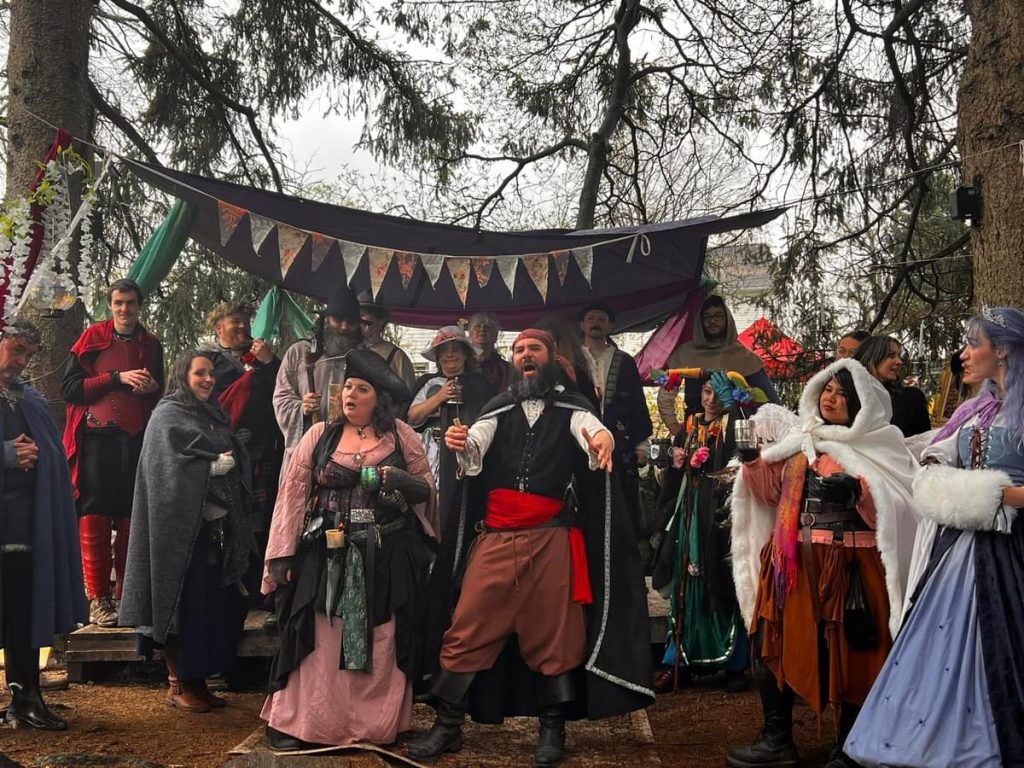
Enchanted Orchard Pub Sing: Orchard King (Paul Taft), Hand of the Duke (Devon Barker), Viking Shieldmaiden (Sylvia Sandridge), Duke of Thorns (Dave Fournier), Orchard Wizard (Richard Fahey), Orchard Herald (Nikolaus Brauer-Chagnon), Pirate Queen (Katharine Taylor), Blossom Baroness (Jen Knight), Countess of the Rose (Dawn Higgins), Pirate Quartermaster (Jarod Tavares), Weird Sister (Siobhan Doherty), Wyndonshire Herald (Alex Deschenes), Blue Knight (Ayden Mel), Orchard Jester (Chelsey Patriss), Siren (Jessa Funa), Prince of Leaves (Michael Barboza-McLean), Orchard Enchantress (Rajuli Fahey), Blueberry Princess (Melanie “Melegie” Lemony); Image by Richard Carter (May 5th, 2025).

Although folks certainly do not (and cannot despite best efforts) actually travel back in time when attending a RenFaire, and many of the performance groups embed non-historical or fantastic elements, the desire to experience something historically adjacent, something medievalish, to invoke modern perceptions (and at times misconceptions) of premodern times, and to be immersed in a world of medievalism, has bloomed in recent years and will likely continue to grow. As a medievalist interested in the intersection between medieval studies and medievalism, my goal in cocreating and directing these RenFaires was never to recreate the historical past or attempt to conjure the authentic premodern world, but rather to evoke the experience and aesthetic of wonder that imbues so many of the works of medieval literature I love most and which dramatize the monstrous, the magical, the mysterious, miraculous and the uncanny. I asked myself and the Muses two essential questions: 1.) what would it be like to walk into a work of medieval literature? And, 2.) what would it be like to walk into a medievalesque fantasy world?
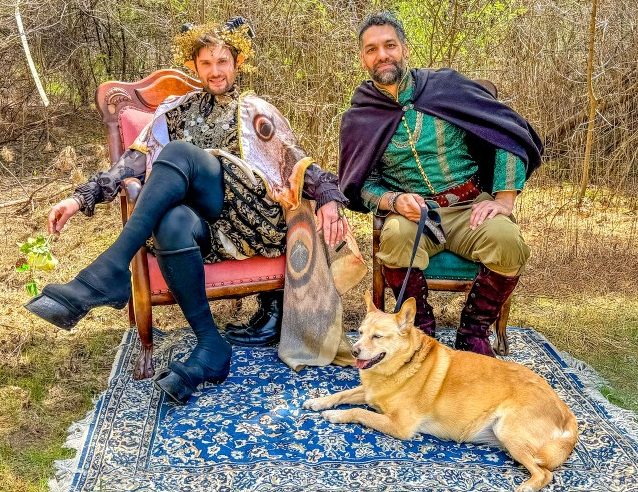
Princes of Wyndonshire: the Satyr Prince (Sasha Khetarpal-Vasser) and the Green Prince (Drew Dias); Image by Mitch Grosky (April 27th, 2024).

I knew I wanted the experience to be highly immersive. I wanted folks attending to feel part of something—to have almost crossed into a fairyworld or an uncanny realm. I wanted the experience to be overwhelming, with too much to possibly see or do. I wanted to create the illusion of entering a world that is alive with everything from town gossip to its own historiography and mythography. Most of all, I wanted the patrons to experience the wonder that is embedded throughout medieval literature and that makes medievalism such a joy to modern audiences. I decided to include both stage performances and many immersive skits, as well as multiple interlacing subplots that come together at various points throughout the events.
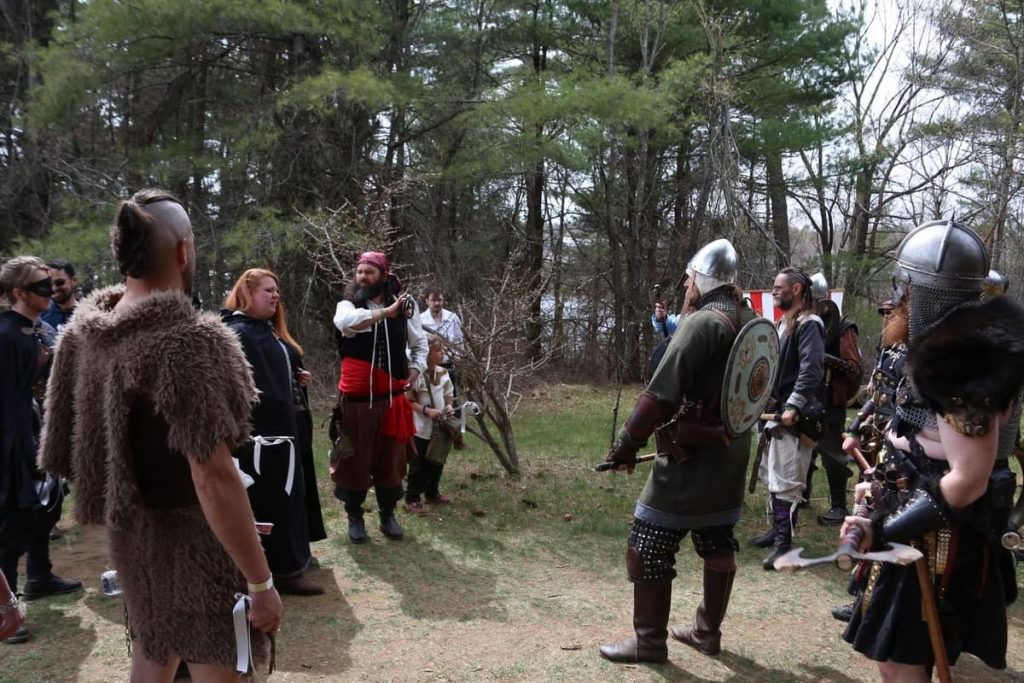
Wyndonshire Rogues and the Green Sash Marauders: Masked Bandit (Mitch Lang), Robber Baroness (Micayla Sullivan), Pirate Quartermaster (Jarod Tavares), Viking Jarl (Jason Sumrall), Viking Warrior (Jeffery Allen Evans), Viking Berserker (Andrew Hamel) & Wyndonshire patrons; Image by Richard Fahey (April 28th, 2024).

In the end, both faires were a wicked good time and proved to be huge successes—for the town and for the farm—and from these experiences a community formed into a sort of immersive theater company, FaeGuild Wonders. Because of our unique approach to these Renaissance Faires, the immersive and theatrical dramatizations in particular, and the inclusive spirit of community present at these events, we received some local press leading up to and after their debuts. But the best part of the entire process for me, personally, was not even seeing my vision come to life—it was the community building and getting to collaborate with my friends and family.
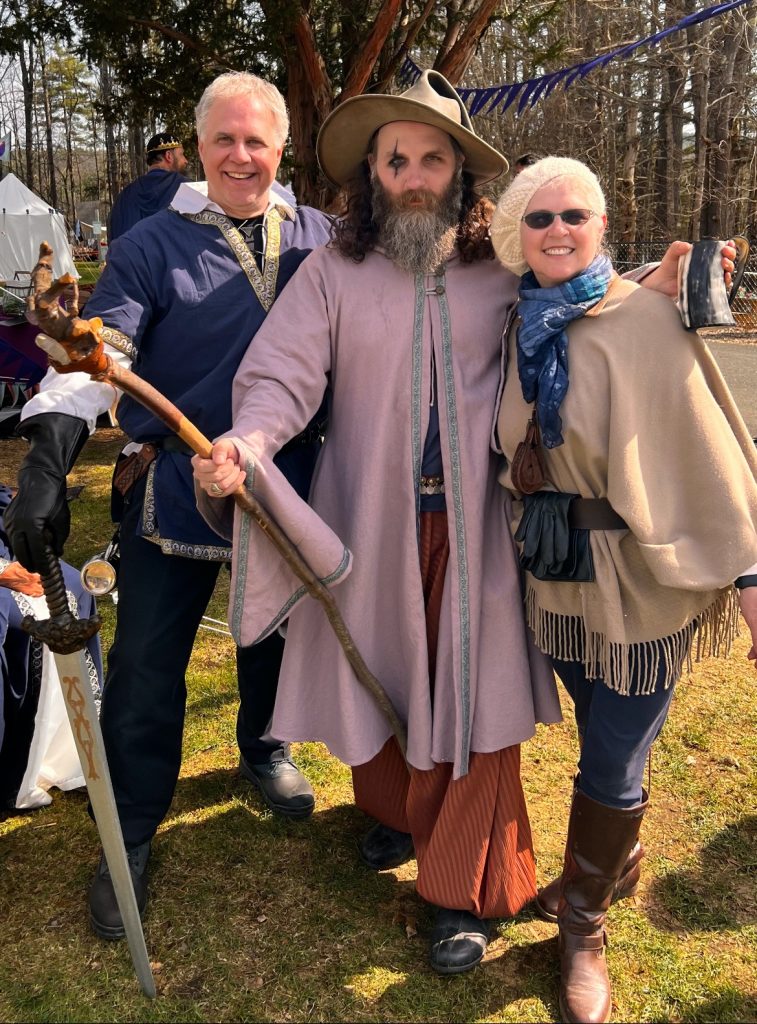
Captain of the Kingsguard (Richard Carter), Wizard of Wyndonshire (Richard Fahey), Kingsguard (Kellie Carter); in back: Blue King (James Higgins); Image by patron for Richard Carter (April 27th, 2024).

I could talk about each event in detail, exploring the ways I engage the medieval aesthetic of wonder as well as the modern imaginary, but those will likely be the substance of future blogs on Wyndonshire and Enchanted Orchard. Most exciting of all for me to share is a brand-new event that Rajuli and I are planning and directing this winter, again in collaboration with the Red Apple Farm team led by the Roses (because they were such awesome partners): the Northfolk Nightmarket on February 22nd and 23rd 2025. This will offer me the incredible opportunity to dramatize the story of Beowulf, the subject of my dissertation and the majority of my scholarship, and interweave the story into an inaugural event which will draw inspiration directly from medieval lore, literature, myth and legend. Perhaps we’ll see you there?

Richard Fahey, PhD in English
Medieval Institute
University of Notre Dame
Seeing the Medieval Together

Back in November, I spent some time wondering about how the spring 2024 iteration of the “Why the Middle Ages Matter” course at John Adams High School would unfold. I spent the last few weeks of 2023 refining my syllabus, working on lesson plans, communicating with guest speakers, and arranging field trips. Looking back, I think I spent so much time preparing for the course because it was all so new to me. The biggest thing that got me nervous was the fact that I would be teaching high schoolers. My prior teaching experiences involved courses designed for university students, so I worried about my ability to make things resonate with a different audience. Furthermore, for the first time I would be leading a teaching team, coordinating with over a dozen guest lecturers, and planning two field trips. I really wanted it to be a good experience for everyone involved. 

Now that it is May and teaching for the course has wrapped up, I like to believe that I can say that things worked out rather well. We all survived! I had six lovely students enrolled in the course. They came from different walks of life and had varying degrees of familiarity with the Middle Ages. These students were all united by their curiosity and eagerness to learn. They impressed me, other members of the teaching team, and my guest lecturers with their questions and comments. I got the impression that they saw our time together during the fourth hour of school as a time to experiment and take risks. They never worried about if a question was partially formulated or about sounding like a novice. Time and time again I thought about how fortunate I was to have such engaged students. Together, we tracked changes around the Mediterranean and beyond as curious co-investigators. With guest lecturers as our guides on our journey, our collective knowledge grew. Field trips allowed us to think beyond the confines of the classroom and encounter cultural productions from the times and places we discussed. They made the Middle Ages feel more real.

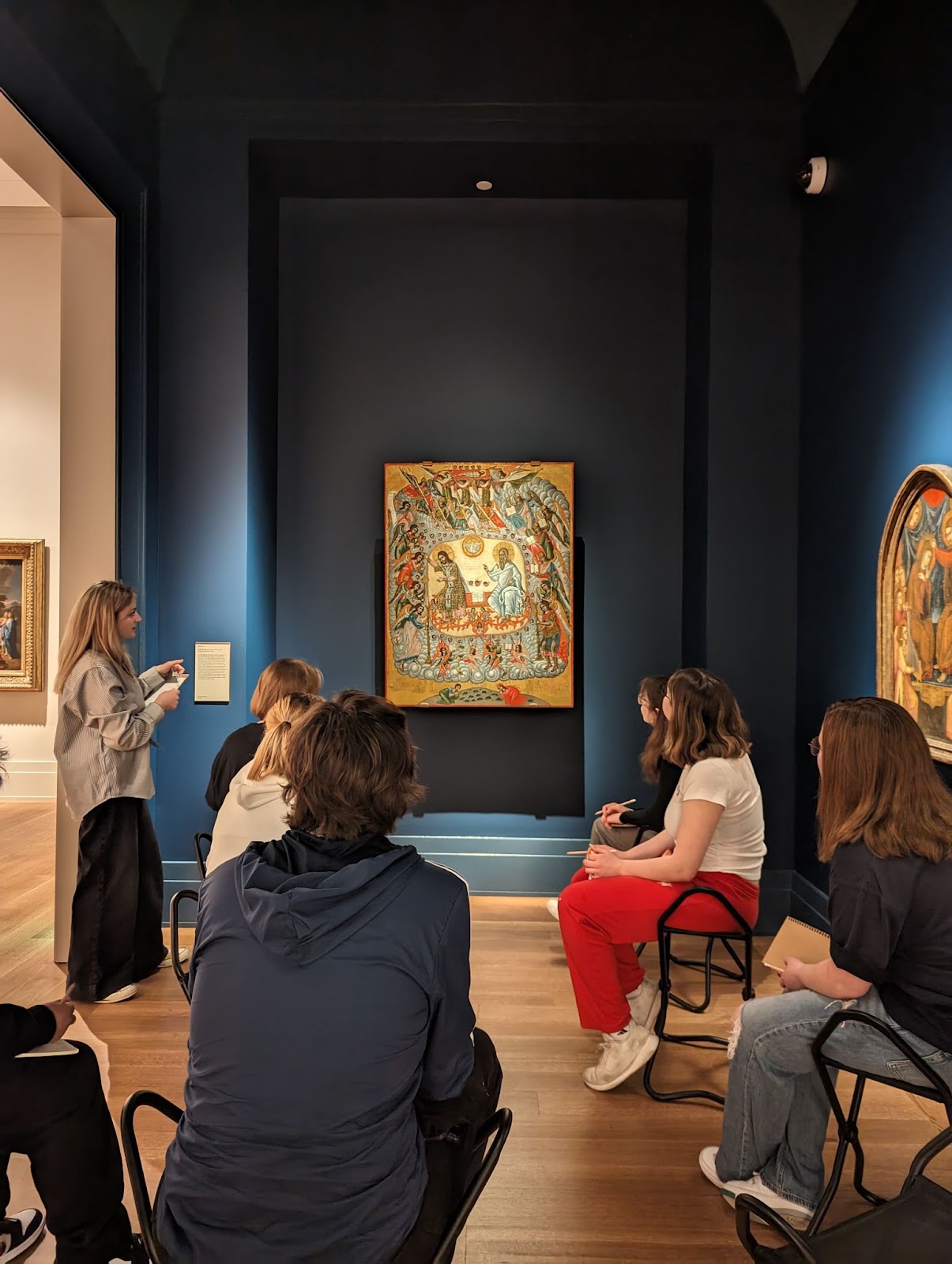
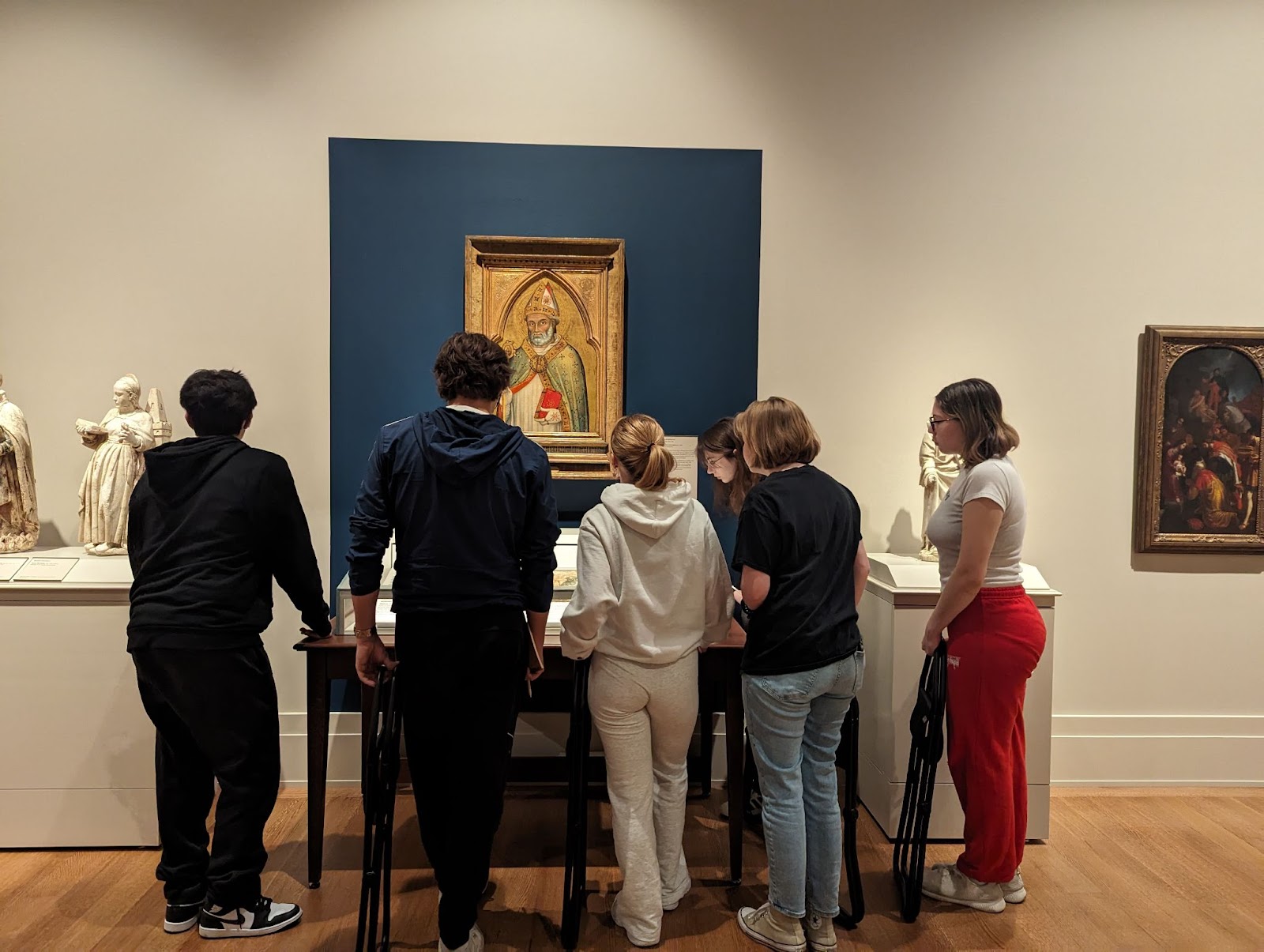
We as a class came to the consensus that our trip in mid-April to the Raclin Murphy Museum was a highlight. They were dazzled by the brand-new building, the high ceilings, and impressive gallery spaces. This was the first visit to the museum for all but one of my students. Maggie Dosch, the Assistant Curator of Education School Programs, was our North Star and guiding light as she led us through her thoughtfully-crafted tour and lesson plan. The teacher became a student as I relinquished control to Maggie and her expertise. She shared so much knowledge with us that morning as she led us through close-readings of various works of art.


Maggie Dosch (left, standing), Assistant Curator of Education School Programs, guides students from John Adams High School, South Bend, IN through a close reading of a piece depicting Byzantine iconography. 

Maggie started us off with a selection of pieces from the gallery that features European Art Through 1700. It was wonderful to see my students outside of our typical classroom setting. Instead of sitting in classic student desks facing the front of our cider-blocked classroom, we were all huddled together around various tableaus and sculptures. With nothing but our humble, portable stools and notebooks and pencils, we were all equals in Maggie’s moving classroom. I found myself joining my students in asking Maggie questions about context and materiality. We all wanted to take advantage of being in the presence of someone who knew the gallery and pieces so intimately. She had us all eating out of the palm of her hand as she told us about the process of gilding, reliquaries, and more. Maggie had choreographed a beautiful,  delicate dance that allowed her to move gracefully between the medieval and the contemporary. We saw works from Byzantium and Italy and beyond. Indeed, she took us on a journey around the Mediterranean even though we never really ever left South Bend. Before we knew it, our time with Maggie was done. She only had an hour to spend with us before she had to move onto her next group.

Over lunch at a nearby fast casual restaurant, my students groaned about how short the visit was. Why couldn’t we have doubled or even tripled our time? There was so much more to see and explore! We barely scratched the surface! As they chatted amongst themselves over a feast of pizza and soda, I could hear them asking each other about their favorite parts of the visit. It was great, as an instructor, to know that my students were having these conversations organically among themselves. When lunch time came to an end and we had to make our way back to John Adams High School, I reminded them that the Raclin Murphy Museum is a community resource – they were welcome to return with their friends and family. Many seemed eager to plan for their next visit!


Students from John Adams High School, South Bend, IN gather around a display detailing various inks used during the Middle Ages as well as the process of gilding

Indeed, experiential learning is crucial for making the Middle Ages matter to these students. It is one thing to work with primary sources, listen to guest lecturers, and look at art and architecture on PowerPoint slides. It is another thing entirely to get outside of the conventional classroom setting and encounter a work from the past in an intimate setting. It is a privilege to have an expert help you make various connections between artistic techniques, influences, and historical context. It is powerful to share your observations in real time with someone who can answer any questions you may have as well as provide more insights. It is a way to break down barriers.

Years from now, I have a feeling that my students will not remember me. I mean, I am guilty of not remembering all the names of my wonderful instructors! As time passes, the details of this class might become fuzzy. My students might be able to tell others something along the lines of, “yeah, I took a medieval studies class in high school that was in partnership with the University of Notre Dame.” Perhaps they will recall a guest lecture or two. They might still have a booklet that they made when Dr. Megan Hall came and taught them about medieval book making technologies. Time can take a toll on memory. Despite this, what I hope is that their visit to the museum will become something they can fondly remember years from now. I think about their course evaluations and how they wrote how appreciative they were to be in such an immersive environment. Indeed, experiential learning is powerful. It allows for one to make meaningful connections between classroom lessons and important takeaways. Sensing the Middle Ages is different from reading about it. It allows us to be transported. We are challenged to ask questions about context, movement, materiality, and more. I am so proud of my students, who embraced their status as novices. May they hold onto their curiosity, kindness, and wit as they grow older and experience new things. As for our limited time as a class: we got to see the medieval together, and for that I am forever grateful.

Anne Le, Ph.D.
Public Humanities Postdoctoral Fellow
Medieval Institute
University of Notre Dame
Learning about Learned Medieval Women with Dr. Megan J. Hall

This week, we’re looking back at an earlier episode of “Meeting in the Middle Ages.” In late 2022, we chatted with Dr. Megan J. Hall, Assistant Director of the Medieval Institute at the University of Notre Dame. We spoke with her about women’s literacy and learning in medieval England, the trials and tribulations of writing an academic article, and why impromptu bell-ringing can reveal the true value of scholarship.

Studying history can show us the bigger picture. It can help to explain why nation states behave as they do, why complex geopolitical situations emerge, and how entire landscapes have been shaped over time. But it also allows us to connect with the past on a local level. It can show us where we come from. Speaking with Dr. Hall, we were reminded several times that through historical research, people can identify with those who came before. Moments of identity like that can drastically reshape our relationship with the past. Dr. Hall’s meeting with a group of bellringers in rural England is a perfect example. During this surprise encounter, she was able to share her own work with the group and participate in a tradition of bell ringing which has centuries of history. Her work prompted one of the group to ask ‘so, could women read in the Middle Ages?’ Dr. Hall was able to correct a common misconception of women and the possibilities open to them in medieval England. Yes, some women could read! Some books were written specifically for women! This revelation changed the questioner’s view of medieval women, and was a triumphant ‘I knew we could!’ she experienced a moment of solidarity with them.

Dr. Hall’s story, as has been the case for so many of the conversations we’ve had on Meeting on the Middle Ages, is also a reminder of the privilege that medievalists have. We are able to visit museums, archives, libraries, and go beyond the public spaces. We can consult ancient materials. We don’t have to rely on facsimiles (well, sometimes we do). We can work with the original, turning it over in our hands and connecting with its creator. In doing so, we become another link in a chain that has been forged over centuries. With the Ancrenne Wisse it begins with the object’s creator, perhaps the scribe or composer of a manuscript. It binds together dozens of men and women who received the text and used it in their lives. Dr. Hall is part of that chain. And in telling her story, we all become a part of it too.

Thanks for listening. See you next time in the Middle Ages.

Will Beattie & Ben Pykare
Medieval Institute
University of Notre Dame