Collection highlights, news about acquisitions, events and exhibits, and behind-the-scenes looks at the work and services of Rare Books & Special Collections (RBSC) at Notre Dame.
This exhibition is curated by David T. Gura, PhD, Curator of Ancient and Medieval Manuscripts.
The current spotlight exhibits are Scripts and Geographies of Byzantine Book Culture (February – April 2024) and A Medieval Nun’s Choir Book (February – early April 2024). The current bi-monthly spotlight will run through April 5, with a new exhibit featuring a selection of books from the Arts & Crafts movement being installed on April 8.
Special Collections will be closed on March 29, in observance of Good Friday, and will be open regular hours on Easter Monday (April 1).
We join the Library of Congress, National Archives and Records Administration, National Endowment for the Humanities, National Gallery of Art, National Park Service, Smithsonian Institution and United States Holocaust Memorial Museum in commemorating and encouraging the study, observance and celebration of the vital role of women in American history by celebrating Women’s History Month.
Second-Wave Feminist Articles from an Underground Newspaper
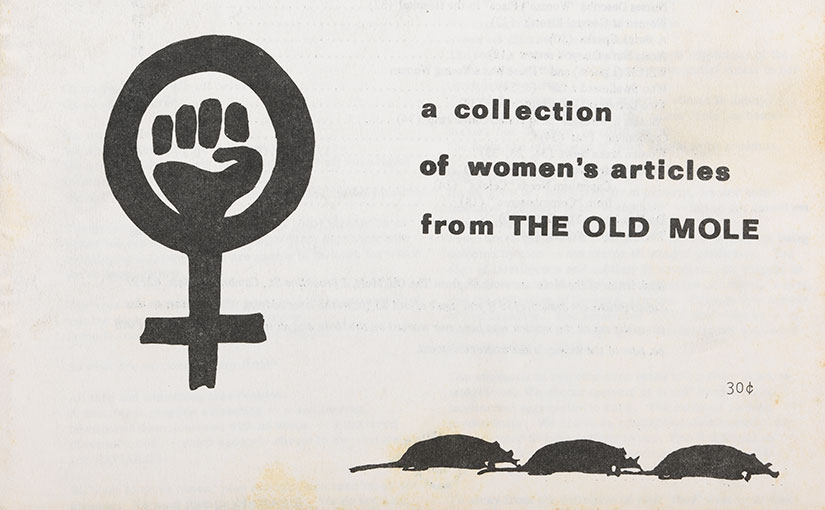
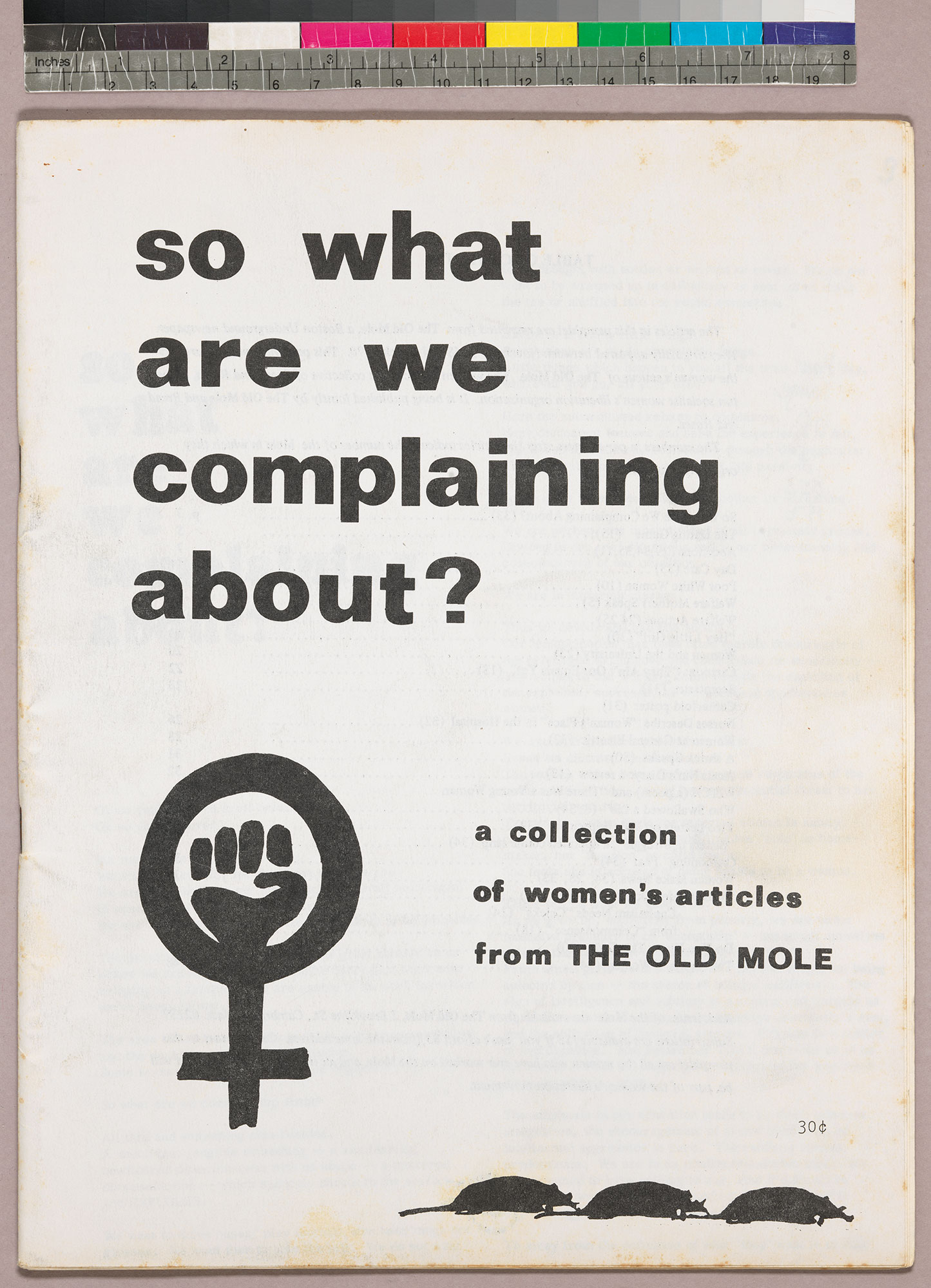
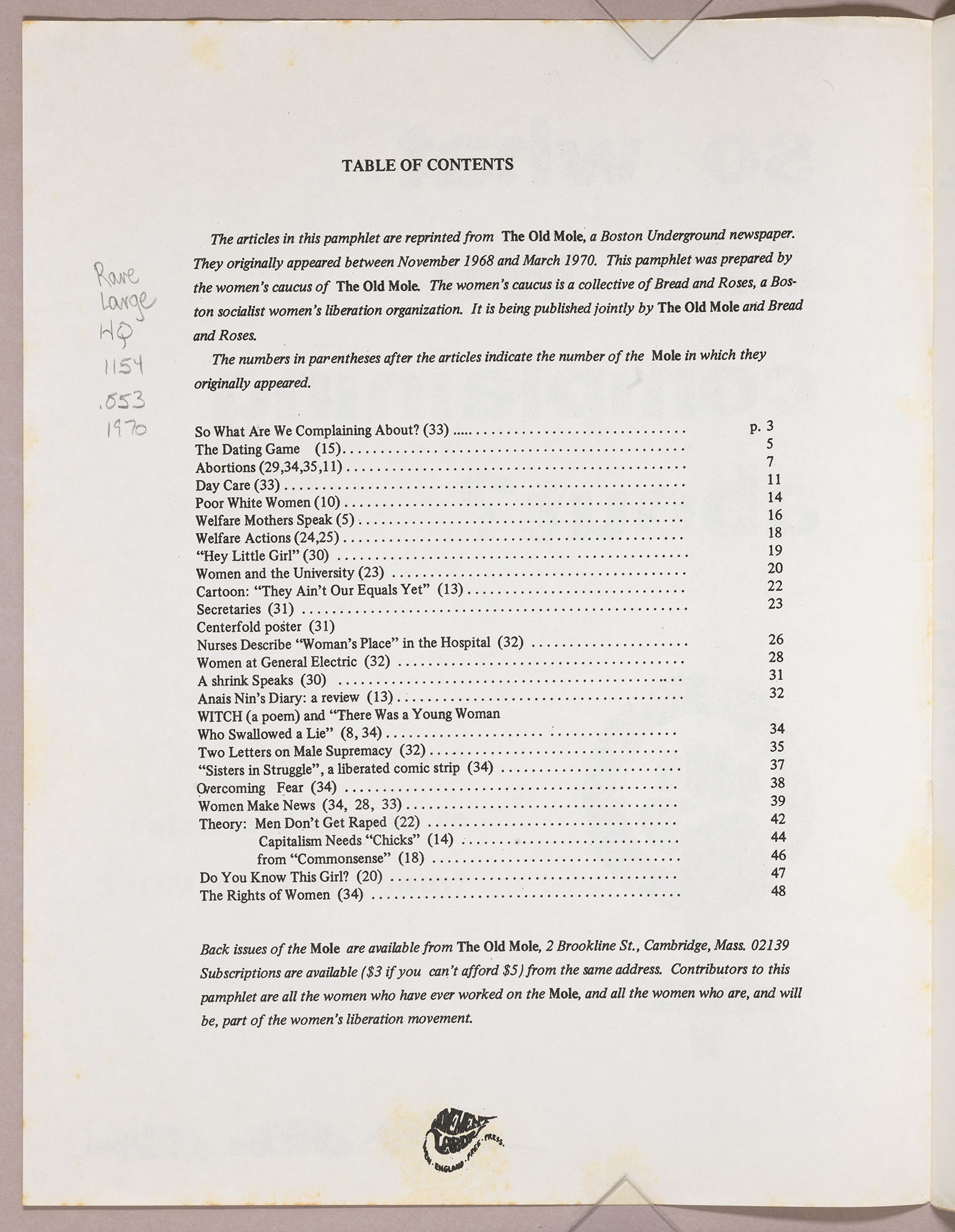
So What Are We Complaining About? is a 48-page booklet of feminist articles collected and reprinted from the pages of an underground newspaper, the Old Mole, published in Cambridge, Massachusetts. The booklet’s publication was a joint venture of the Old Mole and Bread and Roses, a socialist women’s liberation collective, in 1970. The booklet was created by the women’s caucus, a group within Bread and Roses. The Old Mole, which appeared bi-weekly from 1968 to 1970, was the publication of the Harvard chapter of the Students for a Democratic Society (SDS).
It’s not surprising that Bread and Roses women wished to collect and recirculate this content. Among the collective’s founders were activists and a historians Meredith Tax and Linda Gordon. Both women contributed significantly to the feminist movement in the United States from the 1970s and wrote much of its history. Reprinting was one of the best and only ways to publicize content that had already appeared in print, often in small, locally-circulated and ephemeral papers like the Old Mole.
Tax and Gordon founded Bread and Roses in Cambridge, Massachusetts in 1969 as a women’s liberation organization. They chose “Bread and Roses” because it both references an historic labor strike by women (Lawrence, Massachusetts in 1912) and it captures what the collective wanted to attain for women—economic opportunity (“bread”) and quality of life (“roses”). Over the nearly two years the collective was active, it attracted hundreds of members, many of whom were clerical workers who faced poor wages and working conditions. A number of reprinted articles address these problems. The collective took action by forming a union, 9to5, for local clerical workers. Another legacy project became the women’s health resource, Our Bodies, Ourselves, which developed out of the collective’s 1970 initiative, “Women and Their Bodies: A Course.”
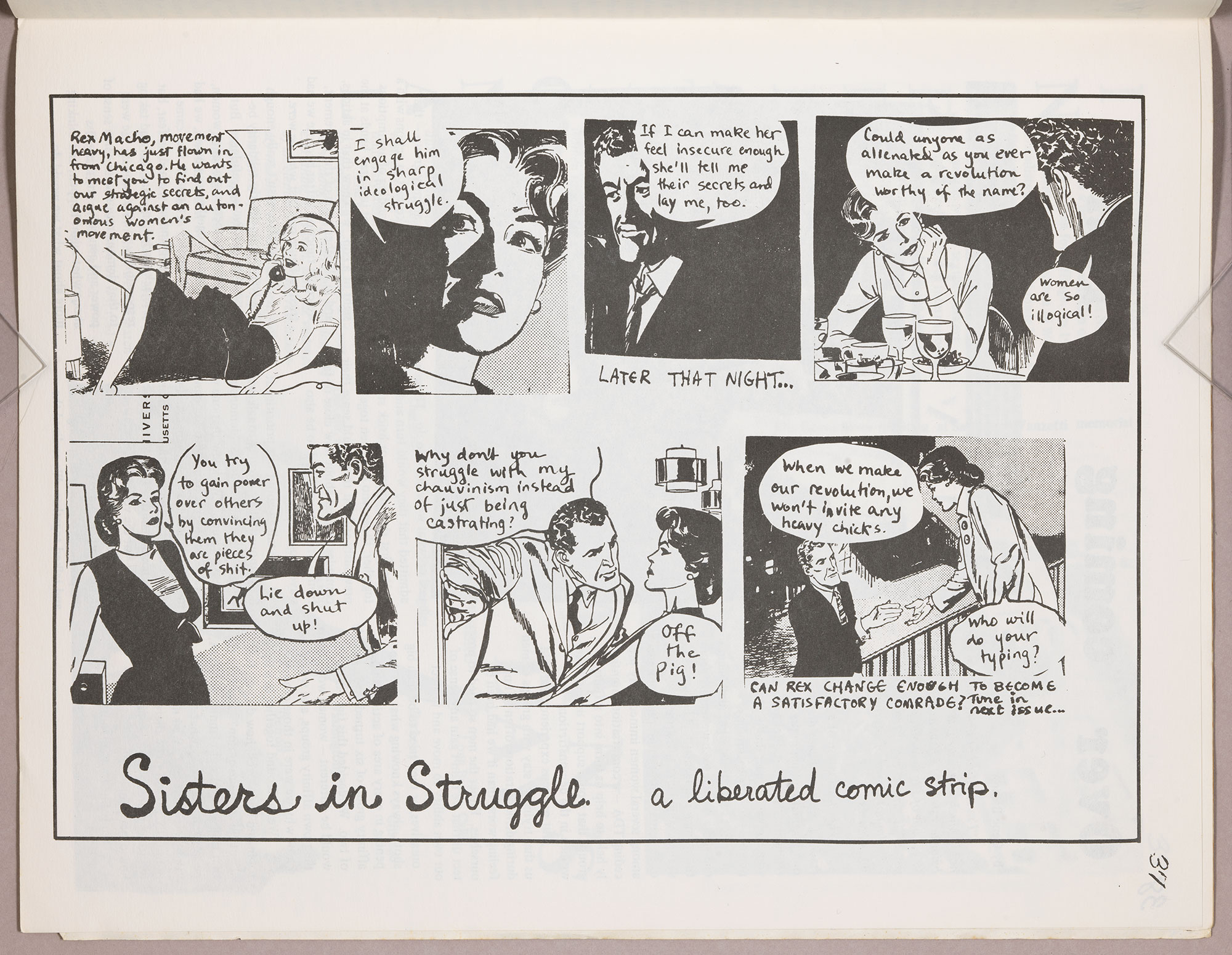
Other features included in this short volume are Bread and Roses’ declaration of women’s rights (March 1970); a satirical, “liberated,” comic strip; and a short history about the establishment of International Women’s Day.
So What Are We Complaining About? is a new acquisition in Rare Books and Special Collections and is part of a growing collection of second-wave, feminist periodicals and newspapers.
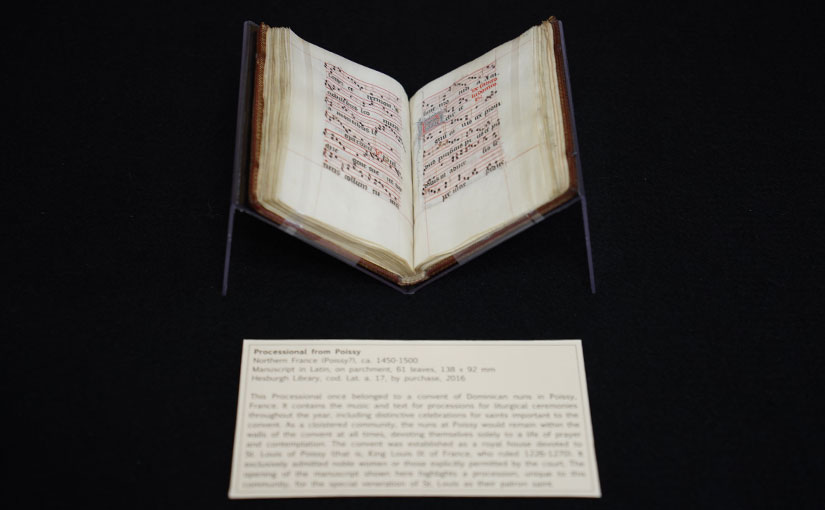
The February-March Spotlight, A Choir Book for Medieval Nuns, highlights one item from the Hesburgh Library’s Special Collections in order to showcase the activities of women religious in the Middle Ages. It features a small fifteenth-century manuscript from Poissy, France, which once belonged to a convent of Dominican nuns devoted to St. Louis (that is, King Louis IX of France, who ruled 1226-1270). This manuscript, called a Processional, would have been used by the nuns at Poissy as they moved through the ceremonial space in liturgical celebrations throughout the year.
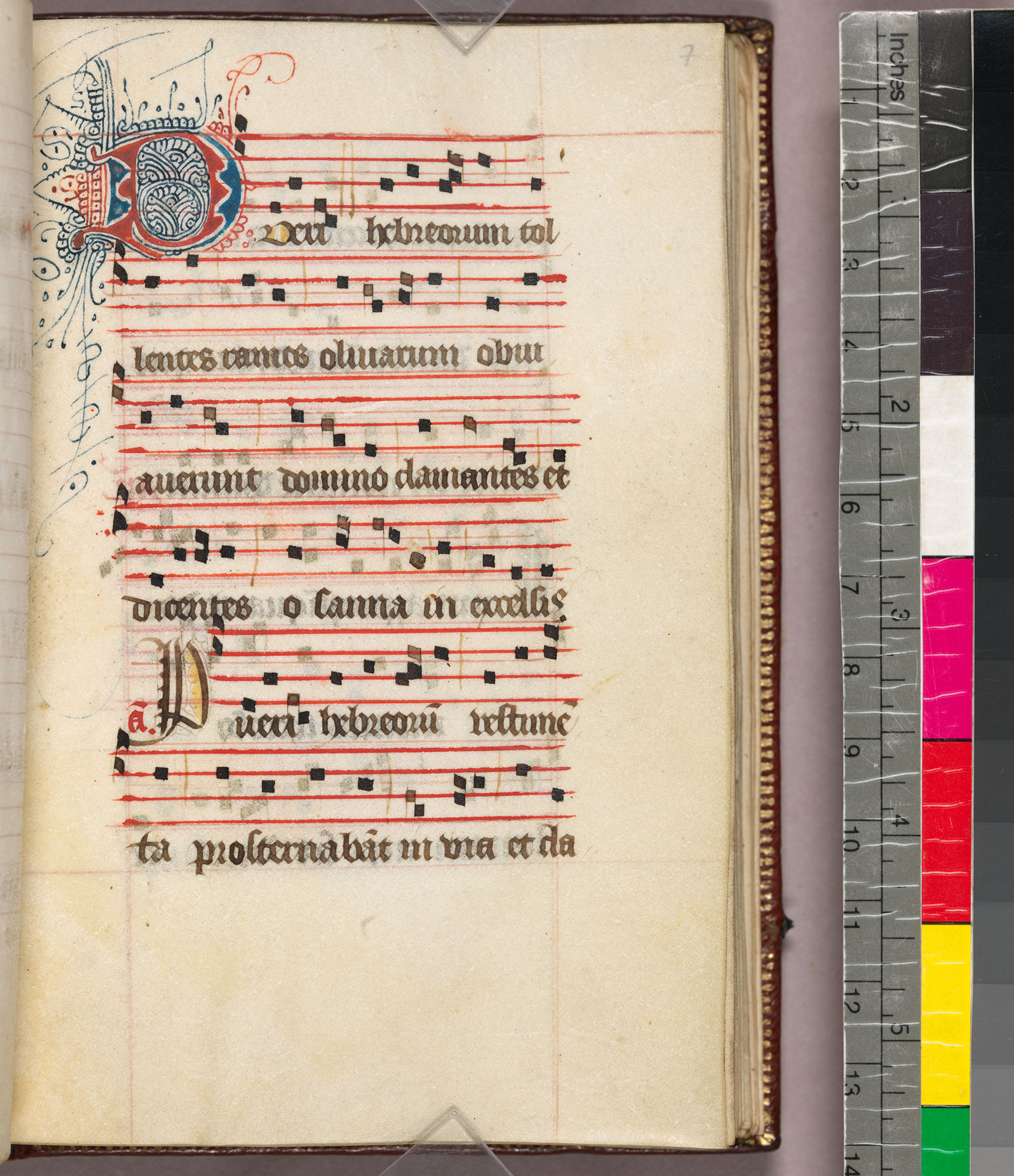
Processional chants for Palm Sunday, cod. Lat. a 17, f. 7r
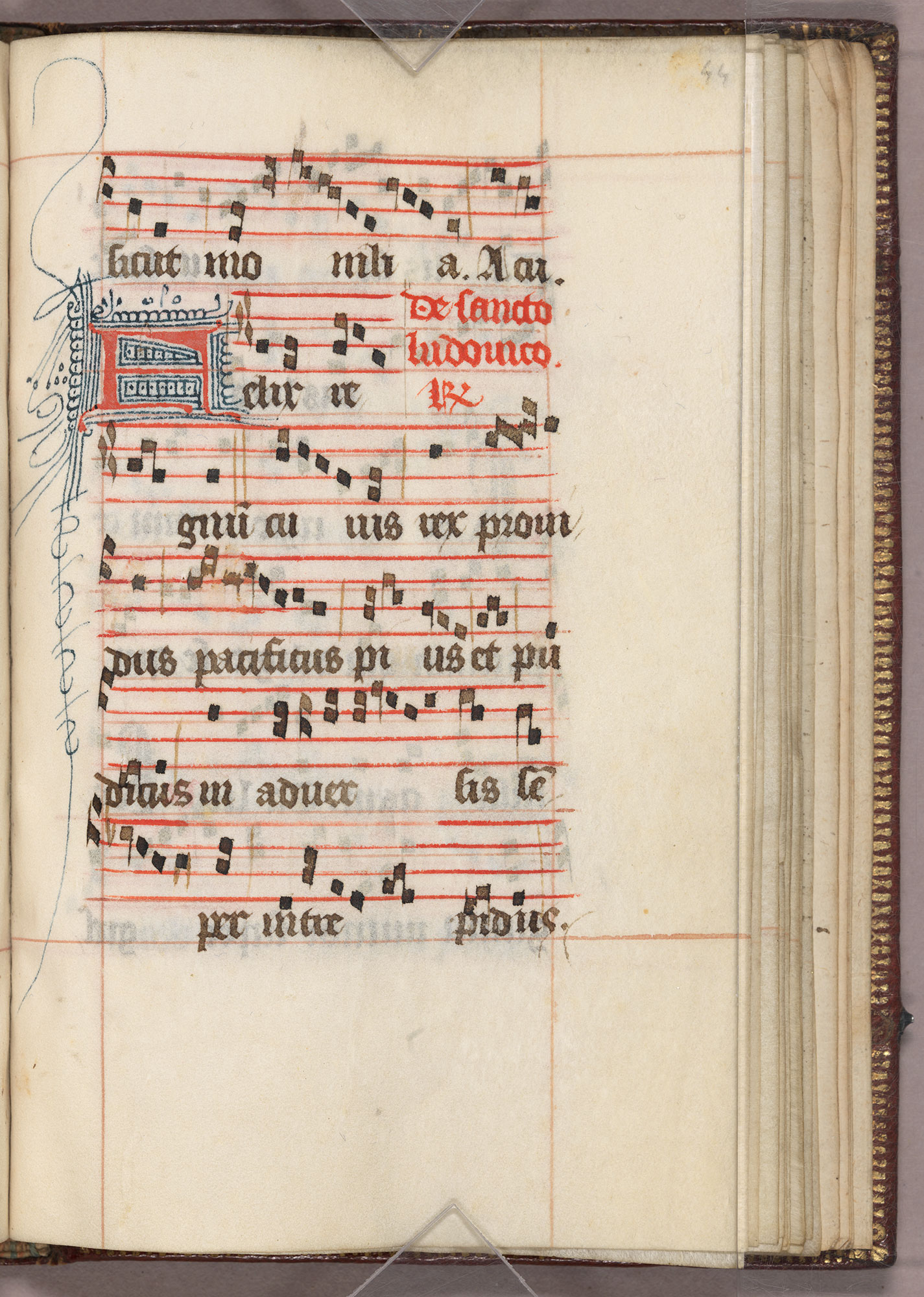
Each member of a procession likely held her own book as they processed. Nuns at Poissy, typically noblewomen, often personalized their Processionals with elaborate paintings of their personal patrons, family coats of arms, or convent community. Unlike most other surviving Processionals from this convent, of which there are many, this manuscript is surprisingly lacking in ornate decorations. Even on celebrations unique to their community, such as the Procession for the feast day of St. Louis, the decorations are standard for the genre. This, along with an ownership mark from the seventeenth century, may indicate that this Processional was a general community book under care of the chantress – the appointed musical leader of the liturgy – rather than personally owned.
Processional chants for St. Louis, cod. Lat. a 17, f. 44r
Even within a women’s community, the foremost leadership roles in the liturgy were primarily held by the male religious who oversaw the convent and its care. However, at the convent in Poissy, the nuns held an explicit liturgical role in certain ceremonies, including processions. This can be seen in this Processional’s rubrics (red-ink liturgical instructions).
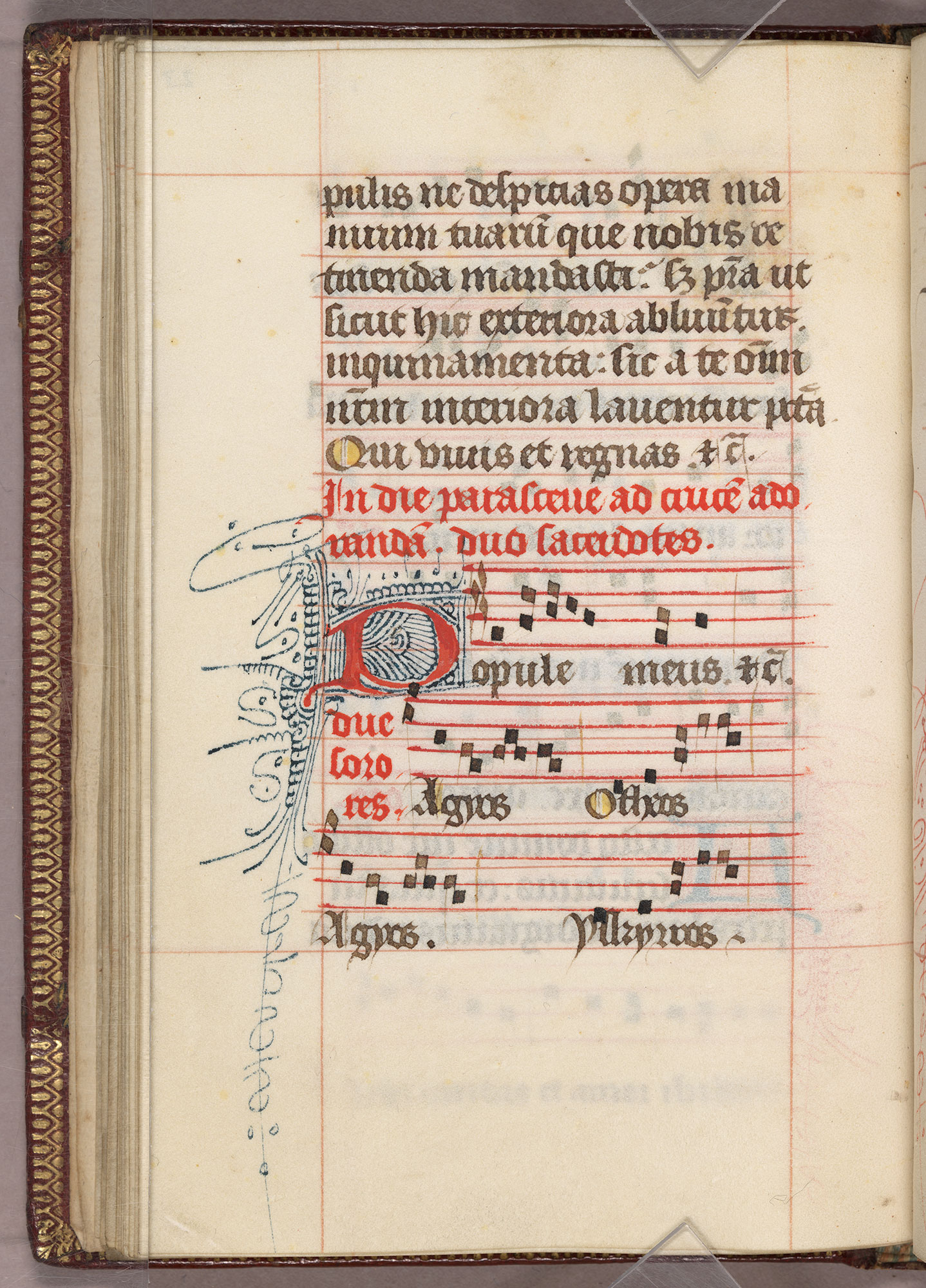
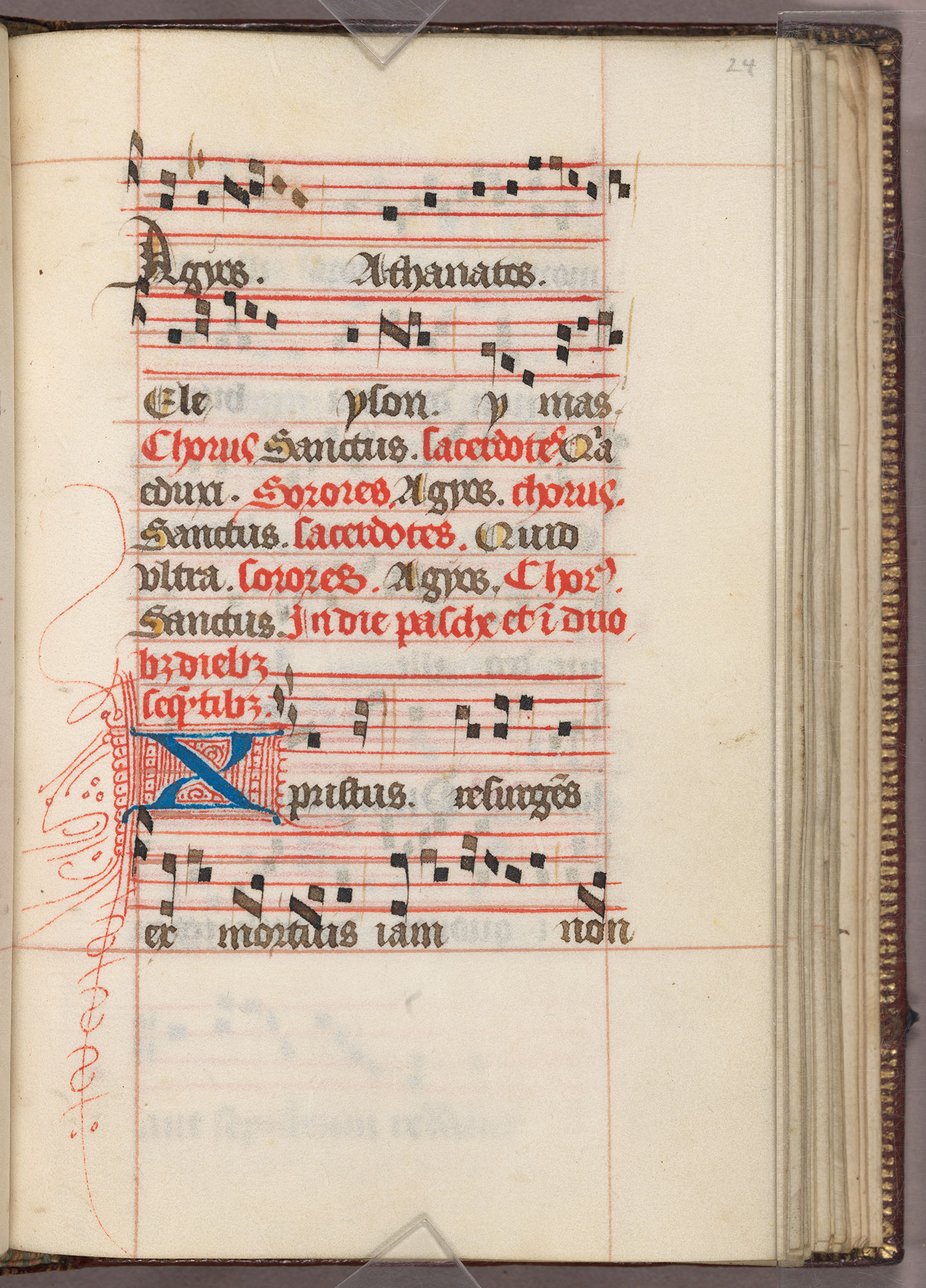
Rubrics (red ink) and chant cues for Good Friday responses, cod. Lat. a 17, f. 23v-24r
For example, on Good Friday, after two priests (duo sacerdotes) sang Christ’s words in a ceremonial recapitulation of the Passion, this manuscript designates that two sisters (due sorores) sang a part assigned typically to male deacons. The choir (chorus) responded afterwards. Since it was unusual to include women as liturgical leaders, these rubrics indicate that women regularly used this manuscript and emphasize their agency and participation within the liturgy.
This exhibit was curated by Kristina Kummerer, a Ph.D. student in the Medieval Institute, as part of a curatorial assistantship in Rare Books and Special Collections. It can be viewed in 102 Hesburgh Library from 9:00 am – 5:00 pm on weekdays.