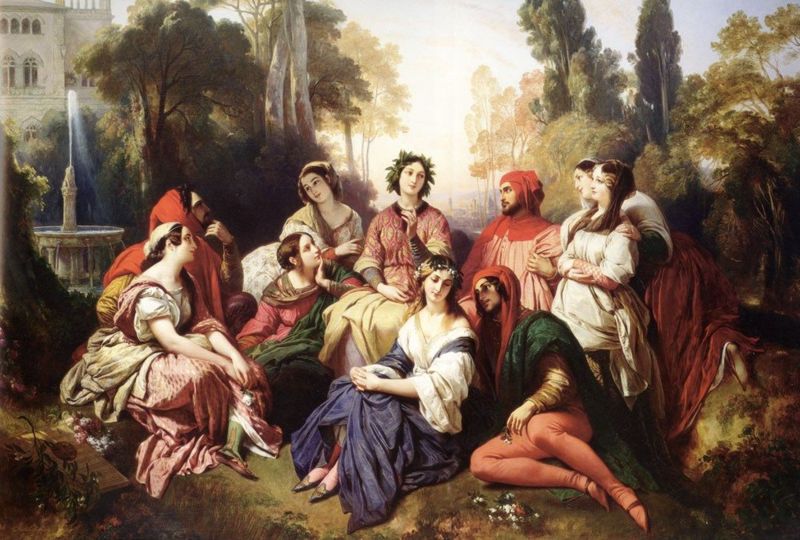
Trecento Italy saw the “three crowns” of literature—Dante, Petrarch and Boccaccio—whose contribution to Italian and European literature was immense and lasting. The literary communication between Italy and England of that century is a fascinating topic for historians, literary scholars, and common readers. In this piece of writing, we shall take a quick look into Chaucer’s possible “indebtedness” to Boccaccio, arguably the writer who is most like Chaucer among the three crowns of Trecento Italian literature.
Among the three writers, Boccaccio was arguably the one to whom Chaucer had the most natural affinity. They might have even met personally when both were in Florence in 1378, but sadly no evidence was found to prove it. On Chaucer’s second visit to Italy, he brought back copies of Boccaccio’s two great Italian poems, the Filostrato and the Teseida, which provided source material and inspiration for Chaucer’s own writings. In the House of Fame, the poetic invocations (II. 518-22) echo Teseida and several lines from Anelida and Arcite (1-21) are quite literal translations from the same work. Twelve stanzas from Teseida are adapted in the Parliament of Fowls (211-94) and Teseida also notably provides the plot for “The Knight’s Tale.” In “The Knight’s Tale,” Arcite calls himself “Philostrate”, literally the one “vanquished by love,” echoing the title of the poem Filostrato by Boccaccio.
Although direct borrowings are hard to prove, there are similarities and parallels between Boccaccio’s Amorosa visione and Chaucer’s House of Fame, between Boccacio’s Decameron and Chaucer’s Canterbury Tales. For modern readers, the latter comparison is very intriguing, not just because of the two works’ literary achievement and popularity, but also because their shared structure of “framed story” and possibly shared aim of depicting (and even healing) human society through the act of “group story-telling.” Notably, the famous Italian writer and director Pier Paolo Pasolini has adapted these two works (Il Decameron 1971 and I racconti di Canterbury 1972), along with the A Thousand and One Nights ( Il fiore delle Mille e una Notte 1974) in his Trilogy of Life movie series, with the intention of presenting the scope of the human world and the depth of humanity on the screen. As for the literary indebtedness, “The Franklin’s Tale” is generally accepted as being inspired from the fifth story of Day Ten in the Decameron as well as by the passage on the question of love in Filocolo (IV. 31-4).
Despite the affinity, similarity, and inter-texuality, Chaucer never mentions Boccaccio by name in his works (as a contrast, Chaucer mentions both Petrarch and Dante several times), nor does he mention Boccaccio’s works explicitly, which leads to the usual suspicion that Chaucer is under “the anxiety of influence.” However, we should remember that medieval authors had a different understanding of concepts like “plagiarism,” “adaptation” or “influence.” While literary scholars and historians are still trying hard to find evidence, more efforts should be given to the parallel reading of the two works, the Decameron and the Canterbury Tales—not just because it is almost a blank field to be explored, but also because it is pure pleasure to read them side by side!
Xiaoyi Zhang PhD Candidate University of Notre Dame
On some first Sunday of Lent in the early fifteenth century, Robert Rypon, the subprior of Durham Cathedral Priory, took the opportunity of a sermon dedicated to the First Commandment to speak about magic – more specifically, to roundly condemn it as a type of idolatry and blasphemy. It is a remarkable sermon that has caught the attention of a few scholars before for its thorough discussion of magic: more than half of the sermon is dedicated to describing sorcery (sortilegium), a sin which Rypon, displaying the same academic and punctilious mode of thought evidenced in his other surviving sermons, breaks down into no less than ten different types or “species.” [1]
Among the types of magic he enumerates is fortune-telling or divination, a sorcery the devil can work through himself or “through living men” (presumably in contradistinction to omens conveyed through spirits or ghosts). Rypon claims with a tone of authority that these diviners or soothsayers are properly called “phitonissae” or “phitones,” [2] in modern English “pythonesses.” The word stands out on the manuscript page for its peculiarity, and raises the question of where the Durham monk learned it. Its story provides a micro case study of the reception and appropriation of the classical tradition by medieval writers.
Rypon’s immediate source seems to be the seventh-century Etymologies of Isidore of Seville, which provides much of the grist and theoretical framework for the rest of his tirade against sorcery. Isidore rightly notes that the term (pythonissae – the spelling is corrupted by Rypon’s time) was originally applied to the female priestesses or oracles of Pythian Apollo at Delphi, [3] a cultic site that owed its original name, Pytho, to the legend that Apollo slew a great python there. By late antiquity, however, the title was already being used for diviners in general, often ones who owed their powers to some unidentified spirit that possessed them. In his Vulgate translation, Jerome described the Witch of Endor as “mulier habens pythonem in Aendor” (a woman in Endor having a divining spirit; 1 Sam. 28:7) and a pythoness (pythonissam; 1 Chron. 10:13). Indeed, Jerome uses the word multiple times throughout the Vulgate (e.g., Lev. 20:27; Deut. 18:11; Isa. 8:19; Acts 16:16) to describe diviners and soothsayers, female and male, and no doubt this was another avenue through which Rypon learned it.
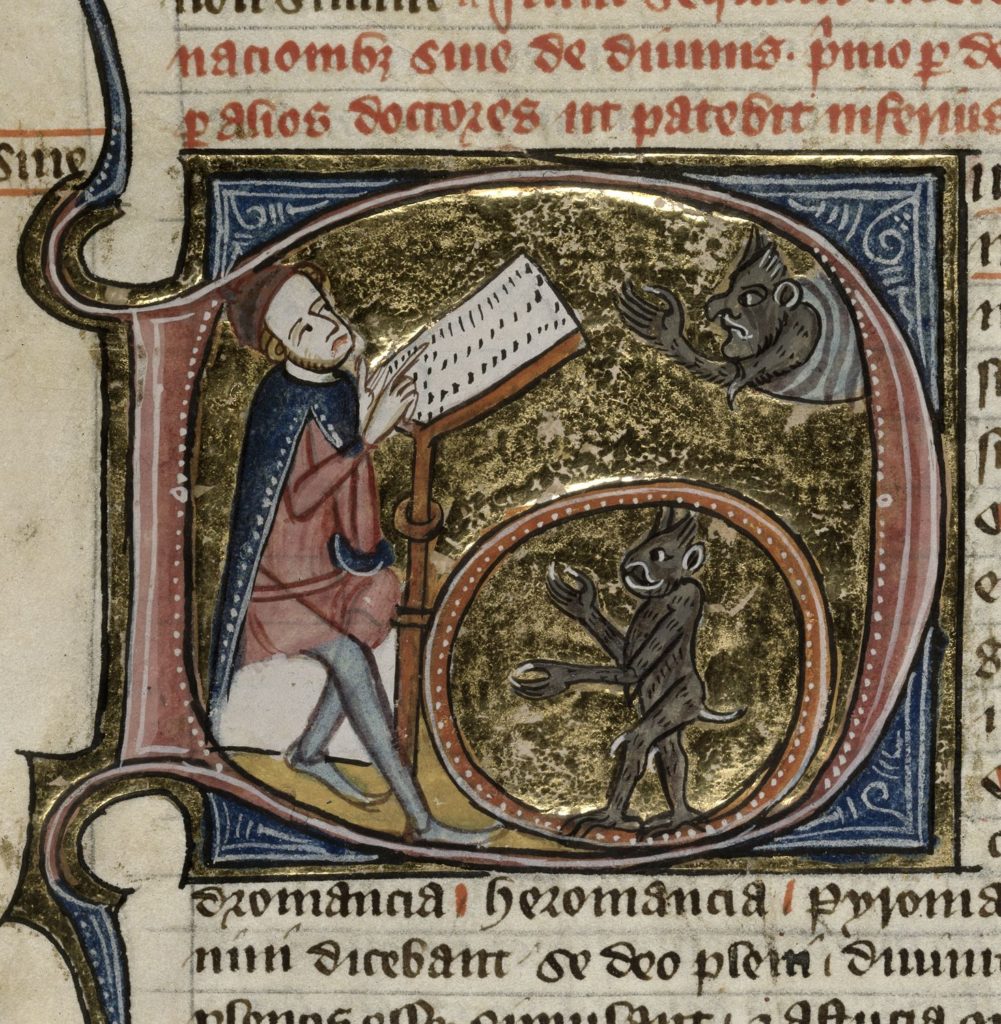
The historiated initial for the entry “divinacionum” shows a soothsayer foretelling the future with the aid of demons. From the Omne Bonum, a fourteenth-century encyclopedia compiled in London. London, British Library, MS Royal 6 E VI, fol. 535v.
Rypon’s original definition of phitonissae makes no mention of ancient Greek oracles, but does closely align with the pythonesses of Jerome and Isidore – people who, by virtue of their possession by spirits or some other (diabolical) magic, can tell the future. However, Rypon then expands the definition of the word, moving well beyond the late antique tradition into the realm of medieval European folklore. Rypon describes (claiming it is well-known) how pythonesses also place threads, ropes, or bridles into the mouths of sleeping people; their victims then believe they have been transformed into horses, and the pythonesses ride them. The same pythonesses are said to be able to travel to Bordeaux in one night (riding the people-horses? it is unclear), and return to England drunk on wine.
In Rypon’s description we hear echoes of common medieval stories, tales of night-riding or night-flying women and nocturnal bacchanals. Phitonissa has come much closer to a general synonym for “witch,” subsuming magical practitioners and activities that would have been unrecognizable to Jerome and Isidore (at least in the context of a pythoness), certainly to an ancient Greek writer. This broader definition was not invented by Rypon. Chaucer, writing a few years earlier, spoke in The House of Fame of “Phitonesses, charmeresses, / Olde wicches, sorceresses”– none of whom tell the future, but rather use magic to create illusions or make people sick (ll. 1259-1270). Despite knowing the word’s original meaning from Isidore, Rypon embraced the expanded definition then current in medieval England without comment, adding detailed and specific local gossip or folklore to an already elastic word.
According to the Oxford English Dictionary, by about the seventeenth century, “pythoness” and “pythonissa” had begun to be reclaimed for classical antiquity. Writers like Byron could speak of a pythoness and actually mean an oracle of Apollo, not a witch. It became an alternative title to the more common “Pythia.” But not before taking on a variety of new meanings in the Middle Ages. The word’s journey from ancient Greece to medieval England is a salutary reminder about the place of the classical tradition in medieval learning and culture – something to be learned and revered, to be sure, but also something to be recycled, refashioned, and reused.
Sam Rostad
University of Notre Dame
[1] London, British Library, MS Harley 4984, fols. 33r-34v. For some of the scholarship on it see G. R. Owst, “Sortilegium in the English Homiletic Literature of the Fourteenth Century,” in Studies Presented to Sir Hilary Jenkinson, ed, J. Conway Davies (London: Oxford University Press, 1957) and Catherine Rider, Magic and Religion in Medieval England (London: Reaktion Books, 2012).
[2] It is not entirely clear whether Rypon here is making a masculine form of a normally female Latin word, the –es being the masculine plural ending, or if he is giving the Middle English term in the singular, i.e. “phitones[s].” But given Jerome’s use of a masculine form (“pythones”; Isa. 19:3), I lean toward the former.
[3] Stephen A. Barney, et al., trans., The “Etymologies” of Isidore of Seville (Cambridge: CUP, 2006), 182.
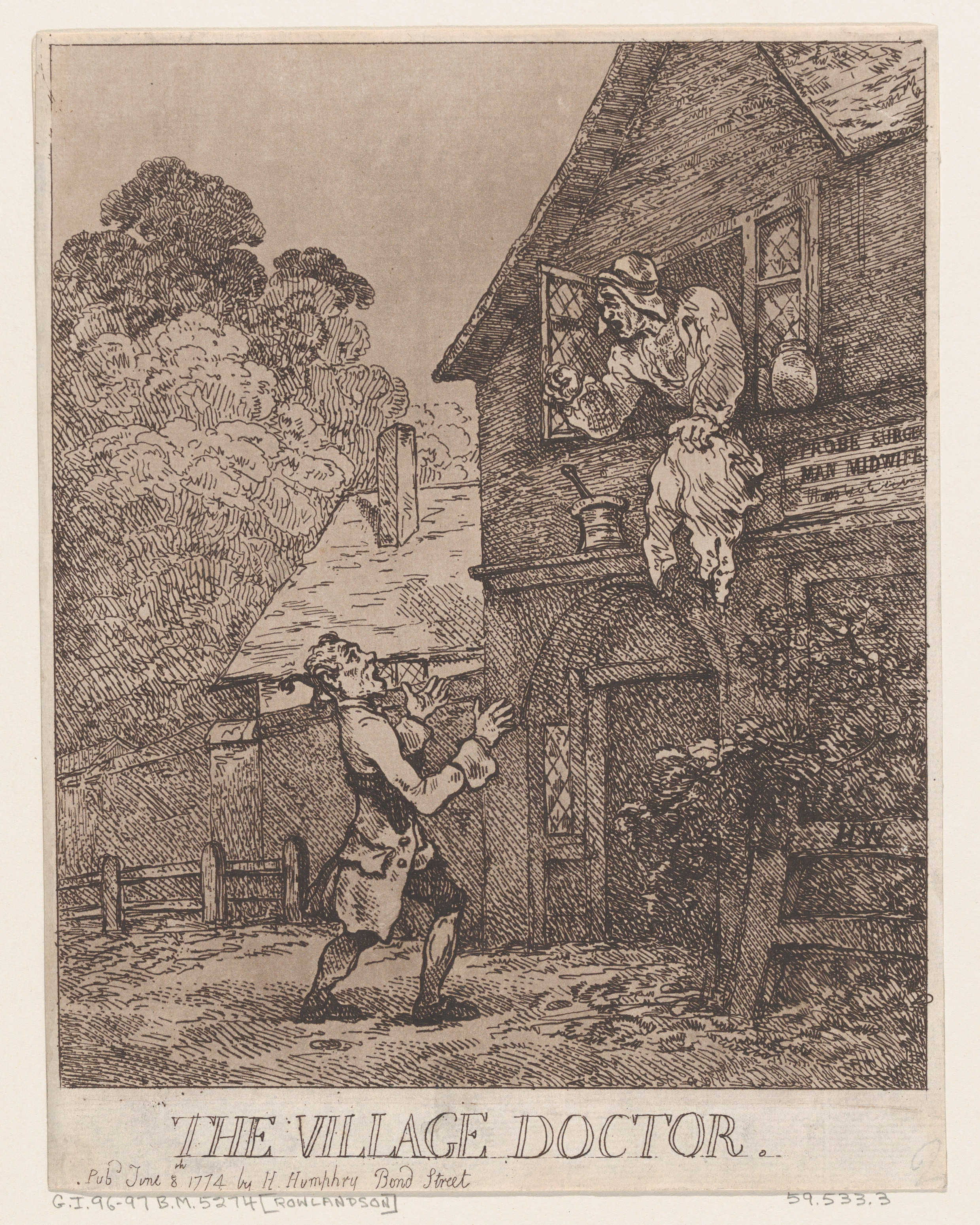
In their 2013 guide to help physicians curate their online personas, Kevin Pho, M.D., and Susan Gay tell the story of a doctor who, upon Googling herself, finds out that she shares her name with an optometrist accused of deliberately blinding patients. In the age of WebMD, Twitter, and online rankings, the challenges of managing both one’s reputation and the endless stream of misinformation permeating the web have generated new ways of talking about medicine and its practitioners. Skepticism of medical doctors, however, has been around since long before the profession was recognized as such.
The Elisha Whittelsey Collection, The Elisha Whittelsey Fund, 1959
The standardization of technical medical training in universities was a late development in the Middle Ages, in part because many academics considered the activities of wise women and barber surgeons to fall below the study of Aristotelian natural philosophy, astrology, and religious council. Even after universities across Western Europe began teaching hands-on medical procedures, they struggled to obligate patients, including aristocratic and royal patients, to rely exclusively on those with degrees. Well into the fifteenth century, it was inconceivable to mandate that English medical professionals be university-trained. This was because, first, the institutions that gave out these credentials in England, Oxford and Cambridge, were far removed from the most populated areas like London. Second, these urban communities were far too vast to be served by the handful of medical graduates.
The works of two major fourteenth-century authors demonstrate that the skepticism and ridicule with which doctors are often treated to this day existed even as the occupation of the medical professional was still being defined. In his “General Prologue” to the Canterbury Tales, for instance, Geoffrey Chaucer heavily satirizes his Physician, who knows little of the Bible, dresses extravagantly, and reaps financial rewards from the plague. A trained alchemist, he uses his claimed expertise in the scientific properties of gold to benefit from its economic value: “For gold in physic (medicine) is a cordial,/ Therefore he loved gold especially” (1.443-44). Like so many of Chaucer’s professional academics in the Canterbury Tales, the Physician abuses his qualifications in order to line his pockets.
William Langland’s B text of Piers Plowman anticipates the “General Prologue”’s criticism of the Physician. In the last passus, the personification Life seeks out a “phisik” to cure him of Old Age (B.20.169). The “Physician with a furred hood,” to whom Life gives gold “that gladdened his heart,” is similar to Chaucer’s Physician in that, in his greed, he takes advantage of Life’s illness. He plays a greater role in Langland’s allegorical theology when it becomes clear that his craft obscures the need for spiritual healing. The “glass helmet,” or placebo, that he offers Life is an ineffective diversion from the true purpose of Old Age: to direct Life toward virtue and cast out spiritual despair (B.20.172). Just as the Physician of the “General Prologue” has studied a long list of Greek, Arabic, and other medical sources, “but little of the Bible” (1.438), Langland’s “phisik” transgresses in that he displaces spiritual action with medical practice.
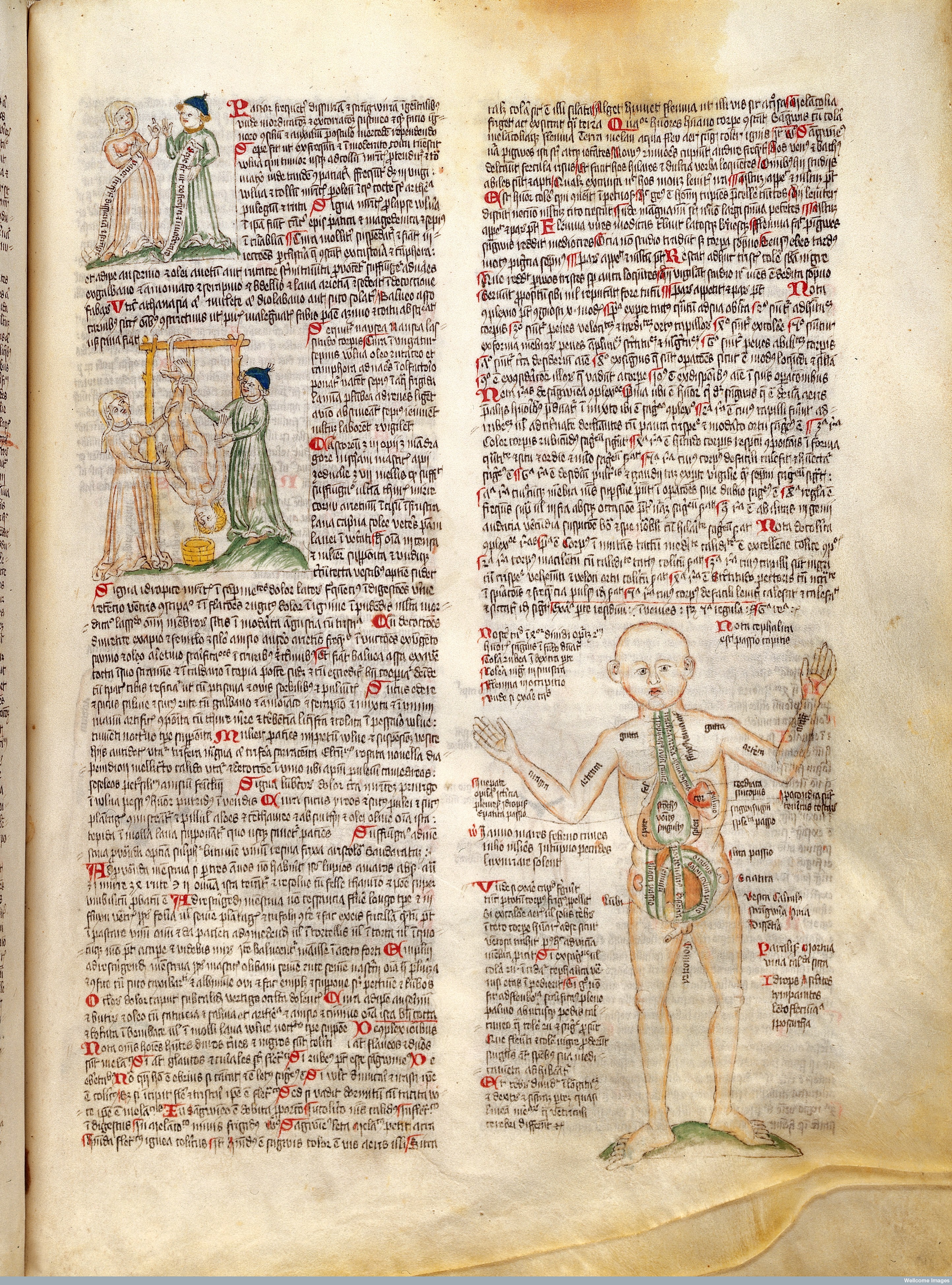
L0029312 Woman and doctor talking, Disease man Credit: Wellcome Library, London. Wellcome Images images@wellcome.ac.uk http://wellcomeimages.org Woman and doctor talking; text from accompanying treatise on scrolls – Woman and doctor hanging a nude woman upside down by her feet from a scaffold over a bucket for suffumigation – Disease man Ink and Watercolour 1420? MS. 49 Wellcome Apocalypse Published: – Copyrighted work available under Creative Commons Attribution only licence CC BY 4.0 http://creativecommons.org/licenses/by/4.0/
Both Chaucer and Langland portray physicians who use the cachet of their expertise to exploit their patients. One of Langland’s earliest adaptors, however, demonstrates that not everyone took such a caustic view. The maker of Piers Plowman Z, takes care to specify that medical knowledge is valuable, and that at least some of its practitioners are worth consulting. In interpolated lines not present in any other version of Piers, Hunger says:
I defame not fysyk (medicine), for the science is true,
But incompetent scoundrels that cannot read a letter
Make themselves masters men for to heal.
But they are master murderers who slay men,
And no leches (doctors) but liars, Lord amend them!
In Ecclesiastes the clerk that can read
May see it there himself and then teach another:
‘Honor the doctor,’ he says, on account of the ‘need.’ (Z.7.260-267)
In this passage, the Z maker is more concerned with the intellectual hierarchy generated by medical knowledge than he is with “fysyk” itself. He criticizes those without what he deems sufficient education, he applies the logic that the misuse of medicine can be fatal in order to encourage the exclusion of the untrained, and he adds to this sense of hierarchy by immediately asserting that “the clerk that can read” should mediate the Bible for his less educated audience. This passage indicates that understanding not just of the medical material, but also of the ethical implications underpinning it, must be mediated by a professional. The Z maker’s frustration is akin to that of many of today’s physicians when their patients diagnose themselves using pharmaceutical commercials and online forums. In the case of Piers Plowman Z, this tension is amplified by the integral nature of bodily and spiritual healing in medieval culture.
Erica Machulak
PhD in English
University of Notre Dame
Founder of Hikma Strategies
References and Further Reading
Chaucer, Geoffrey. The Riverside Chaucer. Edited by Benson, L.D. and Robinson, F.N. 3rd ed. Boston, MA: Houghton Mifflin Co, 1987.
Chen, Pauline W. “Doctors and Their Online Reputation.” New York Times, March 21, 2013. https://well.blogs.nytimes.com/2013/03/21/doctors-and-their-online-reputation/.
Dumas, Geneviève, and Faith Wallis. “Theory and Practice in the Trial of Jean Domrémi, 1423–1427.” Journal of the History of Medicine and Allied Sciences 54, no. 1 (January 1, 1999): 55–87.
Fuller, Karrie. “The Craft of the ‘Z-Maker’: Reading the Z Text’s Unique Lines in Context.” Yearbook of Langland Studies 27 (2013): 15–43.
Getz, Faye. Medicine in the English Middle Ages. Princeton, NJ: Princeton University Press, 1998.
Kerby-Fulton, Kathryn. “Confronting the Scribe-Poet Binary: The Z Text, Writing Office Redaction, and the Oxford Reading Circles.” In New Directions in Medieval Manuscript Studies and Reading Practices Essays in Honor of Derek Pearsall, edited by Sarah Baechle, John J. Thompson, and Kathryn Kerby-Fulton, 489–513. Notre Dame, IN: University of Notre Dame Press, 2014.
Langland, William. Piers Plowman: The B Version: Will’s Visions of Piers Plowman, Do-Well, Do-Better and Do-Best. Edited by George Kane and E. Talbot Donaldson. London: Athlone Press, 1975.
McVaugh, Michael. Medicine before the Plague: Practitioners and Their Patients in the Crown of Aragon, 1285-1345. Cambridge History of Medicine. Cambridge, UK; New York: Cambridge University Press, 1993.
Pho, Kevin, and Susan Gay. Establishing, Managing, and Protecting Your Online Reputation: A Social Media Guide for Physicians and Medical Practices. Phoenix, MD: Greenbranch Publishing, 2013.
Rawcliffe, Carole. Medicine & Society in Later Medieval England. Stroud, England: Alan Sutton Pub., 1995.
Rawcliffe, Carole. Urban Bodies: Communal Health in Late Medieval English Towns and Cities. Woodbridge, Suffolk: The Boydell Press, 2013.
Rigg, A.G., and Brewer, Charlotte, eds. Piers Plowman: The Z Version. Studies and Texts 59. Toronto: Pontifical Institute of Mediaeval Studies, 1983.
 Trecento Italy saw the “three crowns” of literature—Dante, Petrarch and Boccaccio—whose contribution to Italian and European literature was immense and lasting. The literary communication between Italy and England of that century is a fascinating topic for historians, literary scholars, and common readers. In this piece of writing, we shall take a quick look into Chaucer’s possible “indebtedness” to Boccaccio, arguably the writer who is most like Chaucer among the three crowns of Trecento Italian literature.