Myths and Memorials

by Rachel Bohlmann, American History Librarian

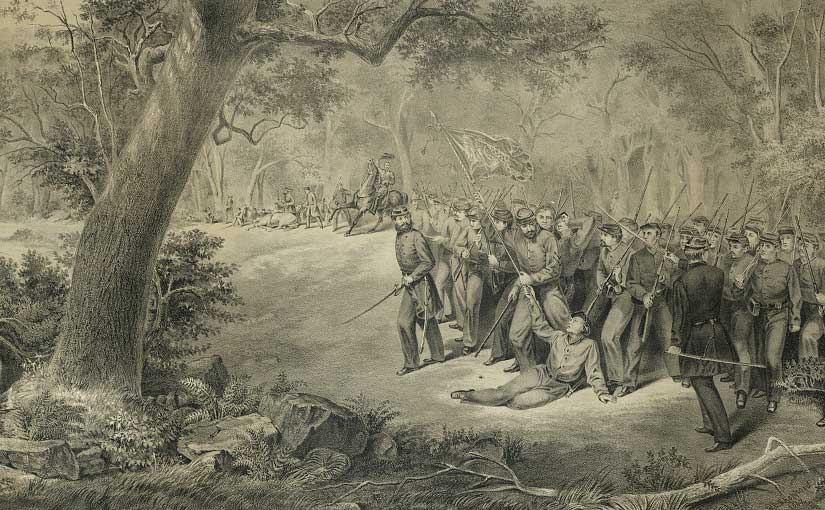
Memorializing the Confederate States of America has been part of a national debate recently, as communities argue over public monuments that valorize a government and its soldiers who fought for slavery. This print, The Charge of the First Maryland Regiment at the Death of Ashby, was published in 1867, just two years after the end of the Civil War. It was an opening salvo in this debate.

Designed to be hung in the homes of Marylanders who identified with the Confederacy, it was commissioned to raise funds to erect a monument to the Maryland Line, a regiment of Marylanders who fought for the Confederacy. The monument was never built.

Although a slave state, Maryland remained in the Union during the war. After President Lincoln ensured that the legislature voted against secession in the spring of 1861, as many as 30,000 Maryland men fled to Virginia to enlist in the Confederate army. They made up about a third of all Marylanders (black and white) who fought in the Civil War. So many Marylanders joined the Army of Northern Virginia that they formed their own regiment, the Maryland Line. The print commemorated a victory of some of those Maryland Confederates near Harrisonburg, Virginia on June 6, 1862. Confederate troops, commanded by Stonewall Jackson, had engaged with Fremont’s Union forces north of Harrisonburg and were in retreat. Confederate Brigadier General Turner Ashby, in an effort to protect the rear of the retreating army, ambushed a detachment of Union soldiers with Maryland and Virginia troops. When the Union line was reinforced, Ashby was killed as he attempted to charge the Union position. The Marylanders then successfully repelled the Union attack and captured its commanding officer.[1]

The print’s image foregrounded Maryland soldiers poised to charge, including a dying Confederate soldier passing the regimental colors to another, a stock scene of nineteenth-century sacrifice and heroism. Ashby’s death is barely discernable in the background. The former Confederates who purchased this print would have already been familiar with Ashby, who had been widely hailed in the South as a hero both before and after his death. As one historian put it, “Ashby represents an early prototype of the Lost Cause hero.”[2] Even small and marginalized, Ashby’s image evoked a set of myths that many whites used to rewrite Southern history into a racialized story of plantation prosperity, contented slaves, and white manly honor.

Maryland raised many monuments honoring the Confederate cause in the century and a half following the war. Two years ago Baltimore removed four Confederate statues from public spaces because they valorized slavery and a government that defended it. The Maryland Historical Trust’s Governor’s Commission on Maryland Military Monuments updated its inventory to reflect these changes in public memory and memorialization. At the same time, however, the Daughters of the Confederacy and other groups rededicated a monument to Ashby outside of Harrisonburg. The debates over history and memorialization continue.


[1] Donald C. Pfanz, Richard S. Ewell: A Soldier’s Life (Chapel Hill: UNC Press, 1998), 204-06.

[2] Peter S. Carmichael, “Turner Ashby’s Appeal,” Gary W. Gallagher, ed., Shenandoah Valley Campaign of 1862 (Chapel Hill: The University of North Carolina Press, 2003), p. 117, accessed May 22, 2019, ProQuest Ebook Central.
Recent Acquisition: Making a Pact with the Devil – Goethe’s Faust

by Julie Tanaka, Curator, Rare Books and Joe Ross, Original Cataloger for Special Collections

Enhancing the German literature holdings is the recent acquisition of Faust: Eine Tragödie, the first edition of Johann Wolfgang von Goethe’s work published in 1808 by J. G. Cotta’schen Buchhandlung in Tübingen.

Faust, the two-part epic poem written by Johann Wolfgang von Goethe (1749-1832), a masterpiece of German literature, reflects the transforming world in which Goethe lived. Begun in the waning years of the Holy Roman Empire (the final dissolution marked by the abdication of Francis II on August 6, 1806) and almost a century before the unification of Germany in 1871 into a nation-state, Goethe’s work exhibits his understanding of the world in upheaval—the revolutions in America and France and the Napoleonic Wars, the rise of Romanticism in literature and art, the Kantian Revolution in philosophy, the Industrial Revolution in science, technology, and economics.

Goethe, drawing upon Gotthold Ephraim Lessing’s call for German dramatists to establish their independence from the French and to treat the Faust tragedy as a specifically German theme began composing his version around 1773. Goethe’s work went through numerous stages. The earliest version, known as the Urfaust, was probably finished by 1775 and the next revision, known as Faust: Ein Fragment, appeared in 1790. After almost a decade, Goethe returned to Faust, adding the prologues, the second part of “Night”, and “Walpurgis Night.” This version now referred to as Part I was finished in 1806 and published two years later. Goethe continued to work on Faust sporadically in the 1820s and completed Part II in 1831 but sealed the completed manuscript—though he made a few final corrections in early 1832—to be published only after his death.

In composing Faust, Goethe drew upon the so-called Faust tradition of texts dating to the early Christian period, but this source base forms only a small part of what he used in his composition. Goethe anchors his Faust firmly in the European tradition, alluding to and parodying ancient Greek and Roman authors including Homer, Hesiod, Herodotus, Apollonius, and Ovid as well as the more contemporary figures of Dante, Shakespeare, Milton, and Calderón de la Barca.

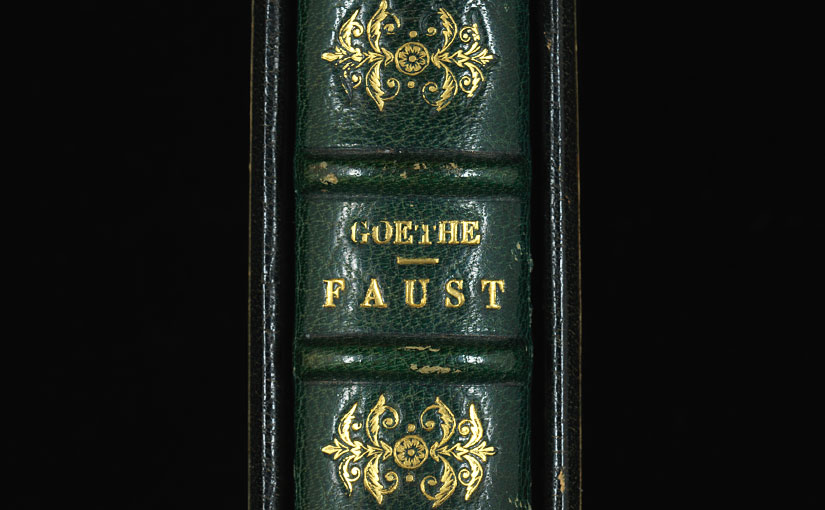
This copy was bound by René Kieffer (1875-1964), one of the foremost Parisian binders of the early twentieth century. Kieffer was trained in classical techniques and worked as a gilder for a decade at the Chambolle-Duru bindery in Paris. After opening his own shop in 1903, he found new inspiration from the father-son binders Jean Michel (1821-90) and Henri François (1846-1925) in Paris. The influence of the latter’s use of curved stamps to work floral and leaf forms is evident in Kieffer’s work.

A fine example of Kieffer’s adoption of the Art Nouveau style, this copy of the first edition of Faust is bound in gilt-tooled green morocco over stiff paper boards. Four rectangular panels on the upper and lower boards display four central lily ornaments. Each rectangle has a floral ornament in the center with four lily corner-pieces. The covers bear a single gilt fillet border, and the spine is gilt-tooled morocco with five raised bands with panels that have a central rose with foliate ornaments on either side. “Goethe / Faust” in gilt lettering appears in the title panel at the top and the bottom panel bears 1808 below the floral ornament. Inside the book are brown morocco doublures (decorative linings, shown above) with a gilt broken circle. Lily ornaments break the line between the four large lily ornaments at top and bottom and either side. A single fillet border surrounds the five floral ornaments that form the upper and lower border. The free end-leaves are silken with diagonal beaded line grain, a full-page floral water-color on verso of free end-leaves. This fine volume is housed in a slip case also designed by Kieffer.


Works Consulted
  • Brown, Jane K. “Faust.” In The Cambridge Companion to Goethe. Edited by Leslie Sharpe. Cambridge: Cambridge University Press, 2002. Pp. 84-100.
  • Sharpe, Leslie. “Introduction.” In The Cambridge Companion to Goethe. Edited by Leslie Sharpe Cambridge: Cambridge University Press, 2002. Pp. 1-5.
  • Sanjuan, Agathe. Les éditions René Kieffer, 1909-1950. Paris: A. Sanjuan, 2002. <http://www.chartes.psl.eu/fr/positions-these/editions-rene-kieffer-1909-1950/>.
  • Arwas, Victor. Art Nouveau: The French Aesthetic. London: Andreas Papadakis Publisher, 2002.
  • Roberts, Matt, Don Etherington, and Walter Henry. “Michel, Marius.” In Bookbinding and the Conservation of Books. New Castle, DE: Oak Knoll Press, 2003. <http://cool.conservation-us.org/don/dt/dt2225.html/>.

Rolling the Dice: Guided by the Stars, Math, and God (in that order)

by Eve Wolynes, Ph.D. candidate, Department of History, University of Notre Dame

Special Collections’ spotlight exhibit for May, “Blasphemous Fun: Late Medieval and Early Modern Game of Chance and Fortune,” features a pair of medieval and Early Modern books on fortune-telling dice games: a modern facsimile of the Libro delle Sorti (The Book of Fates) and the Dodechedron de Fortvne.

The original Libro delle Sorti, held at the Biblioteca Nazionale Marciana in Venice, was written in 1482 by Lorenzo Spirito Gualtieri in Perugia and was illustrated by Umbrian painters in the circle of Pietro Perugino and the young Raphael. Its pages contain a guide to using three six-sided dice to divine the answers to any of twelve questions about the future, in a somewhat comically roundabout method.

First, the reader chooses a question, which then points them to a “king” — an image of one of twelve historical and biblical figures, including Priam, last king of Troy, and King Solomon. These kings then instruct the reader to a “sign” — a table associated with celestial bodies, animals and mythical figures, such as a unicorn, a scorpion, or the moon. These tables provide combinations of dice rolls — whatever the reader rolls, they find that combination on the table, which then directs to a “sphere” of different celestial signs and their Roman Gods — such as the sphere of the Sun (shown in the exhibit) or Taurus (shown here), but also the sphere of Cancer, Capricorn, Mercury, Apollo and Mars. These spheres finally direct to a “list” of decided fates, organized according to the prophets of Christianity. The rather convoluted links of the game intertwine Roman mythology, biblical figures and astrology in its pages to tell a story of Italian medieval culture that dipped into multifaceted heritages — Roman and Catholic pasts interlinked, with astrological stars and theological heavens brought to bear on earthly concerns.

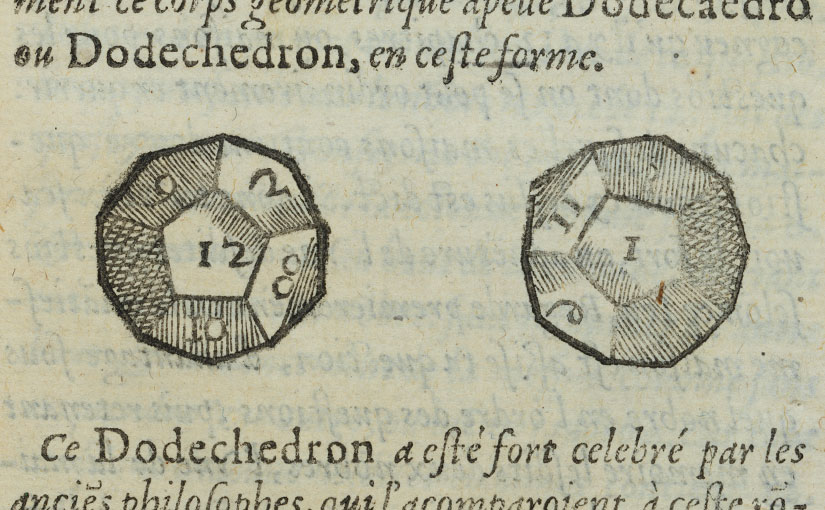
The Dodechedron, meanwhile, is attributed to medieval poet French Jean de Meun, famous for his scandalous and obscene Roman de la Rose, and earliest manuscripts date to roughly the first quarter of the 14th century. The work regained popularity as a printed text in the late 16th and early 17th century – as demonstrated in our 1615 printed edition, and found itself translated into English around the same time. It describes a game of dice played using a 12-sided die connected to the twelve signs of the zodiac in order to predict the future.

Twelve repeats itself frequently throughout the game, which requires that the player choose one of twelve questions from twelve different “houses” (144 questions total) about a wide breadth of topics from a child’s future health to whether a judge in a court case would honestly uphold to justice. Readers then pick a house and a question, correlate those numbers to a 12-by-12 grid and roll a 12-sided die to count out the final tally of their numbered fortune from a list of answers. The repetition of 12 places the Dodechedron into a tradition of spell books that relied upon mathematical calculations founded on astrological divination to calculate the future.

Dice games were nominally frowned upon in the Middle Ages — and gambling with dice barred to members of the church, though that didn’t stop them — and the connections between chance determining the future and pagan practices of divination through dice meant that these games bordered on blasphemous and played on the boundaries of “everyday magic.” Indeed, dice games were often paired with blasphemy as players prayed to God, Mary and saints in the lead up to their rolls — and cursed them when things didn’t go their way. In the 13th century the King of Castile, Alfonso X, attempted to regulate dice games in his Ordinances of Gaming Parlours, and began with punishments for various levels of blasphemy during such games, up to having part of one’s tongue cut off. In discussions of dice games and gambling, the worship of Decius (dice) was often put in contrast with worshipping Deus (God) to characterize such games as a form of pagan or satanic ritual, as referenced in the 14th century Manuale Sacerdotum by John Mirk, preaching that, “He [who gambles with dice] makes of the gaming table an altar for himself, upon which he offers up the goods of the Church to the Devil.” [1]

Fortune-telling games, rather than gambling with dice, however, escaped complete censure by the medieval church and remained closer to the practice of divining “Lots”, also called Sortes Sanctorum (Fates of the Saints), through bible verses and the practical application of astrology, which were both frequently interlocked as such games referenced astrology and the stars throughout their manuals, and games often instructed their players to offer prayers or recite psalms before casting their dice.

The advent of Protestantism after the first half of the 17th century in Europe coincided with a heightened lockdown on fortune-telling as a form of magic that contradicted the omnipotence of God wherein any event was not chance but a direct reflection of personal virtue in God’s eyes. Still, the temptations of chance, future and fortune were hardly daunted by whispers of blasphemy — dice games and fortune telling continued in popularity well into the early modern era and beyond, and live on in our gambling dens and friendly tabletop games today.


[1] Rhiannon Purdie, “Dice-games and the blasphemy of prediction,” in Medieval Futures: Attitudes to the Future in the Middle Ages, 2000. P. 178.

Upcoming Events: May and through the summer

Currently there are no events scheduled to be hosted this summer in Rare Books and Special Collections.

The exhibit As Printers Printed Long Ago: The Saint Dominic’s Press, 1916-1936 will run through the summer and close in late July.

The current spotlight exhibits are The Work of Our Hands: A Multi-Venue Exhibition of Liturgical Vestments (March – May 2019) and Blasphemous Fun: Late Medieval and Early Modern Games of Chance and Fortune (May 2019).

Rare Books and Special Collections is open
regular hours during the summer —
9:00am to 5:00pm, Monday through Friday.

RBSC will be closed Monday, May 27th, for Memorial Day and Thursday, July 4th, for Independence Day.